Does Travelers Cover Mold? The $5,000 Limit and the Slow-Leak Rule
Emergency Answer
Only when the mold comes from a covered water loss, like a pipe that suddenly bursts, and only up to your policy's fungi limit: $5,000 on the Travelers policy we read, with $10,000 and $25,000 seen on others. Testing and hotel costs come out of that same limit. Mold from a leak that ran for weeks or months, from rain seeping in, or from humidity isn't covered unless you bought Travelers' hidden water add-on.
- Find the water first: Mold means something is wet. Stop the leak, and get a plumber to write down what failed.
- Check your declarations page: Look for "Limited Fungi or Other Microbes Remediation" and the dollar amount. That's the most Travelers pays for mold in a policy year, for all claims together.
- Write down when you found it: The date you first saw water or mold, and what you saw. Travelers' policy requires prompt notice.
- Photograph before anyone cleans: The mold, the wet materials, and the part that leaked.
- Ask the cap before remediation starts: Testing, tear-out, removal and your hotel all come out of the same limit.
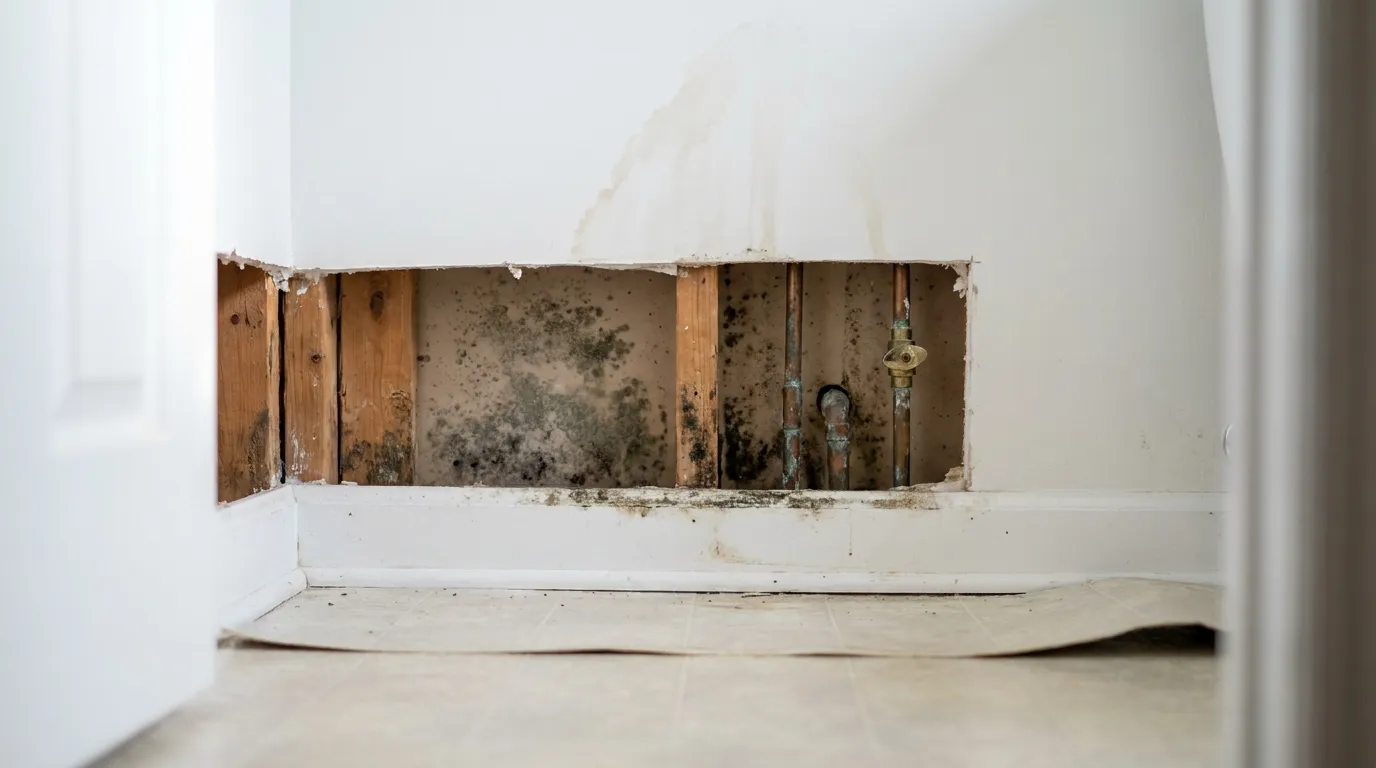
First Actions (To Do Immediately)
- 1 Stop the water: close the fixture's shutoff valve or the main, and fix or cap the leak.
- 2 Dry what's wet within 24 to 48 hours: fans, a dehumidifier, and pulling out soaked carpet pad or insulation.
- 3 Take photos and video of the mold, the wet area and the leaking part before cleanup.
- 4 Keep the failed part (supply line, fitting, valve) and get the plumber's written finding on what failed.
- 5 Find the fungi limit on your declarations page, and check for a hidden water or seepage add-on (HQ-209).
- 6 Report it to Travelers promptly, with the date you discovered the water.
- 7 Keep people with asthma or allergies out of the area until it's cleaned.
DO NOT DO
- ✕ Do not let a remediation company start before you know your fungi limit. Air testing and your hotel count against it too.
- ✕ Do not guess how long it leaked. Tell the adjuster what you saw and when, and let the evidence show the rest.
- ✕ Do not throw away the failed part or the cut-out materials before the adjuster has seen them.
- ✕ Do not paint over mold or a water stain. It hides the damage the adjuster needs to see, and the mold keeps growing.
- ✕ Do not run the HVAC if mold is near the air handler or ducts. It spreads spores through the house.
- ✕ Do not wait weeks to report it. Late notice is its own reason to deny.
Which Mold Gets Paid, and What the Limit Has to Cover
When Travelers Pays for Mold
Travelers doesn't cover mold as its own peril. Its policies pay for mold through an additional coverage called Limited "Fungi" or Other Microbes Remediation. In the issued Travelers policy we read (form HQ-P03, Georgia, 2020), that coverage pays only when all three of these are true:
- The mold came from a covered loss during the policy period, such as a pipe or supply line that burst, or a water heater that failed.
- "All reasonable means were used to save and preserve the property" once you knew about it: stopping the water and drying things out.
- "We receive prompt notice" of the loss. Waiting weeks to report it can cost you the claim on its own.
What the $5,000 Has to Cover
The limit on that Georgia policy was $5,000, and it covers more than the cleanup:
- Removing the mold, and tearing out and replacing drywall, flooring or cabinets to get to it.
- Air testing to find mold or confirm it's gone.
- Hotel and extra living costs if you have to move out while it's removed.
- All of it, for the whole year. It's the most Travelers pays "during the policy period regardless of" how many losses or claims you have. A second leak in the same year draws on what's left.
- Mold from fire or lightning isn't held to the limit.
- Travelers sells more than one level. A Travelers policyholder posted that their policy said "limited 10k for mold," and another had "an extra 25k for mold remediation" on a Georgia home. If yours says $5,000 and you have a finished basement or older plumbing, ask what a higher limit costs.
The Slow-Leak Rule: "Weeks, Months or Years"
This is where most Travelers mold claims are lost. The policy excludes "constant or repeated seepage or leakage of water or steam, or the presence or condensation of humidity, moisture or vapor, that occurs over a period of weeks, months or years… regardless of the source." If the adjuster decides the water was there for weeks, the water damage and the mold are both out, and the mold limit never comes into play.
- Mold and rot get used as evidence. In a 2018 claim that became a class action, Travelers wrote to the homeowners: "Rot is indicative of an ongoing presence of moisture for weeks, months and years. Since water damages that occur for a period of weeks, months or years are excluded, your policy does not provide coverage."
- Mold doesn't prove a long leak. A property adjuster with nearly 20 years' experience put it this way: "Mold can form in 48 hours so the presence of mold is not an automatic reason for coverage to be denied." They added that rot is a different story.
- "Weeks" isn't a fixed number. The same adjuster said some carriers read it as 8 days and others as 15. Travelers' form doesn't define it.
- What helps your claim: a plumber's note that names a part that failed suddenly (a split supply line, a cracked fitting), photos from the day you found it, and a water bill or smart meter showing when usage jumped.
- What hurts it: staining that was there before, rot in the framing, or a leak you knew about and left.
The Fix for Slow Leaks: Travelers' Hidden Water Add-On
Travelers sells an add-on for exactly the leaks the policy excludes: Limited Hidden Water or Steam Seepage or Leakage, form HQ-209. In Travelers' California manual, it's sold alone or in the Enhanced Water Package with water backup coverage, at limits of $5,000 to $20,000. Ask your agent for the form's wording; as the name says, it's meant for leaks hidden inside walls, floors or ceilings.
- People who have it: "The endorsement for mine is called hidden water. And covers slow leaks and sewer backup. Just throwing this out there so people know the name for travelers." Another commenter, on a 2026 New Jersey quote: "Travelers offer the seepage endorsement!!! Ask for it."
- Compare before you buy. In that New Jersey thread, the homeowner's other quote, from regional insurer NJM, covered hidden seepage in the base policy if it was "unknown to all insureds and is hidden within the walls or ceilings or beneath the floors." The Travelers base policy excluded it. The two quotes were within $100 of each other.
Three Legal Fights Over Travelers' Mold and Rot Coverage
- Rose v. Travelers (Pennsylvania, settled 2020). A broken pipe damaged a couple's kitchen and bathroom in 2018. They had paid extra for fungi, microbes and rot coverage; Travelers denied the rot as a long-term leak, with the letter quoted above. The class action said Travelers sold rot coverage it would never pay. It settled: a federal judge gave final approval on July 20, 2020, and eligible US policyholders whose rot claims had been denied could get up to $3,750.
- California district attorneys v. Travelers (filed November 2024). The suit says Travelers marketed fungi and rot coverage for years "without adequately disclosing stringent exclusions." We found no outcome yet.
- Schaff v. Travelers (Illinois appeals court, November 2025). Travelers capped bacteria from a sewage backup at the $5,000 microbes limit; the court said sewage microbes can fall under the water backup coverage instead. The case went back to the trial court. Details are on our Travelers water backup page.
- What they have in common: the limit is small, and the slow-leak exclusion decides most claims before the limit matters. Read both lines of your policy, not just the mold coverage.
What Travelers Policyholders Reported
- Partly paid, water heater leak and mold (Texas): damage to a closet and half a guest room. Travelers valued the repair at $5,778.25, took off depreciation and a $3,010 deductible, and paid $2,519.57. The water and mold company billed $4,862.39, leaving the owner $1,850.39 beyond the deductible that Travelers wouldn't pay. The gap was between the company's prices and the adjuster's.
- Not covered, mold after a storm: a couple found mold behind wood paneling in their finished basement after a record rainstorm. A commenter's answer: "Rain seeping into your basement doesn't sound like a covered loss unfortunately." Rain and groundwater aren't covered water losses, so the mold limit doesn't apply.
- Denied as rot: the Rose claim above.
- The pattern: mold claims are decided by where the water came from and how long it was there. The size of the limit matters only after that.
Mold Can Also Cost You the Policy
Travelers can send an inspector after a new policy starts. A Connecticut homeowner was dropped a few weeks after buying their home: the inspector's report cited peeling paint on a shed, yard debris, and "the mold on the siding." The owner said the photo showed dirty siding. An insurance agency owner in North Carolina wrote that "Travelers is one of those who have really tightened up."
- Wash siding and roof stains that could pass for mold or algae in an inspection photo.
- If you get a notice, ask for the inspection report and photos, fix what's listed, and send dated photos back in writing.
Should You Tell Travelers About Mold?
If it came from a water leak you're claiming, yes, and promptly; the policy requires it, and the mold is part of that loss. If there's no claim, such as mold in a damp bathroom or a basement after rain, it isn't a covered loss and a claim would only go on your record. Fix the moisture problem and clean it. The EPA says you can usually clean mold yourself if it covers less than about 10 square feet.
Mold after a leak elsewhere in the house: see does insurance cover mold after a water leak.
Sources
- Travelers Personal Insurance Co. homeowners policy, form HQ-P03 (Additional Coverage, Limited "Fungi" or Other Microbes Remediation; seepage exclusion), Georgia, 2020–2021 policy period, filed as an exhibit in federal court: policy PDF (CourtListener).
- Travelers California homeowners manual (Quantum Home 2.0), Enhanced Water Package and HQ-209: manual PDF.
- Rose v. Travelers Home & Marine Ins. Co., No. 19-977 (E.D. Pa.), final approval order, July 20, 2020: order (govinfo).
- Law360, California Blames Travelers For Rot Remediation Policy Deceit, November 15, 2024.
- Schaff v. Travelers Home & Marine Ins. Co., 2025 IL App (1st) 240276: opinion.
- U.S. EPA, A Brief Guide to Mold, Moisture, and Your Home: dry within 24 to 48 hours; areas under about 10 square feet.
- About 10 Reddit threads on Travelers mold limits, claims and inspections (r/Insurance, r/homeowners, r/HomeInsurance), read by Emergency Damage Pros in November 2026. US posts only. They show what happens in practice, not legal outcomes.
Documentation Checklist
- Take wide-angle photos of the entire affected room.
- Take close-up photos of the specific damage point.
- Save the broken part or pipe if a plumber replaces it.
- Keep all receipts for emergency repairs and mitigation.
- Do not throw away damaged property until the adjuster has seen it.
Severity Matrix: Medium
Requires professional extraction equipment and dehumidifiers. Moderate risk of mold and structural damage.
Who to Call
Licensed Plumber or Water Damage Restoration Professional
Insurance & Documentation
- Coverage depends on policy, cause, timing, exclusions, endorsements, and documentation
- Coverage depends entirely on your specific policy details, the exact cause of the damage, timing, exclusions, endorsements, and your documentation.
- This information is educational and does not constitute a guarantee of coverage or a promise that your claim will be approved.
Frequently Asked Questions
Does Travelers homeowners insurance cover mold?
Only when the mold results from a covered water loss, such as a pipe that suddenly bursts, and only up to the policy's fungi limit. Mold from a slow leak, rain, groundwater or humidity isn't covered.
How much does Travelers pay for mold?
Up to the Limited Fungi or Other Microbes Remediation amount on your declarations page. It was $5,000 on the Travelers policy we read, and policyholders reported $10,000 and $25,000 on others. It's the most Travelers pays for mold in a policy year, for all claims together.
Does the Travelers mold limit include testing and hotel costs?
Yes. On the policy we read, removal, tear-out to reach the mold, air testing, and extra living costs if you have to move out all come out of the same limit.
Does Travelers cover mold from a slow leak?
Not on a standard policy. It excludes leakage and seepage that happens "over a period of weeks, months or years." The Limited Hidden Water or Steam Seepage or Leakage add-on (HQ-209) is the Travelers option for hidden slow leaks.
Does Travelers cover mold in a basement after heavy rain?
Usually not. Rain or groundwater seeping into a basement isn't a covered water loss, so the mold that follows isn't covered either.
What is Travelers hidden water coverage?
An add-on, form HQ-209 (Limited Hidden Water or Steam Seepage or Leakage), for damage from leaks hidden inside walls, floors or ceilings that the base policy excludes. In Travelers' California manual, limits run from $5,000 to $20,000, sold alone or with water backup coverage in the Enhanced Water Package.
Does Travelers cover rot?
Rot falls under the same limited fungi and microbes coverage on many Travelers policies, but Travelers treats rot as a sign of a long-term leak, which is excluded. That's what the Rose class action was about; it settled in 2020.
Should I tell Travelers about mold?
If it's part of a water loss you're claiming, yes, and promptly; the policy requires prompt notice. If there's no covered loss, like mold from humidity, a claim won't be paid and still goes on your record. Fix the moisture source and clean it.
Get Professional Help Now
Connect with a local water damage expert immediately.