Does Liberty Mutual Cover Mold? The $5,000 Limit and the 14-Day Rule
Emergency Answer
Only when the mold comes from a covered water loss, like a pipe that bursts or a water heater that fails, and only up to the mold limit: $5,000 on Liberty Mutual's filed form, for testing, tear-out, removal and hotel combined. If the water leaked for 14 days or more, Liberty excludes it "whether hidden or not," and the mold with it. Liberty has also dropped California homeowners over "mold" seen on roofs in aerial photos.
- Find the water first: Mold means something is wet. Stop the leak, and get a plumber to write down what failed and how.
- Write down dates: When you last saw the area dry, when you found the water, and when you reported it. Liberty's exclusion turns on 14 days.
- Check your declarations page: Look for the mold limit (often $5,000) and any Water Seepage or Leakage coverage.
- Photograph before anyone cleans: The mold, the wet materials, and the part that leaked.
- Ask the adjuster to split the bill: Regular water damage is paid under your main coverage. Only the extra cost the mold adds comes out of the $5,000.
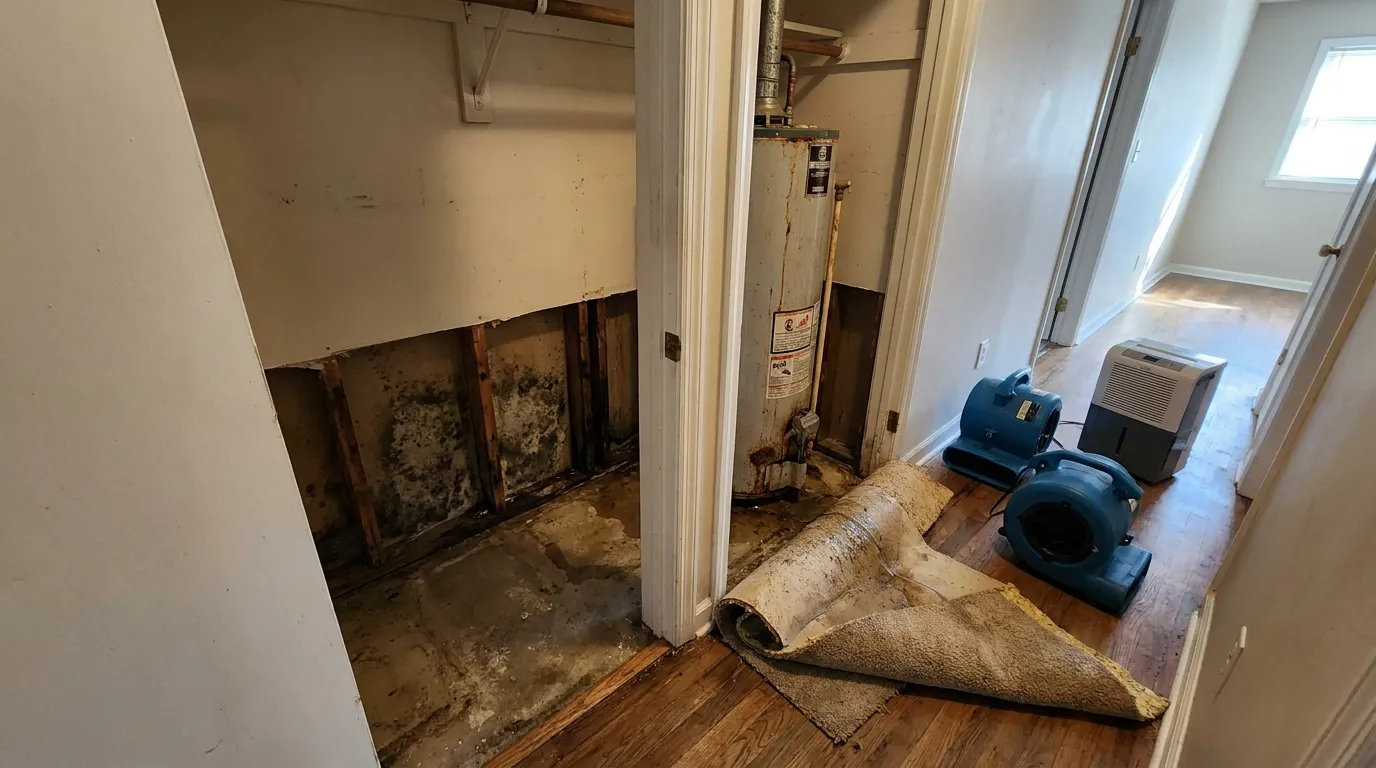
First Actions (To Do Immediately)
- 1 Stop the water: close the fixture's shutoff valve or the main, and fix or cap the leak.
- 2 Dry what's wet within 24 to 48 hours: fans, a dehumidifier, and pulling out soaked carpet pad or insulation.
- 3 Take photos and video of the mold, the wet area and the leaking part before cleanup.
- 4 Keep the failed part and get the plumber's written finding on what failed and how long it likely leaked.
- 5 Write down the timeline: last time the area was dry, when you found it, and any days you were away.
- 6 Report it to Liberty Mutual or Safeco promptly.
- 7 Keep people with asthma or allergies out of the area until it's cleaned.
DO NOT DO
- ✕ Do not let a remediation company start before you know your mold limit. Testing and hotel costs count against it too.
- ✕ Do not take advice to leave out that you were away or to change when the leak started. Five days away is well inside 14; a false statement can void the whole claim.
- ✕ Do not accept a denial of the whole loss without asking what evidence shows the leak ran 14 days or more.
- ✕ Do not throw away the failed part or the cut-out materials before the adjuster has seen them.
- ✕ Do not paint over mold or a water stain. It hides the damage the adjuster needs to see, and the mold keeps growing.
- ✕ Do not ignore a nonrenewal notice that cites roof mold. You may have weeks to fix it and appeal.
Which Mold Gets Paid, and What the Limit Has to Cover
When Liberty Mutual Pays for Mold
Liberty Mutual's mold endorsement (form FMHO 3370, filed in Nevada) starts by excluding mold "even if resulting from a peril insured against." Then it adds one way back in: an Additional Coverage for removing mold "resulting directly from any covered loss."
- Covered loss first: a pipe that bursts, a supply line that splits, or a water heater that fails, found and reported promptly.
- Not covered at all: mold from a leak that ran 14 days or more, from rain or groundwater, or from humidity. There's no covered loss, so the mold coverage never starts.
- Rot is in the same bucket. The form's full name is the Amendatory Mold, Fungus, Wet Rot, Dry Rot, Bacteria, or Virus Endorsement.
- Liability too: the same form removes liability coverage for claims "arising out of or aggravated by" mold. If a tenant or guest says mold in your home made them sick, this policy won't defend you.
What the $5,000 Has to Cover
The mold limit on the filed form is "Aggregate Limit $5,000." Check your declarations page for yours. It has to cover:
- Removal: treatment, containment, decontamination and disposal.
- Tear-out: the cost "to tear out and replace any part of the building as needed to gain access to" the mold.
- Testing to find or measure it.
- Hotel or lost rent if the mold makes the home unlivable.
- All of it, for the whole year, "regardless of" how many losses or claims you have.
- The regular water damage isn't capped. The form says that when a covered loss isn't caused by mold, payment "will not be limited" by the mold coverage "except to the extent that" mold "causes an increase in the loss." Ask the adjuster to put drying and repairs under the main coverage and only the extra mold work under the $5,000.
- Mold can pull work into the limit. A property reinspector, on a Liberty water heater claim found after five days: "At 5 days if there is mold growth there that may put tear out and replacement under any mold limit for that item."
The 14-Day Rule
Most insurers exclude leaks that run for "weeks, months or years." Liberty Mutual names a number. Its Seepage Exclusion Endorsement (FMHO 3391, filed in Nevada) excludes "a gradual, continuous, or repeated seepage or leakage of water, steam or fuel over a period of 14 days or more, resulting in damage to the structure, whether hidden or not." A Liberty denial letter posted in 2026 quoted another version: "more than 14 days, whether known or unknown to any insured."
- Hidden doesn't help. Many policies give you a pass if you couldn't have known about the leak. These two don't: "whether hidden or not," "whether known or unknown."
- A real denial: a Liberty customer's original cast-iron sink drain rusted through and soaked the wall, floor and vanity. They said they noticed within a few days; Liberty denied the claim under the 14-day clause and the rust exclusion.
- An adjuster's read: a property adjuster who spent about half of 15 years at Liberty Mutual replied that the rusted pipe itself isn't covered, "but the ensuing water damage should be covered if the leak itself occurred over a period of less than 14 days." A deteriorated vanity, though, could support the denial.
- Mold gets used as evidence. A former property adjuster: "if there is mold that's usually our telltale sign of it being a longer term issue thus the denial." Another adjuster disagreed: "Mold can form in 48 hours."
- Who has to prove it: the same Liberty-trained adjuster wrote, in another thread, "The burden of proof is on the insurance company (not you) to prove the leak occurred over a period of 14+ days."
- The first 13 days: a Florida appeals court ruled in 2018 (Hicks v. American Integrity) that a "14 or more days" exclusion doesn't clearly exclude damage done in the first 13 days, and a federal appeals court reached the same result in 2017 (Wheeler v. Allstate). Neither binds courts in other states, but both are worth raising in writing.
- What to do: ask Liberty in writing what evidence shows 14 days or more, and whether damage from before day 14 is covered. Send your timeline, the plumber's note and dated photos.
Away When It Leaked? Tell the Truth
A Liberty customer came home from five days away to a failed water heater, wet floors in the closet, hallway and a bedroom, and mold. The plumber told them not to mention the trip, and the rebuilder said "it's all about how I 'phrase' things." The owner refused. A commenter pointed out that the only reason to deny would be a leak "over a period greater than 14 days." Five days is well inside that.
The honest version is your best one: when you left, when you got back, what you found. Misstating the facts can void the whole claim; being away for a few days usually doesn't.
The Add-On for Slow Leaks
One Liberty Mutual agency's 2026 package chart (Utah) lists an optional Water Seepage or Leakage endorsement, Liberty's answer to the 14-day exclusion. Ask your agent for the wording and limit.
It's a separate, smaller limit, not extra coverage on top. One Safeco customer had "leakage and seepage coverage at 10,000," and the adjuster tried to put an entire toilet overflow under it, citing mold and old leaks in photos. That claim is on our Liberty Mutual water backup page.
Roof "Mold" Can Cost You the Policy
In California, Liberty Mutual has nonrenewed homeowners over "algae/mildew/mold/moss" seen on roofs in aerial images. Several turned out to have no mold at all.
- Reinstated within an hour, after a TV station called: a San Francisco couple insured by Liberty since 1976 were dropped over "moss, mildew, algae, and mold" in aerial images that, they said, looked like Google Earth. A roofer with an A+ BBB rating found "Nothing at all." Three weeks of appeals got no reply; ABC7 contacted the CEO's office, and Liberty reissued the policy within an hour of ABC7's follow-up questions (December 2024).
- $42,000 and still dropped: another San Francisco homeowner was dropped over "algae & mold" that an inspector found wasn't there. She spent $42,000 on inspections and upgrades, including a new HVAC system. Liberty still dropped her, she said, after telling her the photos she sent were "in the wrong format."
- A class action: Maria Badin, a Liberty customer since 1993, was nonrenewed in 2024 over roof "algae/mildew/mold/moss." Her roofer found it "in incredible shape"; Liberty replied that "the nonrenewal decision remains valid," and she ended up on the California FAIR Plan. Her proposed class action was filed in December 2024; in August 2025 a federal judge let her contract and unfair-practice claims go forward. It was still open as of September 2026.
- What reversed it on Reddit: a 14-month-old roof flagged for mold was renewed for a year after the owner sent new photos and the roof receipt. Another owner filed a complaint with the California Department of Insurance: "They contacted Liberty within a month and forced them to let me fix it." A $1,000 roof cleaning, and Liberty renewed without raising the rate. A California agent: "We've been lucky to get 80+% reversed with proof of correction."
- What didn't: another owner sent photos of a clean roof and was told "there is no dispute process, no remedy available - decision is final."
- United Policyholders' Amy Bach: "They seem to be non-renewing a lot of people and giving very, it sounds like, sort of inconsistent accounts of why."
If You Get a Roof Mold Nonrenewal
- Ask for the images and the report the decision was based on.
- Get a licensed roofer's written inspection with dated close-up photos. If the roof is new, include the invoice.
- If there's growth, clean it (one owner paid $1,000) and send before-and-after photos.
- Appeal in writing, before the date on the notice. California requires nonrenewal notices at least 75 days ahead, so there's usually time.
- If they won't budge, file a complaint with your state insurance department, and have an independent agent shop your policy at the same time.
What Liberty Mutual Policyholders Reported
- Denied, 14-day rule: the rusted cast-iron drain above.
- Away five days: the water heater claim above; the owner was told it takes three business days for Liberty to assign an adjuster.
- Mold after Liberty's own repair: Liberty paid part of a slow toilet leak and sent a contractor. Within a year the new wall by the tub was moldy; a second contractor found a clear plastic strip left on the tub, so the caulk never stuck. A commenter's advice: call the original adjuster, because work by an insurer's recommended contractor often carries an extra warranty.
- Stuck mid-claim: an Ohio couple, two months into a water claim with the kitchen light still off and holes left open in two rooms, were pointed to Liberty's "Executive Customer Care" escalation and a written formal complaint, with copies of everything.
- The pattern: the date the leak started decides most Liberty mold claims. The $5,000 matters only after that.
Should You Tell Liberty Mutual About Mold?
If it came from a water leak you're claiming, yes, and promptly; the mold is part of that loss, and delay makes the 14-day question harder to answer. If there's no claim, such as mold in a damp bathroom or a basement after rain, it isn't a covered loss and a claim would only go on your record. Fix the moisture problem and clean it. The EPA says you can usually clean mold yourself if it covers less than about 10 square feet.
For how other insurers handle this, see does insurance cover mold after a water leak and Travelers mold coverage.
Sources
- Liberty Mutual form FMHO 3370 11 12, Amendatory Mold, Fungus, Wet Rot, Dry Rot, Bacteria, or Virus Endorsement, filed with the Nevada Division of Insurance: form PDF.
- Liberty Mutual form FMHO 3391 11 12, Seepage Exclusion Endorsement, Nevada filing: form PDF.
- Hicks v. American Integrity Ins. Co. of Fla., No. 5D17-1282 (Fla. 5th DCA 2018): opinion (Justia).
- Badin v. Liberty Mutual Ins. Co., No. 3:25-cv-00163 (S.D. Cal.), order on motion to dismiss, Aug. 13, 2025; Los Angeles Times, SoCal homeowner sues Liberty Mutual, Jan. 3, 2025.
- ABC7 San Francisco, Insurer drops SF homeowners, citing aerial footage (Dec. 12, 2024) and SF homeowner spent $42K to appeal (Dec. 19, 2024).
- Anderson Insurance Group (Liberty Mutual agency, Utah), Why We Recommend Liberty Mutual, package chart, July 2026.
- U.S. EPA, A Brief Guide to Mold, Moisture, and Your Home: dry within 24 to 48 hours; areas under about 10 square feet.
- About 10 Reddit threads on Liberty Mutual and Safeco mold claims, the 14-day exclusion, and roof nonrenewals (r/Insurance, r/homeowners), read by Emergency Damage Pros in November 2026. US posts only. They show what happens in practice, not legal outcomes.
Documentation Checklist
- Take wide-angle photos of the entire affected room.
- Take close-up photos of the specific damage point.
- Save the broken part or pipe if a plumber replaces it.
- Keep all receipts for emergency repairs and mitigation.
- Do not throw away damaged property until the adjuster has seen it.
Severity Matrix: Medium
Requires professional extraction equipment and dehumidifiers. Moderate risk of mold and structural damage.
Who to Call
Licensed Plumber or Water Damage Restoration Professional
Insurance & Documentation
- Coverage depends on policy, cause, timing, exclusions, endorsements, and documentation
- Coverage depends entirely on your specific policy details, the exact cause of the damage, timing, exclusions, endorsements, and your documentation.
- This information is educational and does not constitute a guarantee of coverage or a promise that your claim will be approved.
Frequently Asked Questions
Does Liberty Mutual homeowners insurance cover mold?
Only when the mold results directly from a covered loss, such as a burst pipe or failed water heater, and only up to the mold limit. Mold from a leak that ran 14 days or more, from rain, or from humidity isn't covered.
How much does Liberty Mutual pay for mold?
Up to the mold limit on your declarations page. Liberty's filed endorsement shows a $5,000 aggregate limit for the policy year, covering removal, tear-out, testing and hotel costs combined, however many claims you have.
What is Liberty Mutual's 14-day rule?
Liberty's seepage exclusion removes coverage for leakage that goes on "over a period of 14 days or more… whether hidden or not." Some Liberty policies say "more than 14 days, whether known or unknown to any insured." If the leak ran less than 14 days, the water damage can be covered even if the leaking pipe itself isn't.
Does the Liberty Mutual mold limit include testing and hotel costs?
Yes. The endorsement puts testing, tear-out to reach the mold, removal, and lost rent or extra living costs inside the same limit. Regular water damage that isn't caused by mold is paid under your main coverage.
Does Liberty Mutual cover mold from a slow leak?
Not if the leak ran 14 days or more; the exclusion applies whether or not the leak was hidden. Some Liberty packages offer a Water Seepage or Leakage endorsement with its own limit; ask your agent.
Why is Liberty Mutual being sued over roof mold?
A proposed class action filed in December 2024 by a Poway, California homeowner says Liberty nonrenewed her over "algae/mildew/mold/moss" on her roof that an independent roofer found wasn't there. A federal judge let parts of the case proceed in August 2025; it was still open as of September 2026.
Can I appeal a Liberty Mutual nonrenewal for mold on my roof?
Yes. Ask for the images, get a licensed roofer's report with dated photos, clean the roof if needed, and appeal in writing before the deadline. One California agent said 80% or more of their clients' cases were reversed with proof of correction; others were told the decision was final. A state insurance department complaint has also worked.
Should I tell Liberty Mutual about mold?
If it's part of a water loss you're claiming, yes, and promptly. If there's no covered loss, like mold from humidity, a claim won't be paid and still goes on your record. Fix the moisture source and clean it.
Get Professional Help Now
Connect with a local water damage expert immediately.