Where Is My Main Water Shut Off? How to Find It by House Type
Emergency Answer
It's usually where the water pipe enters the house from the street: the front basement wall near the meter, or the garage, a utility closet or a pipe by an outside hose faucet in slab homes.
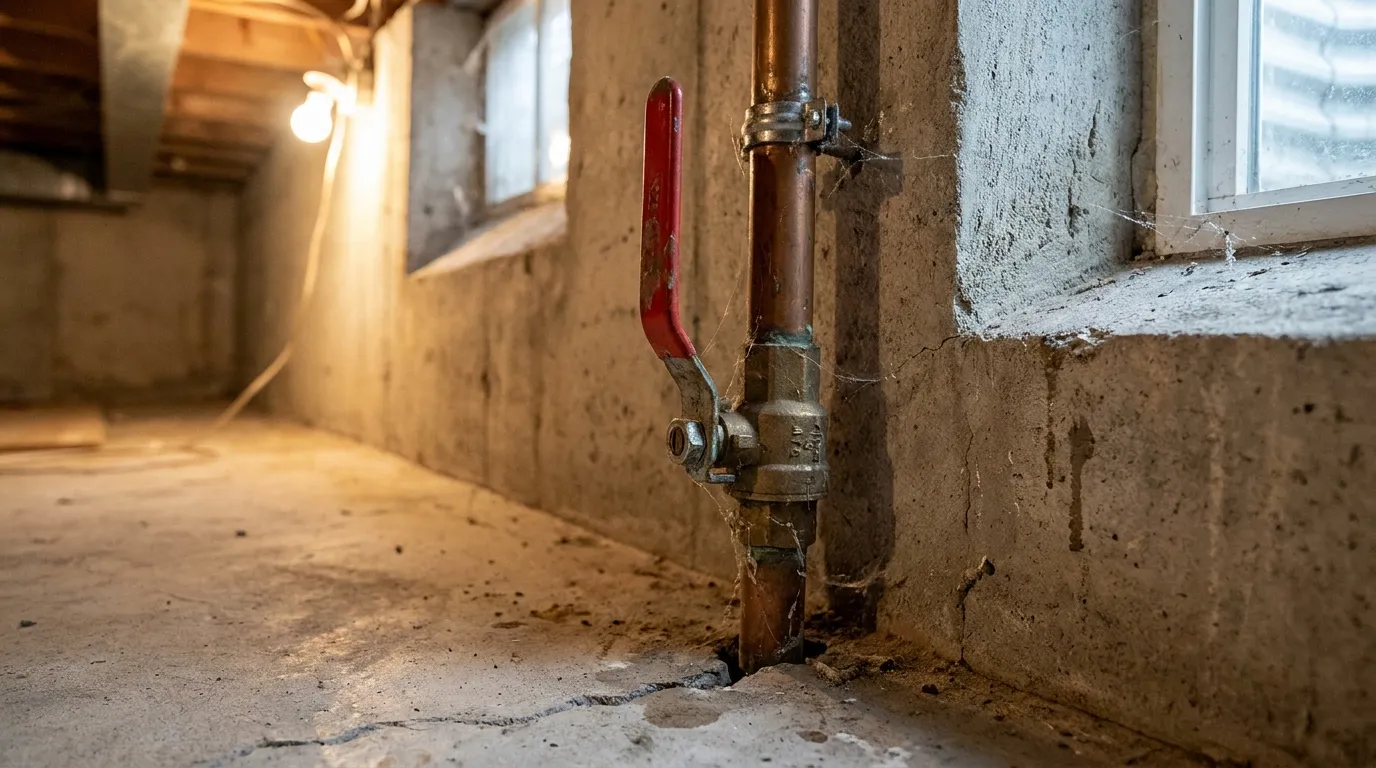
- Basement: On the wall facing the street, where the pipe comes through the wall or floor, usually right next to the water meter. In a finished basement it may be behind an access panel.
- Slab or Crawl Space: Outside on the pipe rising out of the ground by a hose faucet, or in the meter box near the street on the house side of the meter. Inside, check the garage, laundry or water heater closet, or just inside the crawl space access.
- Condo or Apartment: Behind an access panel under a sink, or in the laundry or utility closet. There may be separate hot and cold valves; close both.
- Quick Trick: Find the cold-water pipe on top of your water heater and follow it back toward the street.
- Can't Find It, or It Won't Turn: Call your water utility to shut the water off at the street, and call a plumber.
First Actions (To Do Immediately)
- 1 If water is leaking right now from one fixture, close the small valve behind that fixture first. It's faster.
- 2 Otherwise, go to where the water line enters the house from the street and look for a lever or a round wheel on that pipe.
- 3 Close it: turn a lever a quarter turn so it sits across the pipe, or turn a wheel clockwise until it stops.
- 4 If you can't find it or it won't move, call your water utility's emergency line and a plumber.
DO NOT DO
- ✕ Do not force a valve that won't turn, or use a pipe or long wrench for leverage. The stem or the pipe can break and leave the water running.
- ✕ Do not close the fire sprinkler valve, the one on a pipe with pressure gauges and an alarm or tag, thinking it's the water main.
- ✕ Do not use pliers on the valve at the street or damage the meter-reading wires in a meter box. Use the proper key, if your utility allows you to turn it at all.
- ✕ Do not wait for an emergency to find it. Find it, label it and test it now.
Follow the Line From the Street
Where to Look, by House Type
The main shutoff is the first valve on the water line after it enters the house. Closing it stops water to every faucet, toilet and appliance at once. Find where the water comes in and you've usually found the valve.
- Basement (common in cold climates): on the foundation wall facing the street, where the pipe comes up through the floor or in through the wall, right next to the water meter. Denver Water says that in most single-family homes it's in the basement or crawl space, on a wall facing the street. Check the furnace or mechanical room too, and up between the ceiling joists above the meter.
- Finished basement: behind an access panel in the wall or ceiling on the street side, sometimes inside a closet or behind a vanity. Some were drywalled over during a remodel.
- Crawl space: just inside the crawl space access, where the line rises toward the floor joists on the street side.
- Slab: the garage, the laundry or water heater closet, or under the sink closest to the street.
- Warm climates (South and Southwest): often outside, on a pipe rising out of the ground next to a hose faucet, sometimes alongside the pressure regulator and the sprinkler-system valve. Or it's in the meter box: Austin Water says most homeowners' valves are on their side of the meter, at the meter box. Some homes have no valve at the house at all, only the one in the meter box by the street.
- Condo or apartment: behind an access panel under the kitchen or bathroom sink, or in the laundry or utility closet. There may be one valve for hot and one for cold; close both. If your unit has none, ask building management where the nearest one is and who can close it at night.
- Well water: turn off the well pump at its breaker. The house valve is usually next to the pressure tank.
How to Find It When It Isn't Obvious
- Follow the water heater's cold line. The cold inlet is marked on top of the tank. Trace that pipe back toward the street.
- Draw a line from the meter to the house. If your meter is outside, the valve is usually just inside the wall closest to it.
- Check your home inspection report. It often notes the location, but inspectors sometimes label the wrong valve, so confirm it with the test below.
- Open access panels on the street side of the house, in closets, behind vanities, and in ceilings below bathrooms.
- Ask your water utility. Many will tell you where your service line enters, or send someone to show you.
- Ask a neighbor with a house from the same builder. Builders tend to put the valve in the same place in every house.
- Don't count on 811 to find it. Calling 811 gets the utilities to mark their own lines, usually only as far as the meter or the curb valve. The pipe from there to your house is usually yours, and they won't mark it.
Is This the Main? A One-Minute Check
- Close the valve.
- Open the highest faucet in the house. It should sputter and stop within a minute or two.
- If water keeps running, either it isn't the main or it isn't sealing. Have a plumber look at it.
- Open the valve again slowly. Sputtering air at the faucet afterward is normal.
Valves That Look Like the Main but Aren't
- Fire sprinkler valve: a pipe with pressure gauges, a flow switch and often a tag. It feeds the sprinklers. Don't close it.
- Water heater cold-inlet valve: on the pipe going into the top of the tank. It stops hot water only; cold keeps flowing.
- Sprinkler-system or outdoor faucet valve: a branch off the main line that shuts off outside water only.
- Pressure regulator: a bell-shaped fitting on the main line just after the shutoff. It controls pressure and can't shut the water off.
- Gas valve: on the pipe to the furnace, water heater or stove. Make sure you're on the water pipe.
- Fixture valves: the small valves under sinks and behind toilets and washers. They shut off one fixture, which is the fastest fix when the leak is at that fixture.
How to Turn It Off
- Lever handle (ball valve): a quarter turn. Across the pipe means off, in line with the pipe means on. Turn it at a steady, moderate speed.
- Round wheel (multi-turn valve): clockwise until it stops, which can take several turns. Old wheel valves often don't shut off completely.
- If it's stiff: hold the valve body steady so the pipe doesn't twist, and rock the handle gently back and forth in small moves. Don't force it against its stop. See what to do if your shutoff valve is stuck.
- If it drips at the stem after you turn it: common on old wheel valves. Snug the nut just under the handle slightly. A slow drip isn't an emergency; put a bucket under it and call a plumber during business hours.
- Turning it back on: open a faucet first, then open the valve slowly so the pipes don't bang.
The Valve at the Street
Most homes also have a valve outside. In warm climates it's typically in a meter box near the street. In cold climates it's usually a curb valve: a small metal cap in the lawn near the sidewalk, over a tube that runs down to a valve below the frost line (4½ to 6 feet down in Denver), turned with a long T-handle curb key.
- Who may turn it depends on your utility, and the rules really differ. Austin Water tells customers to use the city valve in the meter box, with a water meter key from a hardware store, if their own valve is missing or damaged. Royal Oak, Michigan asks residents not to turn the curb valve themselves or let a plumber do it, and sends a crew instead. El Dorado Irrigation District in California says only its employees may operate the curb valve. Madison, Wisconsin wants to locate and test the valve first (free), and lends keys for a $250 deposit.
- Even where it's allowed, it may not work. Denver Water warns that many curb valves have seized over the years, or sit in a box full of debris or out of line, so the key can't reach them. Forcing one can break it, and a broken curb valve can mean digging up the yard.
- Look up your utility's rule now, and save its 24-hour emergency number in your phone.
- In a meter box, there may be a valve on each side of the meter. The one on the house side is yours. The street-side one, often with a lock hole, is the utility's.
- Use only the proper key, never pliers, and open the lid carefully: newer meter lids have wires connected to the meter inside, and warm-climate boxes can have insects or spiders.
- Who owns the street valve varies. In Denver, the homeowner owns and maintains the curb valve and the meter pit. In Saint Paul, Minnesota, the utility owns the line under the street. Next door in Minneapolis, the homeowner owns the whole service line back to the city main, curb valve included.
No Main Shutoff Inside? What to Do
- What the code says: the International Plumbing Code requires a full-open valve where the water line enters the building, and another near the curb. Older homes may predate that, and states amend it: North Carolina, for example, also allows the valve outside within 5 feet of the foundation in a valve box, or in the crawl space within 3 feet of the access door.
- Some homes, especially older houses and slab homes in the South, have no valve inside. The only shutoff is at the meter box or the curb.
- In an emergency: use the street valve if your utility allows it, or call the utility's emergency line. Then call a plumber.
- The fix: have a plumber install a full-port ball valve where the line enters the house. The utility shuts the street valve while it goes in.
- If your main is an old wheel valve that won't shut off fully or drips every time you turn it, the same fix applies: replace it with a ball valve.
Label It and Test It Once a Year
- Label it "MAIN WATER SHUTOFF" with an arrow showing which way to turn.
- Show everyone in the house, including teenagers and anyone who house-sits.
- Keep the way clear, inside and out. Keep any tool it needs (a wrench, or a curb or meter key if your utility lets you use one) right next to it, and keep the meter box or curb box clear of dirt, mulch and plants so it can be found and turned.
- Test it regularly, as Denver Water advises; once a year is a good habit. Use the one-minute check above.
- The catch: turning an old wheel valve can make it start dripping at the stem, or stick. Test it on a weekday morning when a plumber is easy to reach, not the night before a trip. Better to find out now than during a flood.
Sources
- International Code Council, International Plumbing Code, Section 606.1: Location of Full-Open Valves.
- North Carolina Office of State Fire Marshal, Formal interpretation: Residential Code P2903.9.1, Service Valve (2023).
- Denver Water, Cold Weather Tips and Homeowner Responsibility.
- Austin Water, Cold Weather Tips.
- City of Royal Oak, Michigan, Curb Stops.
- El Dorado Irrigation District, How to Turn Off the Water in an Emergency.
- Madison Water Utility, Locate and Check Policy.
- Texas 811, Homeowner FAQs, and Colorado 811, Private vs. Public Utilities.
- City of Minneapolis Public Works, Frozen Water Service Lines.
- Saint Paul Regional Water Services, Plumbing Information for Home Owners.
Severity Matrix: High
Requires immediate professional intervention. High risk of structural weakening, electrical hazards, and mold.
Who to Call
Licensed Plumber or Water Damage Restoration Professional
Insurance & Documentation
- Mitigation/documentation support only; no coverage conclusion
Frequently Asked Questions
Where is the main water shut-off valve usually located?
Where the water line enters the house from the street. In basement homes, that's usually the front foundation wall near the water meter. In slab homes, it's the garage, a laundry or water heater closet, or outside on a pipe near a hose faucet. In condos, it's usually behind an access panel under a sink or in the laundry closet.
Does every house have a main water shut-off valve inside?
Newer homes should: the International Plumbing Code requires a valve where the water line enters the building. But some older homes and many slab homes in warm climates only have the valve at the meter box or curb by the street. If yours has none inside, have a plumber add a full-port ball valve where the line enters the house.
Which way do I turn the main water valve to shut it off?
A lever handle turns a quarter turn until it sits across the pipe. A round wheel turns clockwise until it stops. If either won't move, don't force it; call your water utility and a plumber.
Can I turn off the water at the street myself?
It depends on your utility. Austin Water tells customers to use the city valve in the meter box if their own valve is missing or damaged; Royal Oak, Michigan and El Dorado Irrigation District in California ask you to call them instead. Check your utility's rule before you need it, and in an emergency call its 24-hour line.
How do I know if the main water valve is fully off?
Open the highest faucet in the house. It should sputter and stop within a minute or two. If water keeps running, the valve isn't sealing, or it isn't the main.
Get Professional Help Now
Connect with a local water damage expert immediately.
Related Resources
- →Pipe Burst? What to Do in the First 20 Minutes
- →Water Shut Off Valve Stuck in Open Position: How to Free Gate & Ball Valves Without Breaking the Pipe
- →Frozen Pipes: What to Do, How to Tell If One Burst, and How to Thaw It Safely
- →Stuck or Leaking Toilet Shut-Off Valve? How to Fix the Leak or Replace It