Frozen Pipes: What to Do, How to Tell If One Burst, and How to Thaw It Safely
Emergency Answer
If a cold night left you with no water, open the faucet on the frozen line and leave it open, then warm the pipe slowly with a hair dryer, heating pad, space heater or hot towels. Never use a flame. Find your main water shutoff before you start: a pipe can split while it freezes and only start leaking as the ice melts. If water is already spraying or dripping through a ceiling, shut off the main first.
- Rule Out a Burst First: If you hear spraying or see water coming through a wall or ceiling, shut off the main water valve now and skip the thawing.
- Find Where It's Frozen: Turn on every tap. If nothing runs anywhere, the freeze is usually where the main line enters the house. If one tap is dry, it's that fixture's line, often in an outside wall.
- Open the Faucet: Open both hot and cold on the frozen line so melting ice and pressure have somewhere to go.
- Warm It Slowly: Hair dryer, heating pad, hot wet towels, or a space heater at least 3 feet from anything that can burn. No torch, propane heater or open flame.
- Check for a Leak Afterward: With every tap off, watch the small leak indicator on your water meter. If it turns, shut off the main and call a plumber.
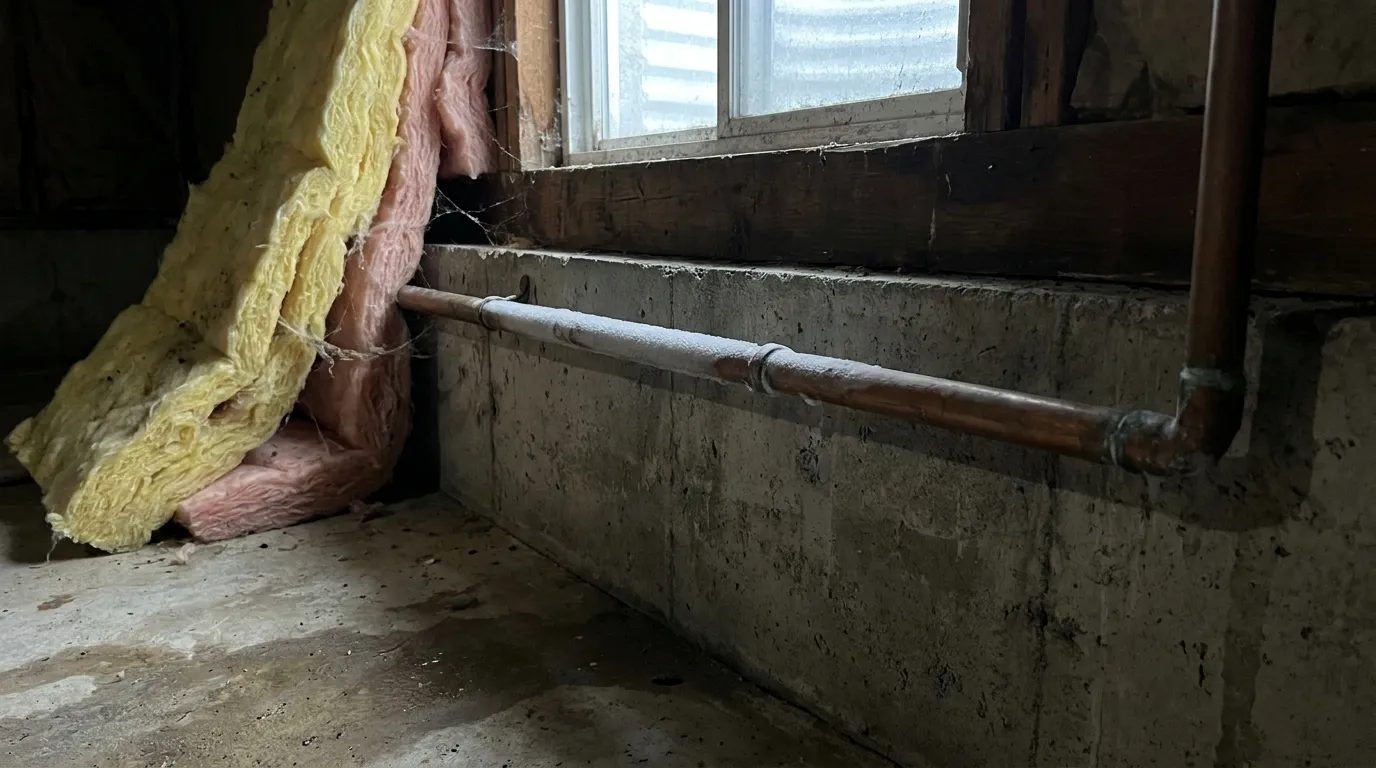
First Actions (To Do Immediately)
- 1 If you hear spraying or see water coming through a wall or ceiling, shut off the main water valve before doing anything else.
- 2 Open the faucet on the frozen line, hot and cold, and leave it open.
- 3 Find your main water shutoff and make sure it turns, in case a split shows up as the ice melts.
- 4 Turn on every other tap in the house to see whether one fixture or the whole house is affected.
DO NOT DO
- ✕ Do not use a blowtorch, propane or kerosene heater, charcoal stove or any open flame. A torch can boil the water inside and burst the pipe, and flames bring fire and carbon monoxide risk.
- ✕ Do not leave a heater or hair dryer running while you're out of the room, and never plug a space heater into an extension cord or power strip.
- ✕ Do not use electrical devices near standing water.
- ✕ Do not heat the house with a gas oven or run a generator indoors; both can produce carbon monoxide.
- ✕ Do not close the faucets on a frozen line while it's still cold out, even if the drip stops. The open tap is what keeps pressure from building.
Where the Pressure Builds in a Frozen Pipe
What This Usually Means
No water after a hard freeze usually means ice has completely blocked a supply pipe somewhere between the street and your tap. The ice itself isn't what breaks pipes. Once the pipe is blocked, more ice keeps forming and squeezes the water trapped between the blockage and the closed faucet. In University of Illinois tests, pressure in that trapped section climbed from a normal 40–50 psi to more than 4,000 psi before the pipe burst. That's why a pipe can split at a spot with almost no ice in it, sometimes inside a heated room, and why opening the faucet matters: an open tap lets the pressure escape.
Why Hidden Moisture Matters
A pipe that split while frozen usually doesn't leak until it thaws, because the ice holds the crack shut. When it lets go, water comes out at full house pressure, often inside a wall or ceiling where you won't see it until the drywall stains or sags. That's why you should find the main shutoff before you start heating, stay home while the pipe thaws, and check the meter afterward. Drywall, insulation and subfloor that stay wet for more than a day or two can start growing mold, so a split caught early costs far less than one found next week.
Frozen, Burst, or a Water Outage? The Two-Minute Check
Before you heat anything, turn on every tap in the house, hot and cold. Which ones run tells you where the ice is.
- Your neighbors have no water either: probably a water main break or street work, not your pipes. Check your water utility's outage alerts or call its customer line. Leave one cold tap slightly open so you'll know when service is back.
- No water anywhere in the house: the freeze is usually in the main line where it comes into the house, at the water meter or the foundation wall, or underground.
- One tap or one room is dry: that fixture's supply line is frozen, usually in an outside wall, under a sink on an outside wall, or over a crawl space.
- Only the shower is dead, hot and cold: plumbing codes require shower valves that cut flow to almost nothing when the cold supply stops (ASSE 1016), so a frozen cold line alone can stop both. Check the hot tap at the bathroom sink.
- Water is spraying, dripping from a ceiling, or the meter's leak indicator turns with every tap off: a pipe has already split. Shut off the main, call a plumber, and follow what to do when a pipe bursts.
Get Ready to Shut the Water Off Before You Thaw
Ice can hold a crack shut. As soon as it melts, water comes out at full pressure, so know where your main shutoff is and make sure it turns before you start.
- Where to look: In most cold-climate homes with a basement, it's on the front foundation wall where the water pipe comes in, just before the water meter. In warmer climates it's often outside near a hose faucet, in line with the meter, or in the garage. See where to find your main water shutoff.
- How to close it: Turn a lever handle a quarter turn so it sits across the pipe. Turn a round wheel clockwise until it stops. Don't force one that won't move; see what to do if your shutoff valve is stuck.
- If you can't stay home while it thaws (work, travel, overnight), shut off the main and open the taps. If you're home and watching, you can leave the water on so you'll see the moment it flows, and shut it off at the first sign of a leak.
- If you shut off the main and drain the pipes, turn off an electric water heater at its breaker, or set a gas one to pilot or vacation, so it doesn't heat a partly empty tank. Before turning it back on, refill it with a hot tap open until the air stops sputtering out.
- Renting? Call your landlord or property manager first. The shutoff, the thawing and the repair are usually theirs to handle.
How to Thaw a Frozen Pipe
Gentle heat can take several hours to work, depending on how cold it is and how much of the pipe is frozen. If the pipe still hasn't thawed after a few hours, call a licensed plumber.
- Open the faucet the frozen pipe feeds. If the whole house is dry, open the lowest cold tap, ideally a basement laundry tap.
- Find the cold spot. Run your hand along exposed pipe for the coldest section or frost. Check first where the pipe comes in through the foundation wall, then pipes along outside walls, under sinks on outside walls, and in the garage, crawl space and attic.
- Heat from the faucet end back toward the ice, so melted water can drain out the open tap. Use a hair dryer (a baking sheet behind the pipe reflects heat onto the back), an electric heating pad, towels soaked in hot water, or a space heater.
- For a frozen main line at the meter, warm the air where the pipe comes through the floor or foundation wall with a space heater, especially if that part of the basement is unheated. If the ice is in the buried line outside, heat from inside won't reach it; that needs a contractor with thawing equipment.
- For pipes inside a wall or ceiling, warm the space: turn up the heat, open cabinet doors, remove any access panel, and point a space heater at the wall.
- Keep going until full water pressure comes back, then check every other tap. If one pipe froze, others may have too.
Safe Heat by Pipe Type
- Copper (orange-brown metal): the most likely to split. Hair dryer, heating pad, hot towels or a space heater. No flame: it can scorch the framing behind the pipe and boil the water inside.
- PEX (flexible red, blue or white plastic): usually survives freezing without splitting, according to the Plastics Pipe Institute, though fittings can still fail. Use a hair dryer, warm towels or room heat. Pipe makers allow a heat gun only if it keeps moving with a hand on the pipe, and the pipe must stay under 180°F. Never use a flame or an electric pipe-thawing machine on PEX; the damage may not show.
- CPVC (rigid cream or tan plastic): rated to 180°F. Gentle heat only: heating pad, warm towels, hair dryer or room heat.
- Older grey plastic pipe (polybutylene): prone to failing at fittings. Thaw it gently and have a plumber look at it.
Your City or a Plumber: Who Thaws It
Who thaws a frozen line depends on who owns that stretch of pipe. In most US cities, the water utility owns the main under the street and you own at least the pipe from your property line or curb valve into the house, so a freeze on your side is yours to thaw and pay for. Some cities put even more on the owner. Two neighboring cities show the range: in Saint Paul, Minnesota, the utility owns the part under the street, while in Minneapolis you own the whole line back to the city main, curb valve included, and the city will only send an inspector to confirm it's frozen. Many utilities also own the meter but bill you if it cracks from freezing. Call your water utility's emergency line to find out where your part starts.
Call a licensed plumber if you can't find or reach the frozen section, the pipe is inside a finished wall or ceiling, it has already split, or gentle heat hasn't brought the water back after several hours. If water has already soaked drywall, insulation or flooring, a water damage restoration company can measure moisture inside the wall before mold sets in.
After the Water Comes Back: Check for a Split
- Let the tap run for a few minutes, then turn off every tap and water-using appliance in the house.
- Find the leak indicator on your water meter: a small red or blue triangle, star or dial. Watch it for five minutes. If it turns, water is escaping somewhere.
- Close the main shutoff and watch again. If it still turns, the leak is between the meter and the house. If it stops, the leak is inside.
- For the next day, check walls and ceilings near and below the pipe that froze for stains, sagging or a hissing sound. A pipe can fail anywhere past the ice, not just where it froze.
Tonight: Keep It From Freezing Again
- Leave a slow drip on the faucet farthest from where water enters the house, hot and cold, since they're separate lines. A drip delays freezing, but its real job is relieving pressure, so keep the tap open even if the drip stops.
- Open cabinet doors under sinks on outside walls.
- Keep the heat at the same temperature day and night, and no lower than 55°F if you go away. Insurers can deny frozen-pipe claims when the heat wasn't kept on; see whether homeowners insurance covers burst pipes.
- Don't box in the water meter or main line without a louvered door or open access panel. Saint Paul's water utility warns that meters boxed in with drywall during remodels are prone to freezing.
- If the main line from the street froze, it can freeze again while the ground stays frozen. Minneapolis advises running a pencil-width stream of cold water from the lowest faucet in the house until the ground thaws, with the drain clear and a note on the tap so no one turns it off.
- Seal drafts where pipes pass through the rim joist or outside walls. In the University of Illinois tests, moving cold air froze pipes even inside insulated walls.
- Disconnect garden hoses, close the indoor valve to each outdoor faucet, and drain the outdoor faucet.
Sources
- Gordon, J. R., An Investigation into Freezing and Bursting Water Pipes in Residential Construction, University of Illinois Building Research Council, Research Report 96-1 (1996).
- American Red Cross, Preventing and Thawing Frozen Pipes.
- Seattle Public Utilities, Frozen Pipes in Winter Weather.
- City of Minneapolis Public Works, Frozen Water Service Lines.
- Saint Paul Regional Water Services, Protect Your House From Frozen Meters and Pipes and Plumbing Information for Home Owners.
- Village of Wheeling, Illinois, Frozen Pipe Talking Points.
- Plastics Pipe Institute, TR-52: Resistance of PEX Pipe to Breakage When Frozen.
- Portland Water Bureau, How to Check for Leaks.
- NFPA, Portable Electric Space Heater Safety.
- U.S. DOE Building America Solution Center, Flush Water Heater Tank.
What You Can Check Safely
- Listen for dripping or running water: Can help identify active leaks behind walls or above ceilings.
- Check the water meter: If all fixtures are off but the meter is spinning, you have an active plumbing leak.
- Inspect adjacent rooms: Water travels horizontally along floor joists and subfloors.
What Professionals Look For
- Thermal imaging (infrared) to detect temperature anomalies indicating hidden moisture.
- Moisture meters to test the exact saturation levels of wood, drywall, and masonry.
- Borescope inspections to look inside wall cavities without removing large sections of drywall.
- Hygrometers to measure the relative humidity of the affected rooms and evaluate the risk of condensation and mold.
Severity Matrix: Medium
Requires professional extraction equipment and dehumidifiers. Moderate risk of mold and structural damage.
Who to Call
Licensed Plumber or Water Damage Restoration Professional
Insurance & Documentation
- Documentation and claim context only; no coverage conclusion
Frequently Asked Questions
How long does it take for frozen pipes to thaw?
With gentle heat, an exposed pipe can take several hours. If it hasn't thawed after a few hours, call a licensed plumber. A main line frozen underground usually needs a contractor with thawing equipment. Left alone, pipes only thaw once the space around them warms up, which can take days in a long cold snap.
Should I turn off the main water if my pipes are frozen?
If you can't stay home to watch the pipe while it thaws, yes: shut off the main and open the taps so a split can't flood the house while you're gone. If you're home and watching, you can leave it on so you'll see the moment water flows, as long as you can reach the shutoff quickly. Either way, find it and make sure it turns before you start heating.
Will a frozen pipe always burst?
No. In University of Illinois tests, pipes burst only after ice completely blocked them and the water trapped behind the blockage reached thousands of psi. An open faucet lets that pressure escape, which is why opening the tap on a frozen line is the most important step.
How cold does it have to be for pipes to freeze?
It depends on how long the cold lasts and how exposed the pipe is. In University of Illinois freezer tests, a bare 3/4-inch copper pipe froze solid in about 11.5 hours at 20°F, 6.5 hours at 10°F and under 5 hours at 0°F. Wind and drafts speed it up, even inside insulated walls.
Can I use a heat gun or torch to thaw a frozen pipe?
Never a torch or any open flame: it can boil the water inside, burst the pipe and set the framing on fire. A heat gun is risky on plastic pipe and needs constant movement on any pipe. A hair dryer, heating pad or hot towels do the job more safely.
Get Professional Help Now
Connect with a local water damage expert immediately.