Does Nationwide Cover Water Backup or Sump Pump Failure?
Emergency Answer
Only if your policy has Nationwide's Water Backup add-on. Without it, water that backs up through a sewer or drain, or overflows when the sump pump fails, isn't covered. With it, Nationwide pays for damage to the house and your belongings up to the limit you picked; its coverage overview lists a $50,000 maximum. It doesn't pay for the pump itself, the sewer pipe in the yard, or water that comes in through the walls.
- Check your declarations page: Look for Water Backup, or "Limited Water Back-Up and Sump Discharge or Overflow Coverage," and the dollar limit next to it. If it isn't listed, or the quote showed it as declined, you don't have backup coverage.
- Find the deductible line too: Some Nationwide policies list a separate Water Backup Deductible. The ones we saw were $500 and $1,000.
- Know the limit before drying starts: In the Nationwide wording quoted in a Delaware court case, the backup limit is the most it pays for the house, other structures and your belongings together. Tell the restoration company the number before they begin.
- Photograph where the water came in: Water up a floor drain or toilet, or over the sump pit, is backup. Water through the walls, up through the slab, or under a door is groundwater or surface water, which the add-on doesn't cover.
- Get the cause in writing from the plumber: Nationwide's backup wording excludes loss "caused by the negligence of an insured." A written cause, such as a city main surcharge, tree roots or a failed float switch, answers that before it comes up.
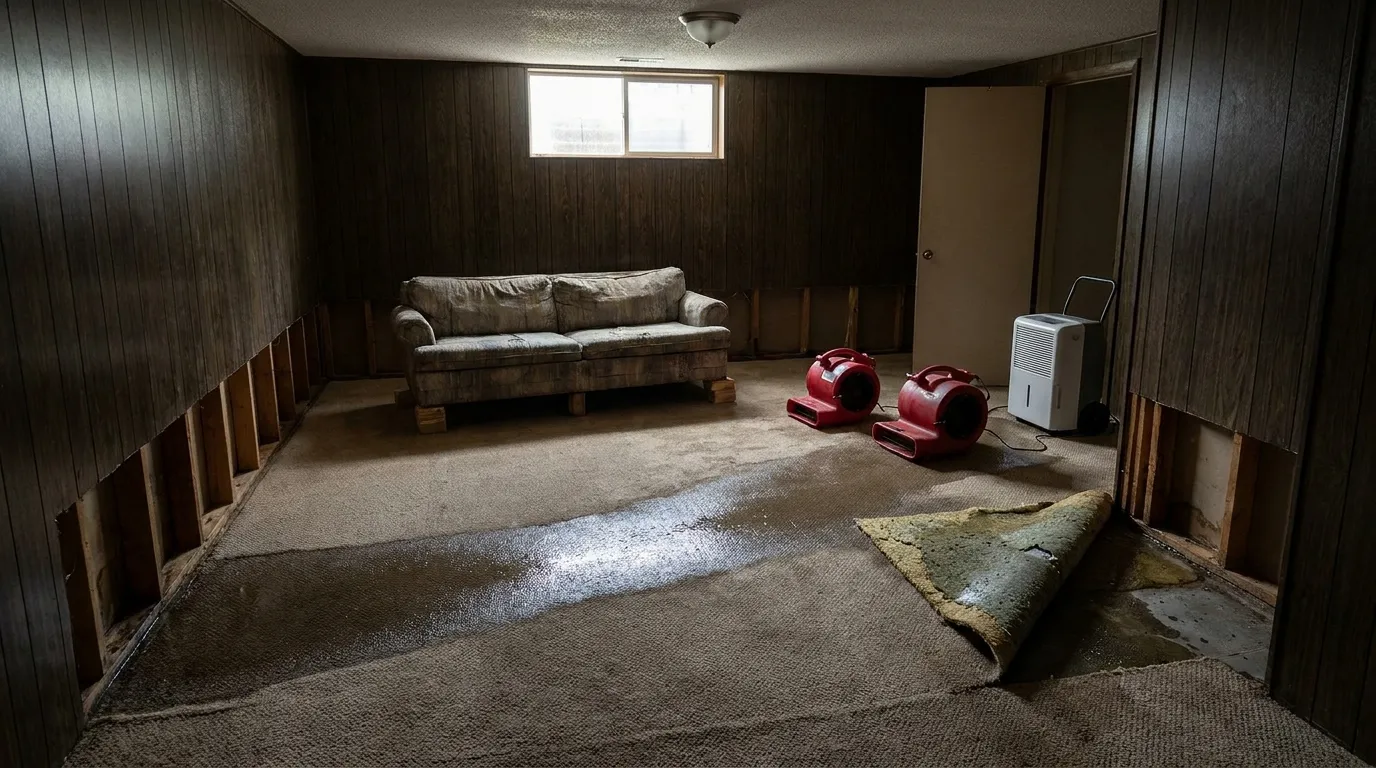
First Actions (To Do Immediately)
- 1 If sewage came up a drain, keep children and pets out, and stop running water and flushing until the line is cleared. Every drain in the house empties into the same pipe.
- 2 If water is near outlets, the furnace or the water heater, shut off power to the basement from a dry spot.
- 3 If the sump pump stopped, check its plug, the outlet's GFCI button and the breaker. Get a backup or rented pump running if the pit is still filling.
- 4 Take photos and video before cleanup: the water line on the walls, the drain or pit the water came from, the pump, and everything that got wet.
- 5 Have a plumber clear the line and write down what caused it and where the blockage was. Ask for the camera video if they scope the line.
- 6 Report the loss to Nationwide's claims line, and ask what your backup limit and deductible are before you sign the restoration company's contract.
- 7 If someone else's water caused it, such as a neighbor, a business or the city, tell Nationwide. In one claim we read, Nationwide paid the homeowner and then went after the school that caused the backup.
DO NOT DO
- ✕ Do not let the restoration company run up a bill before you know your limit. Drying and tear-out can use most of a $5,000 or $10,000 limit.
- ✕ Do not cut drying short to save the limit. In one Nationwide claim, the contractor ran fans for about three days and left most of the paneling up; mold later spread to the first floor.
- ✕ Do not call it a "flood" if water came up a drain or over the sump pit, and do not call water through the walls a backup. Describe exactly where the water entered.
- ✕ Do not throw anything away before the adjuster has inspected it or approved photos. Set it aside.
- ✕ Do not call the claims line just to ask whether something is covered. A Nationwide customer found a question call logged as a claim, and the premium went up 40%. Ask your agent general questions first.
- ✕ Do not count on coverage you add today for water that's already coming in. The Nationwide wording we read excludes a loss that starts within five days of adding the coverage, unless it was added at renewal.
What Pays for What When Water Comes Up in the Basement
What a Nationwide Policy Says Without the Add-On
Nationwide's own article on water damage lists water backup among the things a standard policy won't cover: "If water backs up into your living space through sewers or drains... coverage can be excluded from your standard home owners policy. Water backup endorsement can cover the cost of damage from these kinds of issues."
Two court cases quote the Nationwide policy wording, one from Arkansas and one from Delaware. Both policies exclude water that "backs up through sewers or drains from outside the dwelling's plumbing system," water that "overflows a sump pump, sump pump well or other system designed to remove subsurface water," and water "below the surface of the ground," including water that "seeps or leaks through a building... foundation." Newer Nationwide policies and some states use different forms, so ask for your form number.
- City sewer backs up through a floor drain: excluded without the add-on.
- Sump pump stops and the pit overflows: excluded without the add-on.
- A clog inside the house's own pipes: the exclusion quoted above is for backup "from outside the dwelling's plumbing system." If a toilet or tub overflowed because of a clog in the house's own drain pipes, ask Nationwide to look at it under the main policy's plumbing coverage before it comes out of the smaller backup limit.
What Nationwide's Water Backup Add-On Covers
Nationwide's coverage page: Water Backup "provides coverage if water backs up through your sewer, drains or your sump pump overflows." Its article on endorsements says the add-on "may include repairs and replacement of drywall, carpet, flooring as well as mold mitigation service that result from the water backup."
- The wording on a real policy: in the Delaware case, Nationwide's backup coverage (called "Option R" on that policy) paid for damage from water that "backs up through sewers or drains from outside the dwelling's plumbing system" or "overflows from a sump pump, sump pump well or other system designed to remove subsurface water... from the foundation area."
- It goes by several names. Nationwide's site says Water Backup. A 2020–21 California declarations page listed form H 02 03, "Limited Water Back-Up and Sump Discharge or Overflow Coverage," and a Florida policy listed the Florida version, H 02 53 FL.
- Two exclusions in the add-on itself: "loss caused by the negligence of an insured," and a loss that "occurs or is in progress within the first five days of the Inception of this coverage unless added at renewal."
- What it doesn't change: flood, surface water and groundwater are still excluded. The add-on fixes the backup exclusion only.
Limits and Deductibles: Up to $50,000, Sometimes a Separate Deductible
Nationwide's homeowners coverage overview for agents lists "Water Backup (Max $50,000)." You pick the limit, and the policies we saw ranged widely.
- Limits we saw: $5,000 on a 2020–21 California policy; $10,000 per occurrence on a Virginia quote. A Midwest agent said Nationwide offers "like a flat $25,000-$50,000 limits," and a Minnesota broker said "Nationwide also goes up to 50k."
- Florida is different. Nationwide's 2025 Florida underwriting guide says the HO3 policy "includes coverage to 5% of Coverage A," which can be raised by $5,000 up to $50,000. It can "only be added at new business or the renewal/anniversary date."
- A separate deductible: the California policy listed a $1,000 Water Backup Deductible, and the Virginia quote had a separate $500 deductible for water backup. The Delaware policy used the regular policy deductible instead. Check which one is on yours.
- One limit for everything: in the Delaware wording, the limit "is the most we will pay for all covered property under Coverage A — Dwelling, Coverage B — Other Structures and Coverage C — Personal Property." Drying, tear-out, rebuilding and belongings all come out of it.
- It's cheap to raise: the backup line on the California policy cost $11.88 for the year at a $5,000 limit. Ask your agent the price of the next limit up. If you have a finished basement, add up drying (often several thousand dollars on its own), drywall, flooring and what you store down there.
Check It Now: Declined on Quotes, and the Five-Day Rule
Backup coverage isn't automatic. On a Nationwide quote posted for review, an underwriter spotted it right away: "Water / Sewer backup is currently declined. For perspective this is a coverage I wont allow my clients to decline." The same underwriter pointed out that service line and equipment breakdown were declined too.
And you can't buy it when the forecast turns. The Nationwide wording in the Delaware case doesn't cover a backup that starts in the first five days after the coverage is added, unless it was added at renewal. Florida's guide only allows adding it at new business or renewal, and Nationwide adds equipment breakdown "at new business or renewal only."
- Read the quote before you bind: look for the words "declined" or "rejected" next to Water Backup, Service Line and Equipment Breakdown.
- At renewal: coverage added then skips the five-day wait in the Nationwide wording we read, so put the renewal date on your calendar and review the water add-ons each year.
- If you just bought the house: add backup coverage with the first policy, not after the first storm.
Pump, Sewer Line, Slab or Flood: Which Coverage Pays
The backup add-on pays for water damage inside the house. The other things that go wrong are covered by other add-ons or not at all. The diagram above shows the four main ones.
- The pump itself: the backup add-on pays for the carpet the water ruined, not the pump. Nationwide's Equipment Breakdown add-on covers "electrical, mechanical or pressure system breakdowns (that's not due to regular equipment wear and tear)," with a $50,000 maximum and a $500 deductible, for about $39 to $45 a year. Its list of examples doesn't name sump pumps, so ask your agent whether yours would count.
- A cracked or root-filled sewer line in the yard: that takes the Service Line add-on. Nationwide's agent blog says it pays for the line plus "trees, shrubs, plants, lawns, and sidewalks" torn up to reach it, and hotel costs if you have to move out. Its example: a root-cracked sewer line plus landscaping, $7,650. A Minnesota broker recalled Nationwide service line limits of "20k up to house age 49, 50+ a max of 2500," so ask what your home's age gets you.
- A leak in a pipe under the slab: in *Bull v. Nationwide* (8th Cir. 2016), a pipe under an Arkansas garage slab leaked and caused settling, cracking and mold. Nationwide denied it under the "water below the surface of the ground" exclusion, and the court agreed, even though the water came from a pipe rather than from nature.
- Water through the walls or along the ground: groundwater and surface water are excluded even with the add-on. Nationwide's own sump pump guide suggests both backup coverage and a separate flood policy.
When a Storm Hits Everything at Once: Monzo v. Nationwide
In July 2017, a heavy thunderstorm hit a Delaware home with Nationwide's backup coverage. The septic backup alarm went off, there was water in the basement, and the runoff from the gutters, the foundation drains and the sump pump was "too much for the drainage system to handle." A stone retaining wall holding the drain pipes partly collapsed, and a footbridge over the stream on the property was destroyed.
Nationwide denied it all, and the trial court agreed. In March 2021, Delaware's Supreme Court split the result.
- The bridge stayed denied. The engineers said erosion of the stream banks and the weight of the water helped bring it down. Both are excluded, and the policy's anti-concurrent causation clause excludes a loss when an excluded cause contributes at all.
- The retaining wall went back to the trial court. The court said the gutters and exterior drains are "drains" outside "the dwelling's plumbing system," and the sump pump overflow counted too, so a backup covered by the add-on could have been the only cause.
- What to take from it: when a storm causes a backup and surface flooding at the same time, the claim can turn on which water did the damage. Get the plumber, or an engineer on a big loss, to write down where each part of the water came from.
What Happened in the Nationwide Claims We Read
- Paid, then Nationwide sued the cause: a school drained its new swimming pool into a 6-inch sewer line that "could never handle the capacity," and the water came up into the owner's finished basement. "They paid the claim through drain back up. It was a big claim. I never had to get into a lawsuit with the school. Instead, Nationwide did that for me."
- Paid to the limit, then mold: a grandmother's basement flooded, and "Nationwide paid out her policy amount (10K)." The contractors "only took out some of the paneling, set up fans for like 3 days," and mold later spread upstairs. A former claims executive said the problem was "the poor workmanship of the contractor," not the insurer, and that it's hard to pursue years later.
- Declined without the owner noticing: the Los Angeles quote above had water and sewer backup declined until an underwriter on Reddit pointed it out.
- The pattern: the add-on paid when it was on the policy and the water came up a drain. The losses came from limits too low for a finished basement, drying cut short, and coverage that was never added.
Before You File: Your Claims History
- Every water claim is recorded, even one that pays $0. A Nationwide customer called with a question about a fallen tree and was told it wasn't covered. At renewal the premium was up 40%: "by simply calling and asking a question I was 'filing a claim' at Nationwide."
- If the damage is small, get a repair estimate before filing and compare it to your backup deductible. Ask your agent general questions rather than calling the claims line.
- If the damage is big, report it right away. Waiting can cost you coverage, and drying can't wait.
- How Nationwide rates on claims: Nationwide scored 720 in J.D. Power's 2026 property claims study, 5th of 15 insurers and above the 702 average.
Keep It From Happening Again
Test the sump pump at least once a year by pouring water into the pit, and add a battery backup for storms that knock out power. Check that the discharge line outside isn't crushed or frozen, and that it empties well away from the foundation. If the city sewer has backed up into your house before, ask a plumber about a backwater valve on your sewer line. Nationwide's sump pump guide makes the same point: check the pump before you find out it failed from "an inch of water in your basement."
If water is coming up through a floor drain right now, start with what to do when a basement floor drain backs up. For a pump that just quit, see signs your sump pump failed. For how other insurers handle this, see does insurance cover sump pump failure, does home insurance cover sewer backups, Travelers water backup coverage, Liberty Mutual water backup coverage, and Farmers water backup coverage.
Sources
- Nationwide, What Does Homeowners Insurance Cover?, Does Homeowners Insurance Cover Water Damage?, What Is an Insurance Endorsement?, Equipment Breakdown Coverage and Maintaining Your Home's Sump Pump, read November 2026.
- Nationwide Agency Forward blog, Key insurance endorsements to consider during property reviews (service line and equipment breakdown).
- Nationwide, Homeowners Insurance Coverage Overview, NPO-1455AO (11/20): "Water Backup (Max $50,000)."
- Nationwide, Florida Homeowners Quick Reference Guide, 2025: Water Back-up form 12669.
- Nationwide homeowner declarations, California, policy period November 2020 to November 2021, filed as an exhibit in Sonoma County Superior Court in 2022 (Trellis): form H 02 03, $5,000 limit, $1,000 Water Backup Deductible, $11.88 premium.
- *Monzo v. Nationwide Property & Casualty Insurance Co.*, Delaware Supreme Court, No. 199, 2020, decided March 11, 2021 (CourtListener): water exclusion and Option R wording.
- *Bull v. Nationwide Mutual Fire Insurance Co.*, 824 F.3d 722 (8th Cir. 2016) (CourtListener).
- J.D. Power, 2026 U.S. Property Claims Satisfaction Study.
- U.S. EPA, A Brief Guide to Mold, Moisture, and Your Home: dry water-damaged areas within 24 to 48 hours.
- About 10 Reddit threads on Nationwide backup, quote and claims experiences (r/Insurance, r/homeowners, r/HomeInsurance), read by Emergency Damage Pros in November 2026. US posts only. They show what happens in practice, not legal outcomes.
Documentation Checklist
- Take wide-angle photos of the entire affected room.
- Take close-up photos of the specific damage point.
- Save the broken part or pipe if a plumber replaces it.
- Keep all receipts for emergency repairs and mitigation.
- Do not throw away damaged property until the adjuster has seen it.
Severity Matrix: Medium
Requires professional extraction equipment and dehumidifiers. Moderate risk of mold and structural damage.
Who to Call
Licensed Plumber or Water Damage Restoration Professional
Insurance & Documentation
- Coverage depends on policy, cause, timing, exclusions, endorsements, and documentation
- Coverage depends entirely on your specific policy details, the exact cause of the damage, timing, exclusions, endorsements, and your documentation.
- This information is educational and does not constitute a guarantee of coverage or a promise that your claim will be approved.
Frequently Asked Questions
Does Nationwide cover sump pump failure?
Only with the Water Backup add-on, which covers water damage when the sump pump overflows, up to the limit you chose. Without it, the Nationwide policy wording excludes water that "overflows a sump pump, sump pump well or other system designed to remove subsurface water." The add-on doesn't pay to replace the pump.
Does Nationwide cover sewer backup?
Only with the Water Backup add-on. Nationwide's coverage page says it "provides coverage if water backs up through your sewer, drains or your sump pump overflows." Without it, sewage backing up from outside the house's plumbing is excluded.
How much water backup coverage does Nationwide offer?
Up to $50,000, according to Nationwide's coverage overview. The policies we saw had $5,000 and $10,000 limits, and agents said Nationwide offers $25,000 to $50,000. In Florida, Nationwide's HO3 includes backup up to 5% of the dwelling limit, which can be raised.
Does Nationwide water backup have its own deductible?
On some policies, yes. A California Nationwide policy listed a $1,000 Water Backup Deductible, and a Virginia quote had a separate $500 one. The Delaware policy in a court case used the regular deductible. Check your declarations page.
Can I add Nationwide water backup coverage right before a storm?
It won't help for that storm. The Nationwide wording we read excludes a loss that "occurs or is in progress within the first five days" after the coverage starts, unless it was added at renewal. In Florida it can only be added at new business or renewal.
Does Nationwide water backup cover mold?
Nationwide says the add-on may cover "mold mitigation service that result from the water backup," along with drywall, carpet and flooring, all within the backup limit. Mold that grows later because drying was cut short is a harder claim; dry everything within 24 to 48 hours.
Does Nationwide pay to fix the sewer line or the pump?
Not under the backup add-on. A broken sewer line in the yard needs the Service Line add-on. A broken pump may fall under Equipment Breakdown if it's on your policy and the pump broke suddenly, not from wear and tear. Ask your agent.
Is Nationwide good at paying water claims?
Nationwide scored 720 in J.D. Power's 2026 property claims study, 5th of 15 insurers and above the 702 average. In the backup claims we read, it paid when the add-on was on the policy; the problems were low limits and coverage that had been declined on the quote.
Get Professional Help Now
Connect with a local water damage expert immediately.