Can Water Dripping From a Light Fixture Cause a Fire? Yes—Do This Now
Emergency Answer
Yes—water dripping from a ceiling light fixture can cause an electrical fire, electrical shock, or explosive bulb shattering.
- Cut Power at the Panel, Not the Wall Switch: Turn off the main breaker from a dry spot (or that room's breaker if it's clearly labeled). In many homes, live 120V feed wires pass through the ceiling box even when the wall switch is off.
- Never Touch the Fixture, Switch, or Water Pool: If your hands or shoes are wet, touching a live dripping fixture or metal trim can deliver a lethal electric shock.
- Catch the Water Safely: After cutting power at the panel, place a plastic bucket beneath the fixture to catch drips.
- Stop the Source Upstairs: Shut off plumbing supply lines or inspect roof lines directly above the fixture cavity.
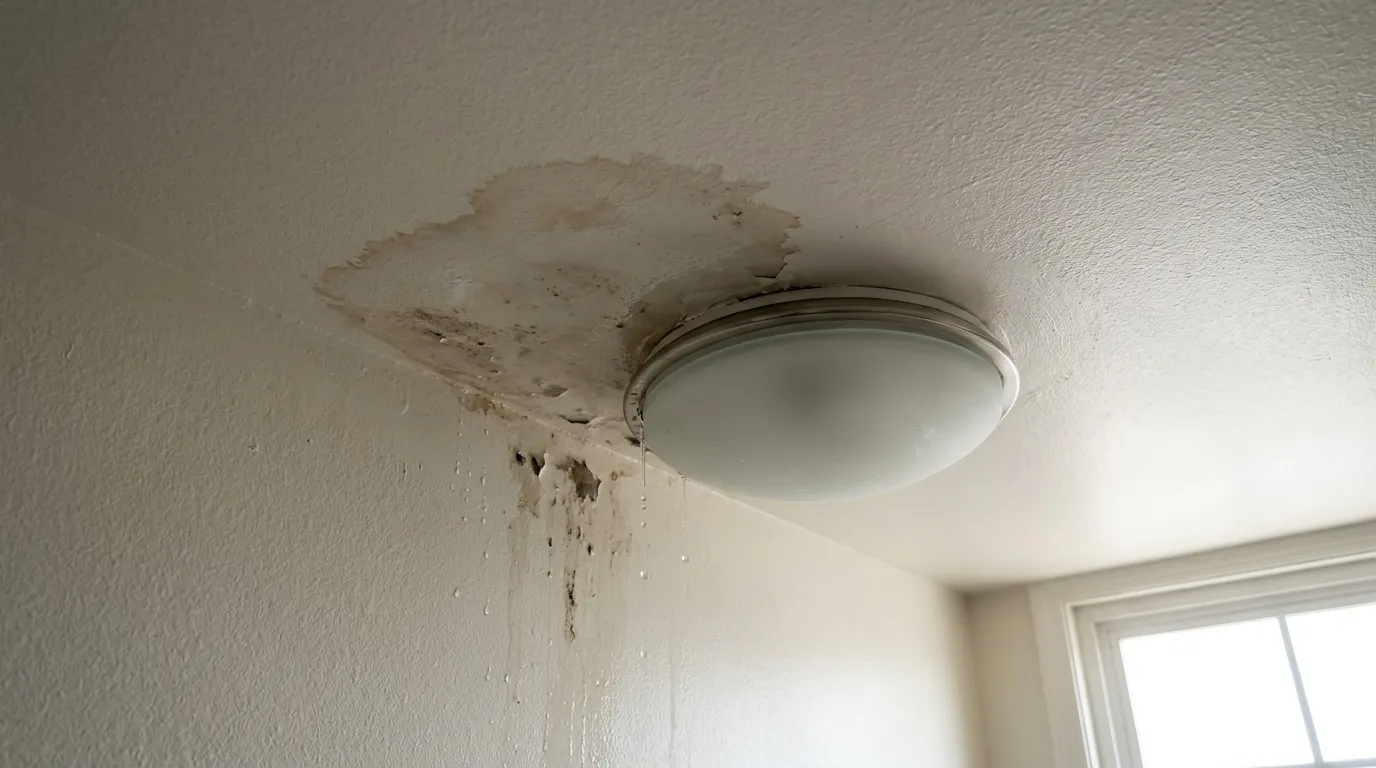
First Actions (To Do Immediately)
- 1 Turn off power to the affected area at the breaker panel if safe to do so.
- 2 Turn off the main water supply if the source is active and safe to reach.
- 3 Document the damage thoroughly with clear photos and videos before any cleanup.
- 4 Move valuable or easily damaged items out of the affected area if safe to do so.
DO NOT DO
- ✕ Do not assume the damage will dry on its own without professional assessment.
- ✕ Do not touch wet electrical fixtures, outlets, or appliances under any circumstances.
How the Water May Be Spreading
ELECTRICAL FIRE HAZARD: WATER INSIDE CEILING JUNCTION BOX
How Water in a Light Fixture Ignites a Fire
Pure water is a poor conductor, but residential water running through drywall, plaster, and joists is full of dissolved minerals and salts, making it highly conductive. When water enters an overhead electrical box:
- Short Circuits & Electrical Arcing: Water bridges the gap between the black (hot) wire nut and the neutral or grounded metal junction box. This causes high-temperature electrical arcing (temperatures exceeding 1,000°F), which instantly ignites dry paper insulation or wooden floor joists.
- Corrosion and Resistance Heating: Even if the breaker does not trip immediately, water corrodes copper conductors and steel terminal screws. High electrical resistance builds up over hours, generating intense smoldering heat inside the ceiling cavity.
- Thermal Shock on Hot Bulbs: Cold water dripping onto incandescent, halogen, or hot LED driver circuits can cause the glass envelope to explode, showering sparks and hot filaments into nearby flooring or furniture.
Why Flipping the Wall Switch Off Is Not Safe
In standard residential wiring ("switch loop" configurations), the continuous 120V line from your electrical panel runs directly into the ceiling junction box first, and only a single switch leg travels down to the wall.
Even with the light switch in the "OFF" position, 120 volts of electricity remains live and energizing the junction box. If water pools inside the box, arcing and electrocution hazards persist until the circuit breaker is physically tripped or switched off at the main electrical panel.
What to Do Immediately
- Cut Power at the Panel: Turn off the main breaker from a dry spot (or that room's breaker if it's clearly labeled). Don't touch the wall switch.
- Place a Bucket Below the Dripping Fixture: Do not attempt to catch water with your hands or touch the light fixture trim.
- Puncture a Relief Hole 4–6 Inches Away from the Fixture: Water naturally pools around ceiling cutouts because the hole is the lowest path of resistance. Relieve drywall water weight by poking a small hole with a screwdriver 6 inches away from the electrical box to divert water away from internal wiring.
- Inspect Upstream Water Sources: Check toilets, tubs, shower drains, or roofing directly overhead.
Water Leaking From a Light Fixture After a Shower
If it only drips while someone upstairs showers or right after, the water is coming from that bathroom: cracked grout or failed caulk at the tub, a leaking shower drain gasket, or the valve behind the handle. To narrow it down, fill the tub with the drain closed and wait, then run the shower against the walls only. Drips during the fill test point to the drain or overflow; drips during the wall test point to grout or caulk. A bathroom light under an attic can also drip from the exhaust fan duct, when warm, wet air condenses in an uninsulated duct and runs back down.
Water Coming Out of a Light Fixture After Heavy Rain
On the top floor, rain water gets in at roof flashing, a vent boot, or damaged shingles, runs along a rafter or wire, and comes out at the light because the fixture hole is the lowest opening in the ceiling. On a lower floor, look at the window or door flashing above it, or the unit upstairs in an apartment. See can a leaky roof cause an electrical fire for the roof side of this.
Condensation or Brown Water in the Light Fixture
Clear drips on a cold day with no rain and no bathroom running above usually mean attic condensation. Warm, humid air leaks into the attic around recessed lights, freezes on the roof nails and sheathing, then melts and drips back down the nearest opening. Brown or rusty water means the water traveled through insulation, drywall, or past rusty nails before reaching the fixture. It isn't a different source, but it usually means a longer path and more wet material above. See condensation or a leak to tell them apart.
Related Guides
Once power is turned off, see our guide on inspecting and replacing water-damaged ceiling lights.
If an upstairs bathroom is the source of the leak, follow our steps for toilet overflows leaking into ceilings.
What You Can Check Safely
- Listen for dripping or running water: Can help identify active leaks behind walls or above ceilings.
- Check the water meter: If all fixtures are off but the meter is spinning, you have an active plumbing leak.
- Inspect adjacent rooms: Water travels horizontally along floor joists and subfloors.
What Professionals Look For
- Thermal imaging (infrared) to detect temperature anomalies indicating hidden moisture.
- Moisture meters to test the exact saturation levels of wood, drywall, and masonry.
- Borescope inspections to look inside wall cavities without removing large sections of drywall.
- Hygrometers to measure the relative humidity of the affected rooms and evaluate the risk of condensation and mold.
Severity Matrix: Critical
Life-safety hazard. Evacuate if necessary. Requires complete professional mitigation and potential reconstruction.
Who to Call
Licensed Plumber or Water Damage Restoration Professional
Insurance & Documentation
- Documentation and claim context only; no coverage conclusion
Frequently Asked Questions
Can water leaking through a light fixture cause an electrical fire?
Yes. Water conducts electricity between live (120V) and neutral conductors inside the ceiling electrical junction box, triggering sustained electrical arcing, intense heat, and ignition of surrounding ceiling insulation, drywall paper, or wood joists.
Is a ceiling light safe if the wall switch is turned off while water is dripping?
No. In many residential electrical ceiling switch loops, an ungrounded 120V continuous hot feed wire remains energized inside the ceiling octagon box at all times, even when the wall switch is toggled OFF. Power must be shut off at the main breaker panel.
What should you do immediately if water is dripping from a ceiling light?
1) Turn off the main breaker from a dry spot, or that room's breaker if it's clearly labeled. 2) Never touch the light fixture or wall switch with wet hands. 3) Evacuate the drop zone beneath the fixture and set buckets to catch runoff. 4) Do not restore power until an electrician and restoration specialist inspect and dry the ceiling cavity.
Is water leaking from a ceiling light an emergency?
Yes. Water in an electrical box can arc and start a fire, and the wet ceiling around it is holding weight. Cut power at the panel from a dry spot, keep people out from under it, put a bucket down, and find the source above.
Is it safe to turn the light back on after a water leak?
Not until the box and fixture are dry and checked. Water leaves corrosion on wire connections and can ruin LED drivers and sockets, which can fail days later. Leave the breaker off and have an electrician check it. See [what to do with a water-damaged ceiling light](/diagnosis/what-to-do-with-water-damaged-ceiling-light/).
Water is dripping from a light fixture in my apartment. Who do I call?
Cut power at your unit's breaker panel, then call the building's emergency maintenance line and follow up in writing with photos. Knock on the unit above, because the leak is usually theirs. Don't wait for a weekday if water is in the fixture.
Get Professional Help Now
Connect with a local water damage expert immediately.