How to Turn Off Water to a Dishwasher: Under-Sink Valve & Main Shutoff
Emergency Answer
Under the kitchen sink, close the dishwasher valve by hand: turn a quarter-turn lever 90° until it crosses the pipe, or turn a multi-turn knob clockwise until it stops. On a dual-outlet angle stop, never force a seized plastic knob with pliers, because the stem can snap under 60 PSI line pressure; shut off the main house valve instead.
- Open the Sink Cabinet: Find the hot supply line under the faucet. The dishwasher line is the 3/8-inch braided hose that runs from it through the cabinet wall toward the dishwasher.
- Identify the Valve Type: A dedicated 1/4-turn ball valve has a single lever on the dishwasher branch. A dual-outlet angle stop is one brass body with two stacked knobs: one feeds the faucet and the other feeds the dishwasher.
- Close It by Hand Only: Turn a ball-valve lever 90° clockwise until it sits perpendicular to the pipe, or turn the dishwasher knob on a dual-outlet stop clockwise until it seats. If a plastic multi-turn stem won't move with firm hand pressure, stop.
- Stem-Shear Fallback: Forcing a seized plastic stem with pliers can snap the shaft and leave 60 PSI of water spraying into the cabinet with no way to close it. Go straight to the whole-house main shutoff instead.
- Confirm It's Off: Start a rinse cycle for about 30 seconds. If no water enters the tub, the supply is closed; cancel the cycle.
Dishwasher Water Shutoff
UNDER-SINK DISHWASHER SHUT-OFF: DUAL-STOP VS. DEDICATED VALVE
Look under the sink for the dishwasher branch line. Close its valve clockwise; use the main shutoff if the dedicated valve is absent or stuck while water is leaking.
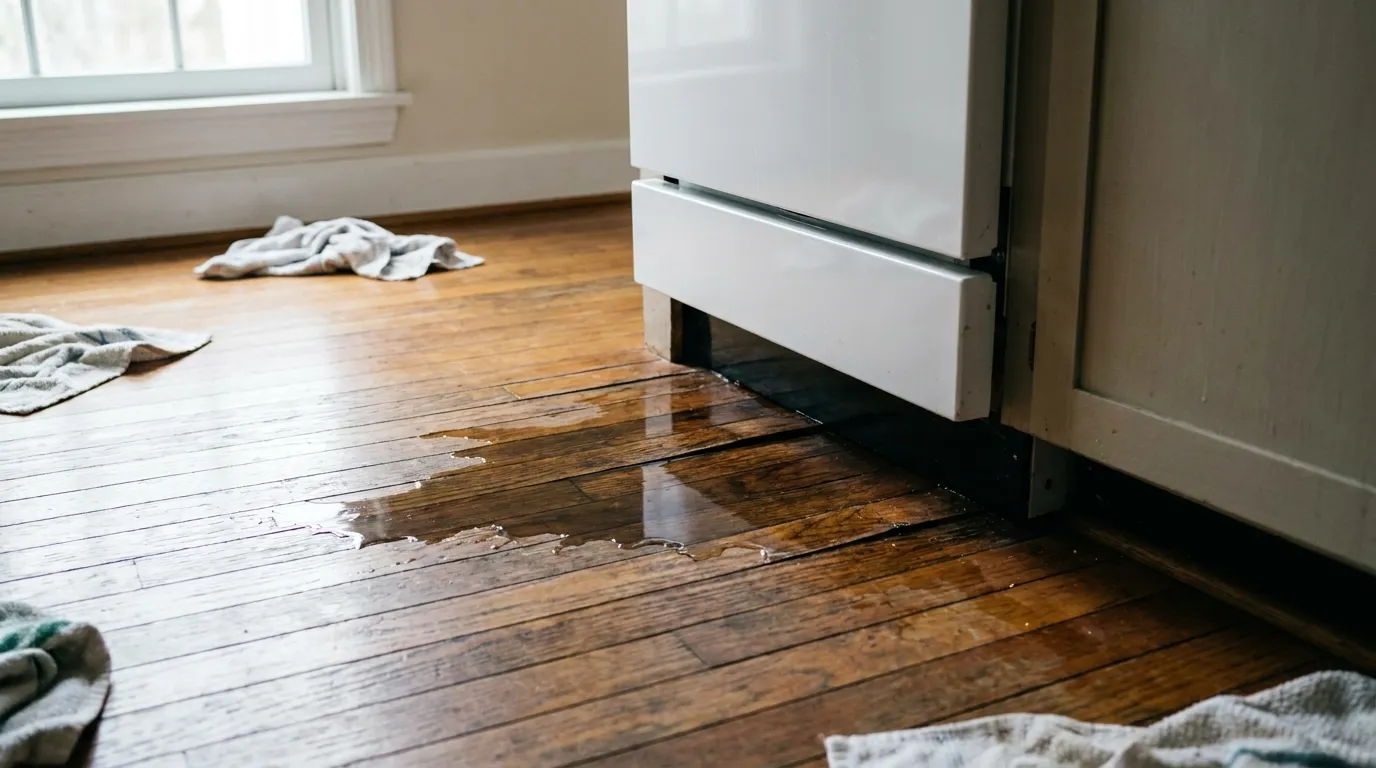
First Actions (To Do Immediately)
- 1 If water is spreading toward outlets or the dishwasher's electrical box, switch off the dishwasher circuit at the breaker panel before reaching under the sink.
- 2 Empty the sink cabinet and use a flashlight to trace the 3/8-inch braided dishwasher line back to its shutoff on the hot supply.
- 3 Close the valve by hand only: lever 90° until it crosses the pipe, or multi-turn knob clockwise until it stops.
- 4 If the knob is seized or there is no valve, shut off the whole-house main water valve and open a low faucet to relieve pressure.
- 5 Towel up standing water, pull the dishwasher toe-kick, and photograph the floor and cabinet base before cleanup.
DO NOT DO
- ✕ Do not use pliers or a wrench on a corroded plastic multi-turn stem; it can shear off and leave the line spraying at full pressure.
- ✕ Do not close the faucet knob on a dual-outlet stop by mistake and assume the dishwasher is off; confirm which outlet feeds the braided dishwasher line.
- ✕ Do not run the dishwasher again until the leak source (inlet valve, supply line, door gasket, or pump seal) is found and fixed.
- ✕ Do not leave wet flooring in front of the dishwasher to air dry; moisture trapped under vinyl or laminate can rot the subfloor.
Where to Look First
The dishwasher shutoff is almost always inside the sink cabinet on the hot-water supply. Follow the 3/8-inch braided stainless line from the dishwasher side of the cabinet back to where it connects to the hot riser. That connection is either a dedicated quarter-turn ball valve, a dual-outlet angle stop shared with the faucet, or occasionally no valve at all, in which case the dishwasher can only be shut off at the main water valve or a branch valve in the basement ceiling below the kitchen.
Dual-Outlet Angle Stop vs. Dedicated Valve: The Stem-Shear Trap
Many kitchens feed the faucet and the dishwasher from a single dual-outlet angle stop: one brass body with two stacked oval knobs. Those knobs usually turn plastic multi-turn stems that seize after years untouched. When a stuck knob is forced with pliers, the plastic shaft can snap inside the valve, and with around 60 PSI of household line pressure behind it, the valve can no longer be closed and the cabinet floods faster than the original leak. A dedicated quarter-turn ball valve is far less likely to seize and closes with a single 90° turn. If any knob will not turn by hand, close the whole-house main shutoff and have a plumber replace the stop with a quarter-turn valve.
No Valve Under the Sink? Three Other Ways to Shut It Off
1) A single valve under the sink that feeds both the faucet and the dishwasher: closing it shuts off both, which is fine for an emergency. 2) A branch valve in the basement or crawlspace ceiling below the kitchen, on the hot line heading up toward the sink. 3) The cold-water inlet valve on top of the water heater. Most dishwashers run on the hot line, so closing it stops water from flowing to the dishwasher without shutting off the whole house. Open a hot tap to let the pressure drop. If none of these work, close the main water shutoff. A valve that won't turn: see how to loosen a stuck shutoff valve.
When to Stop and Call a Professional
Call a plumber if the dishwasher valve won't close by hand, drips from the stem after closing, or there's no valve at all; a quarter-turn dishwasher valve is a small job. Call an appliance tech if the leak comes from inside the dishwasher (door gasket, pump, or inlet valve). Call a restoration company if water ran under the flooring or into the cabinet base and the floor feels soft.
What to Check After the Immediate Action
Once the valve is closed, confirm the water meter's leak indicator has stopped spinning, then pull the dishwasher toe-kick and look underneath with a flashlight. Dishwasher leaks usually run under the appliance and spread beneath vinyl, laminate, or hardwood before they show at the front edge, so check for soft or cupped spots and take moisture readings across the kitchen floor. Photograph everything before cleanup. To decide whether the floor can be dried in place or has to come up, run the flooring type, subfloor material, and hours wet through our Subfloor & Flooring Salvage vs. Tear-Out Calculator.
Severity Matrix: High
Requires immediate professional intervention. High risk of structural weakening, electrical hazards, and mold.
Who to Call
Licensed Plumber or Water Damage Restoration Professional
Insurance & Documentation
- Mitigation/documentation support only; no coverage conclusion
Frequently Asked Questions
Where is the shut-off valve to turn off water to a dishwasher?
The dedicated shutoff valve is located inside the cabinet under the kitchen sink along the hot water supply line. It is either a 90-degree quarter-turn ball valve lever or a multi-turn oval knob on a dual-outlet brass valve feeding both the sink faucet and dishwasher.
How do you turn off water to a dishwasher if there is no valve under the sink?
If there is no dedicated under-sink shutoff, locate the 1/2-inch copper branch valve in the basement or crawlspace ceiling directly beneath the kitchen. If unlocatable, shut off the main water valve where the municipal service line enters the home.
Which way do you turn a dishwasher shut-off valve to stop the water?
For quarter-turn lever valves, turn the handle perpendicular to the pipe. For multi-turn oval knobs, turn clockwise ('righty-tighty') until the valve seats firmly. Do not use pliers on plastic handles to prevent shearing.
How do I turn off water to the dishwasher only?
Look for the valve on the braided line that runs to the dishwasher. On a dual-outlet valve, close only the knob that feeds that line. If there's one valve that feeds both the faucet and the dishwasher, it can't do one without the other; a plumber can swap it for a dual-outlet valve.
Which position is off on a dishwasher shutoff valve?
On a lever valve, the handle across the pipe is off and the handle in line with the pipe is on. On a round or oval knob, all the way clockwise is off. To confirm, start a short cycle: if you don't hear it fill within a couple of minutes, the water is off.
What happens if you turn the water off while the dishwasher is running?
It can't fill, so it usually stops with a fill error or runs a cycle with no water. Cancel the cycle first, then close the valve. After the water is back on, run a short cycle to clear the error.
Get Professional Help Now
Connect with a local water damage expert immediately.