Water Leaking From Upstairs Neighbor? What to Do and Who Pays
Emergency Answer
Stop the water and cut power to anything wet first. Then file with your own insurance: unless the upstairs owner was negligent, their insurer usually won't pay, and your insurer can go after them later if they were.
- Stop the Water: Knock upstairs. The shutoff is the valve behind their toilet, under the sink, at the washer or water heater, or the valve for the whole unit. No answer: call building maintenance or the association's emergency line.
- Turn Off Power: If water is coming through a ceiling light or near outlets, shut off that breaker from a dry spot. Don't touch the fixture.
- Protect Your Things: Move furniture and electronics out from under the leak. Put down buckets and towels.
- Record It: Photos and video of the ceiling, the water, and what's damaged, plus the time. Write down what the neighbor says caused it.
- Report It: Tell the association or landlord in writing, and call your own insurer the same day.
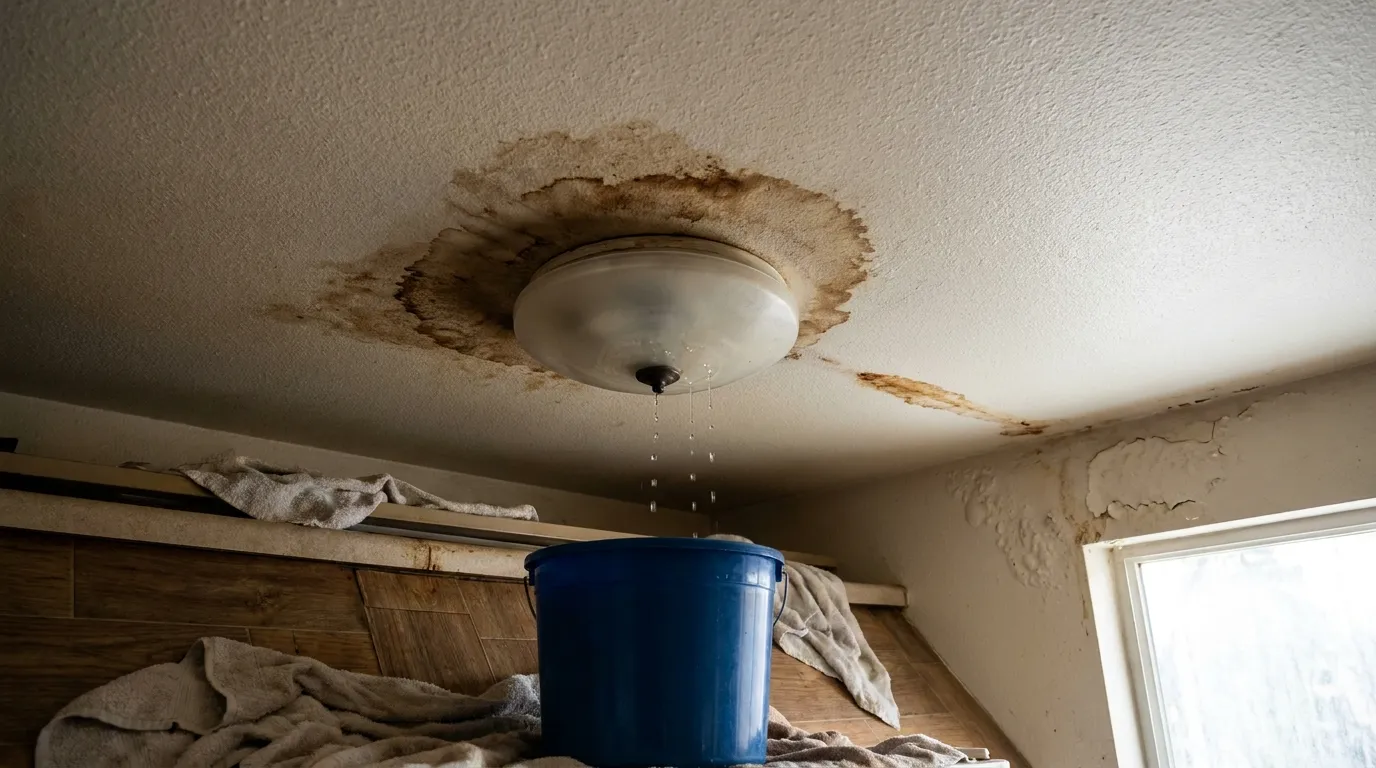
First Actions (To Do Immediately)
- 1 Go upstairs and get the water shut off: the valve behind their toilet, under the sink, at the washer or water heater, or the valve for the whole unit.
- 2 If nobody answers, call building maintenance or the association's emergency line. If water is coming fast or through a light, call the fire department; they can get in and stop it.
- 3 Turn off the breaker for any wet ceiling light, fan or outlet, from a dry spot.
- 4 Move furniture, electronics and papers away from the leak, and catch the water with buckets and towels.
- 5 Take photos and video of the ceiling, walls, floor and damaged belongings before cleanup, with dates.
- 6 Ask the upstairs owner (or the landlord, if they rent) for their insurance company and policy number, and get the plumber's written finding on what leaked.
- 7 Report it in writing to the association or your landlord, and call your own insurer the same day.
DO NOT DO
- ✕ Do not touch a ceiling light or fan with water in it, or stand under a sagging ceiling.
- ✕ Do not wait for the neighbor's insurer to decide before you start drying. Wet drywall and insulation should be dried within 24 to 48 hours.
- ✕ Do not let anyone paint over a water-stained ceiling that hasn't been opened and dried.
- ✕ Do not close up the ceiling or walls until the leak upstairs is fixed and the framing reads dry.
- ✕ Do not accept a small cash offer or sign a release before you have a repair estimate.
- ✕ Do not assume your neighbor's insurer has to pay because the water came from their unit.
Who Pays for Water Damage From the Unit Above
The First 15 Minutes
- Get the water stopped upstairs. Most leaks come from one fixture: a tub, toilet, sink, washer, water heater or AC drain line. The valve behind the toilet or under the sink stops it, and most units also have a valve for the whole unit. If the neighbor isn't home, call building maintenance or the association's emergency line. One poster's neighbor wouldn't let a plumber in while he was at work; a board member in that thread said to call the fire department next time. In a New York thread, the tenant below a repeat leaker called the fire department each time because the super wouldn't go in.
- Turn off power to anything wet. In several threads, water came through a ceiling light, fan or switch; one light filled with water and stopped working, another fell out of the ceiling. Shut off that breaker from a dry spot. See whether water dripping from a light can cause a fire.
- Catch the water and move your things. Buckets, towels, furniture out of the way. If the ceiling is bulging with water, see whether to pop a water bubble in the ceiling.
- Record everything before cleanup. Photos and video of the ceiling, walls, floor and belongings, with the time. Screenshot any text where the neighbor says what happened.
- Report it in writing the same day, to the association or property manager (or your landlord if you rent), and to your own insurer. Waiting can cost you coverage: insurers exclude damage from leaks left to continue.
Who Pays: Three Separate Questions
"Who pays" is really three questions, and they usually have different answers.
- The leak itself: whoever owns what broke. A tub, toilet, faucet, appliance or pipe that serves only the upstairs unit is usually that owner's to repair. A pipe that serves more than one unit, like a shared drain stack, is usually the association's.
- Your damage: your own insurance, in most cases, minus your deductible. A condo owner's policy (HO-6) covers your unit's interior and belongings; a renter's policy (HO-4) covers your belongings. The upstairs owner owes you only if they were negligent, or if your condo documents say they owe it regardless. Even then, their insurer can refuse; in one thread the bylaws made the upstairs owner responsible for an unseated wax ring, and their insurer still said no because the owner didn't know. Then you collect from the owner directly.
- The ceiling, framing and shared pipes: often the association's, depending on your declaration and state law. Many association policies have a large deductible ($10,000 and $25,000 came up in the threads), and some declarations pass it to the owner where the leak started.
- What people reported: in the threads we read, the downstairs owner's own insurance paid for most repairs; the upstairs neighbor's insurer paid directly only when there was written proof of negligence. Associations covered drywall or drying in a few cases and refused in others.
"Not Negligent": Why Their Insurer Says No
This surprised almost every poster. The upstairs owner's homeowners policy pays you through its liability coverage, and liability coverage only pays when the owner is legally at fault. A part failing without warning isn't anyone's fault. Of the cases we read where the downstairs owner went to the neighbor's insurer, 7 were turned down, most with the words "not negligent." State Farm denied one shower-plumbing leak this way; another insurer denied a clogged AC drain line despite video of the water coming down.
- Usually not negligent: a washer hose or pipe that bursts, a water heater that fails, a fridge line that pops off, a slow leak no one could see. One commenter's insurer told him that in California "gravity is not my fault."
- Usually negligent: ignoring a leak after being told about it; a DIY repair done wrong (one wax ring "not seated properly," one bidet attached and removed by a short-term guest); leaving a tub running; a fixture that was visibly corroded and leaking.
- What won those cases: proof. One owner got the neighbor's insurer to reverse its denial by pointing to the plumber's photos of a corroded sink pipe and a leaking faucet. Another got about $20,000 after the upstairs unit's management company admitted fault in writing. A text saying "I think it was the water line" was not enough in another case.
- Repeat leaks change things. If the same fixture leaked before and wasn't fixed, that's the strongest negligence argument there is. Several posters were on their second or third leak from the same unit. Tell the upstairs owner about every leak in writing, so a repeat can't be called a surprise.
Who Fixes What Inside a Condo
Your declaration and bylaws decide this. Look for the definition of your unit's boundaries and a maintenance or insurance section. The common setup:
- Yours ("walls in"): paint, flooring, cabinets, countertops, fixtures, appliances and belongings.
- Often the association's: drywall, ceilings, subfloor, framing, and pipes inside walls and floors, especially pipes that serve more than one unit. Some documents make every pipe that serves only one unit that unit's responsibility, even inside the ceiling.
- Florida as an example: the common elements include pipes and installations that serve more than one unit (Fla. Stat. § 718.108), and the association's insurance must exclude floor, wall and ceiling coverings, appliances, water heaters, cabinets and countertops, which are the owner's to insure (Fla. Stat. § 718.111(11)(f)). Other states differ, and documents written after those rules can differ too.
- Get the source in writing. Ask the plumber to write down exactly what leaked and where. That one line decides whether the upstairs owner, the association or nobody is responsible.
File With Your Own Insurer or Theirs?
Most commenters with insurance experience gave the same advice: file with your own insurer and give it the neighbor's insurance details. Your insurer has a contract with you; the neighbor's insurer doesn't.
- Subrogation: after paying you, your insurer can try to collect from the upstairs owner or their insurer if they were at fault. If it succeeds, you get some or all of your deductible back. Among posters who said how it ended, 4 got some or all of their deductible back (one after about 6 months) and 5 didn't, often because the insurer decided the amount wasn't worth chasing or the neighbor never answered.
- Check your coverage limits. One poster's policy paid only $20,000 for damage caused by someone else; his repairs ran about $50,000 more. Look at your dwelling (Coverage A) and loss-of-use limits now.
- Waiver of subrogation: some condo declarations say owners' insurers can't go after other owners. One poster's insurer recovered on the first leak and then refused on the second, citing that clause. If yours has one, getting money from the neighbor means suing them yourself.
- Going straight to the neighbor's insurer can work when the owner admits fault in writing and the cause is clearly negligence. It saves your deductible and keeps a claim off your record. Otherwise you'll likely get a denial and lose weeks.
- Your own insurer can deny a slow leak too. Homeowners policies cover sudden water damage and exclude leakage that went on for weeks, even when it came from a neighbor and you couldn't see it. One couple came home from vacation to a leak from the bathtub upstairs; their adjuster called it an ongoing issue and denied about $20,000 in repairs. Report the leak the day you see it, and describe a sudden failure as what it was (a hose burst, a line came off) rather than just "a leak," which adjusters can read as ongoing. If you're denied, ask for the reason in writing.
- A claim on your record: several posters worried about higher premiums. Claims go into an industry database (the CLUE report) that insurers check, and a not-at-fault water claim can still count at renewal. Commenters warned that some insurers log even a call asking about coverage. For small damage, some paid the repair themselves and asked the neighbor to cover it.
If You Rent
- The landlord repairs the ceiling, walls and floors and dries the building. That's their property.
- Your renter's insurance covers your belongings and, if the place is unlivable, the cost of staying elsewhere (loss of use). Keep hotel and meal receipts. Without renter's insurance, posters who lost belongings had no one to claim against unless the neighbor was negligent.
- Rent: if part of the unit can't be used during repairs, ask in writing for a rent reduction. Don't simply stop paying: withholding rent without following your city's or state's notice rules can get you evicted. A local tenant resource center can tell you the rules where you live.
- If the landlord stalls, put every request in writing and call your city's building or code enforcement office. In one thread, the city inspector declared a tenant's unit unlivable after the ceiling collapsed, which forced the owner to pull permits and fix it.
If the Neighbor Won't Answer or Won't Pay
- Write it down. Send a dated letter or email (certified mail if they've ignored you) saying what leaked, what it damaged, and what you're asking for, and copy the association.
- "No insurance" may not be the whole story. Commenters pointed out that a mortgage lender requires homeowners insurance, and the county recorder shows whether there's a mortgage. A lender's force-placed policy may not include liability coverage, though, and some condo buyers aren't required to carry any.
- If the unit above is an Airbnb, ask the owner whether the stay was booked through Airbnb. Airbnb's host liability insurance (up to $1 million) can pay for damage to a neighbor's property when the host is legally responsible.
- Small amounts: small claims court is the usual route for a deductible. Limits vary by state; in British Columbia, the Civil Resolution Tribunal handles claims up to $5,000.
- Large amounts: talk to an attorney who handles condo or insurance cases, and ask the other damaged units to join you. One poster with about $50,000 in uncovered damage was turned down by several real estate lawyers; commenters suggested a plaintiff-side insurance attorney instead.
- Winning isn't the same as collecting. A court judgment can usually be recorded as a lien on the neighbor's unit and paid when they sell or refinance. Homestead protections in some states, including California, limit how much you can collect from someone's primary residence.
- A denied claim on your own policy: ask for the reason in writing, and if it doesn't match your policy, file a complaint with your state insurance department or hire a public adjuster.
Drying and Repairs: Don't Let It Get Painted Over
Water that came through a ceiling has soaked the drywall, the insulation above it, and often the framing. The EPA says to dry water-damaged materials within 24 to 48 hours to prevent mold.
- Expect the wet drywall to be cut out. In one thread, a renter asked whether the landlord really needed to remove a bathroom wall over some peeling paint. Every reply said yes. If the stain spreads or the paint bubbles, see what a water stain on the ceiling means.
- Check the moisture before it's closed up. Ask for moisture readings on the framing, or buy a cheap meter. One commenter's rule: the wood should read below about 15% before new drywall goes up.
- Wait for the leak to be fixed. Several posters had new ceilings soaked again because the repair upstairs wasn't done.
- Check the work before you sign off. Test every switch, outlet and the thermostat after the ceiling is cut open: in one condo, the drying crew cut the thermostat wire, the heat went off in a cold snap, and pipes froze and flooded the unit a second time. Ask for the whole ceiling to be retextured and painted so the patch doesn't show.
- Costs people reported: $2,500 for one bathroom ceiling; $5,000 to $6,000 for a kitchen ceiling under a leaking fridge line; $7,000 below a burst sink pipe; $20,000 and more for leaks that ran for weeks or reached several rooms. One commenter's overflowing bathtub cost about $5,000; another poster's estimate was about $100,000 from a restoration company. Get your own estimate, not only the association's or the neighbor's contractor's.
- Mold: if it's already growing, see whether insurance covers mold after a water leak. Leaks that ran for weeks are where insurers most often refuse.
What to Keep
- Photos and video from the first hour, plus after each stage of repair.
- The plumber's written finding on what leaked, and any earlier leaks from the same unit.
- Every message with the neighbor, the association and your landlord, with dates.
- The neighbor's insurer and policy number, and your claim number.
- Receipts: drying, repairs, hotel, meals, replaced belongings, your own time if you did work yourself.
If It Was a Toilet or a Supply Line
- Toilet overflow: whether the water was clean or sewage changes what has to come out. See what to do after a toilet overflows and whether insurance covers a toilet overflow through the ceiling.
- A burst supply line or pipe: see what to do when a toilet supply line bursts and whether homeowners insurance covers burst pipes.
Sources
- Florida Statutes § 718.108 (common elements) and § 718.111(11) (association insurance).
- U.S. EPA, A Brief Guide to Mold, Moisture, and Your Home: dry water-damaged areas within 24 to 48 hours.
- 37 Reddit threads on water leaking from an upstairs unit (r/Insurance, r/HOA, r/homeowners, r/legaladvice, r/Apartmentliving and others), read and counted by Emergency Damage Pros in November 2026. Counts are of cases where the poster said what happened; they show what happens in practice, not legal outcomes.
- Two videos by a Florida licensed public adjuster on condo water damage and who pays for what.
Severity Matrix: Critical
Life-safety hazard. Evacuate if necessary. Requires complete professional mitigation and potential reconstruction.
Who to Call
Licensed Plumber or Water Damage Restoration Professional
Insurance & Documentation
- Mitigation/documentation support only; no coverage conclusion
Frequently Asked Questions
Is my upstairs neighbor responsible for water damage to my unit?
Only if they were negligent, or your condo documents make them responsible regardless. Ignoring a known leak, a bad DIY repair or leaving a tub running is negligence. A pipe, hose or water heater failing without warning usually isn't, and then each owner's own insurance pays for their own unit.
Should I file with my insurance or my neighbor's?
Usually your own. Give your insurer the neighbor's insurance details; if the neighbor was at fault, your insurer can recover from them and return your deductible. Going straight to the neighbor's insurer works mainly when the owner admits fault in writing and the cause is clearly negligence.
Why did my neighbor's insurance deny my claim?
Their policy pays you only through liability coverage, which applies when the owner is legally at fault. If the insurer decides a part simply failed, it will say the owner wasn't negligent and deny. Proof of negligence, such as an earlier unfixed leak or a plumber's photos of corroded parts, can change that.
Do I have to pay my deductible if it wasn't my fault?
Yes, when you claim on your own policy. Fault doesn't change the deductible. If your insurer recovers from the person at fault, it refunds some or all of it, but that can take months and doesn't always happen.
Does the HOA pay for water damage from the unit above?
Sometimes, for what the association is responsible for: often drywall, ceilings, subfloor and pipes serving more than one unit. Your declaration decides. The association's policy often has a deductible of $10,000 or more, and some declarations pass it to the owner where the leak started.
What if the upstairs neighbor won't let anyone in to fix the leak?
Call the association or property manager; many condo declarations give the association access for emergency repairs. If water is actively coming through, call the fire department. Put every request in writing, since refusing access while the water keeps coming makes a negligence case stronger.
My upstairs neighbor has no insurance. What now?
Claim on your own policy first. If the neighbor was negligent, you or your insurer can still sue them; owners are liable whether or not they're insured. Check the county recorder for a mortgage, since lenders require insurance, and send a written demand before small claims court.
I rent. Who pays for my damaged belongings?
Your renter's insurance, if you have it. The landlord repairs the building but usually not your belongings. Without renter's insurance, you'd have to show the upstairs neighbor was negligent and collect from them.
Get Professional Help Now
Connect with a local water damage expert immediately.