Toilet Overflowed? What to Do Now, and What to Throw Out
Emergency Answer
Stop the water and don't flush again; wash and disinfect hard floors; then check carpet pad, plank-floor edges, baseboards and the ceiling below, because that's where overflow water does lasting damage.
- Stop the Water: Close the valve behind the toilet, clockwise. If it won't turn, lift the tank lid and press the flapper down, or lift the float. Don't flush again.
- Check Below: If water is coming through a ceiling light, turn that breaker off from a dry spot. If it's running into a floor register, dam it with towels.
- Photograph, Then Glove Up: Photos of the floor, the bowl and any ceiling below before you mop. Gloves on; keep children and pets out.
- Get It Up, Wash, Then Disinfect: Towels and a wet-dry vacuum first, then detergent, then disinfectant, on hard surfaces only.
- Check What It Soaked: Carpet pad, the edges of plank flooring, baseboards, and the room below. Those decide whether this is a mop job or a tear-out.
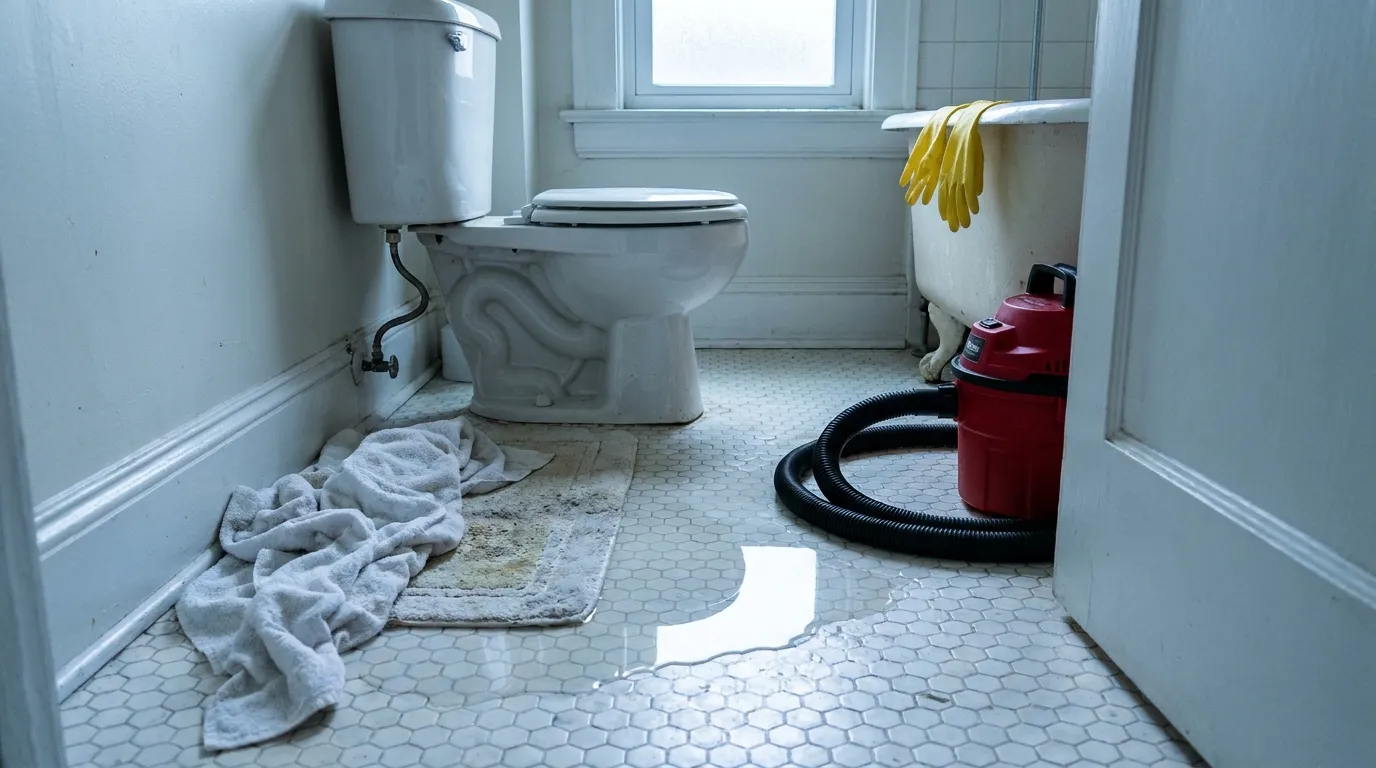
First Actions (To Do Immediately)
- 1 Close the valve behind the toilet clockwise. If it won't turn, lift the tank lid and press the flapper down or lift the float.
- 2 If water is coming through a ceiling light or reaching outlets below, turn off that circuit (or the main) at the breaker from a dry spot.
- 3 Photograph the floor, the bowl and any ceiling below before you clean.
- 4 Put on gloves, keep children and pets out, and get the water up with towels and a wet-dry vacuum.
DO NOT DO
- ✕ Do not flush again to see if it clears. Pour a bucket of water into the bowl instead, so you control how much goes in.
- ✕ Do not run fans over water with feces in it before it's cleaned up and disinfected. The EPA says not to use fans until you know the water is clean or sanitary.
- ✕ Do not mix bleach with vinegar, ammonia or any other cleaner. The fumes can be dangerous.
- ✕ Do not flood the floor with bleach water or disinfectant. It pushes contaminated water further under the flooring and into the baseboards.
- ✕ Do not use bleach on carpet or wood floors.
- ✕ Do not sand a cupped wood floor until it has dried out.
- ✕ Do not scrape, sand or grind old floor tiles or black adhesive you find under carpet until they've been tested for asbestos.
Where Overflow Water Goes, and What Has to Come Out
The First 15 Minutes
- Stop the water. Close the valve on the wall or floor behind the toilet: an oval handle clockwise until it stops, a lever a quarter turn. If it won't turn, lift the tank lid and press the rubber flapper down so it stays closed, or lift the float so the tank stops filling. Don't pull the flapper chain; that opens the flapper and sends the whole tank into the bowl. See how to stop a toilet from overflowing and fixing or replacing a stuck toilet valve.
- Don't flush again. Each flush puts another tankful in the bowl. To test whether the clog is gone, pour a bucket of water into the bowl instead.
- Check the room below. If water is coming through a ceiling light, turn that circuit off at the breaker, from a dry spot. If water is running into a floor register, put towels around it to slow it down and turn the heating or cooling off. See toilet water in a floor vent.
- Photograph it. The floor, the bowl, the base of the toilet, and any ceiling or wall below, before you mop. An insurer can't see it after it's cleaned up.
- Glove up and keep people out. Rubber gloves, and eye protection if you're scrubbing or spraying. Keep children and pets out until the floor is clean.
- Get the water up. Towels, then a wet-dry vacuum. Bag towels that soaked up bowl water, or wash them hot, separately.
- Wash, then disinfect. Mop hard floors with detergent and water first; disinfectant doesn't work well on a dirty surface. Then disinfect (see below). Don't flood the floor while you do it.
- Fix the cause before anyone uses the toilet again. Clear the clog, and if the tank kept running, find out why. See why a fill valve gets stuck.
How Much Water Was It?
A clogged toilet can only put out what its tank holds, plus a little more. That's why most overflows are smaller than they look, and a few are much bigger.
- One flush on a toilet made since 1994: about 1.6 gallons. That's the federal maximum per flush. While the tank refills, a small tube keeps pouring water into the bowl, so a little more comes over the rim after the tank is empty.
- One flush on an older toilet: more. The EPA says older toilets can use as much as 6 gallons per flush.
- Each extra flush adds another tankful. Kids and guests who keep flushing to make the water go down are a common cause.
- A toilet that keeps running has no limit. A sticking handle or a fill valve that won't shut off keeps refilling the tank and draining it into the bowl until someone closes the valve. These are the overflows that run for hours.
- What the cases show: we read about 25 overflows on Reddit where the cause was clear. About 15 were a clog plus one or more extra flushes, about 6 were a clog plus a toilet that kept running, and 4 were sewage pushed up from the main line. The ones that ran for hours did the most damage, into walls and onto other floors. But water doesn't need hours to get below: in one case a 5-minute overflow reached the basement.
Clean Water, Urine or Sewage: What the Standard Says
The restoration industry's standard, IICRC S500, sorts water into three categories by how contaminated it is. For a toilet, it comes down to what was in the bowl and where the water came from.
- Category 1 (clean): water from the tank, or a bowl with nothing in it. Same as tap water when it leaves the toilet.
- Category 2: an overflow from the bowl with some urine but no feces, on the room side of the trap.
- Category 3: sewage, and any backflow that comes from beyond the toilet's trap (the drain or the sewer line), no matter how clean it looks. Restoration companies treat bowl water with feces in it as Category 3 too.
- Water gets worse with time. The standard says clean water can become Category 2 or 3 after it touches floors and building materials, and with time and warmth. A sour or musty smell is one sign it has.
- What that means in your house: hard surfaces such as tile, sheet vinyl, porcelain and sealed concrete can be washed and disinfected, whatever the category. Absorbent materials are the problem: carpet pad, drywall that wicked water up, particleboard vanities, and anything under plank flooring.
- A small spill is a household cleanup. A few cups to a gallon or two of bowl water on tile or sheet vinyl, mopped up within minutes, doesn't call for a restoration crew. Wash, disinfect, dry, and check the edges where floor meets wall and toilet. In the 4 cases we read where the water stayed on a bathroom's tile or vinyl floor, that was all it took.
- But tile isn't waterproof. Grout, the gap around the toilet's base and the edge at the tub let standing water through to the subfloor. If water sat on the floor for more than a few minutes, or there was a lot of it, check underneath and below.
Disinfecting Without Making It Worse
- Clean first. The CDC says to clean visibly dirty surfaces with soap or detergent before disinfecting.
- Bleach: follow the label. If the bottle has no directions, the CDC's mix is 5 tablespoons (1/3 cup) of regular unscented household bleach per gallon of room-temperature water. Keep the surface visibly wet for at least 1 minute, or as long as the label says. Mix it fresh each day.
- Never mix bleach with anything but water: not vinegar, not ammonia, not another cleaner. The CDC warns the fumes can be very dangerous. Open a window.
- Hard surfaces only. Bleach discolors carpet and doesn't reach the pad underneath.
- Don't flood it. Pouring bleach water over the floor so it "gets everywhere the toilet water went" drives the water further under the flooring and into the walls. In one case we read, the owner did exactly that on plank flooring and the bathroom still smelled of sewage three weeks later.
- Bath mats, towels and a fabric hamper: wash them hot, separately, or throw them out.
- Skip the ozone generator in a house people live in. The EPA says no federal agency has approved them for use in occupied spaces.
Where the Water Went That You Can't See
Of the overflows we read, 17 reached the room below. Water from a bathroom floor follows pipes, joists and wiring and comes out wherever there's an opening, not always straight below the toilet.
- Through a ceiling light: 3 cases. One poster's kitchen light ran "like a waterfall" into the sink; another's chandelier filled with water. Turn that circuit off at the breaker before touching anything.
- Out of a heating or cooling register, or down the duct: 3 cases. In one, the duct filled and collapsed onto a water line below. See toilet water in a floor vent.
- Along pipes into a basement or crawl space: 2 cases, one onto the crawl space's plastic sheeting and insulation.
- Down an exterior wall: 1 case. A toilet ran for about 4 hours; water came out of the kitchen window flashing a floor below, in the wall that runs down from the bathroom. Insulation in a wet exterior wall can't dry on its own; the EPA says wet fiberglass insulation should be thrown out and replaced.
- Ceilings, walls and cabinets below: 8 cases, from a few drop-ceiling tiles to a kitchen ceiling destroyed by repeated overflows.
- Baseboards and the bottom of the wall. Water wicks into baseboards and up the back of drywall even when the floor looks dry. One poster wiped up a spill in 15 minutes; the water had already wicked into the wall behind the baseboard, and it had to be opened to dry. See wet drywall after a small leak.
- Under the toilet itself. If the base isn't caulked, water runs underneath the porcelain and sits there.
- How to know: a $20 to $50 moisture meter, or a free inspection, which many restoration companies offer. In one case a company used an infrared camera and a moisture meter, found the framing dry, sprayed disinfectant and left without charging.
Carpet: It's the Pad
Carpet face dries fast. The foam pad under it holds water for days, and it spreads further than the wet spot you can see.
- What the cases show: of 7 toilet overflows onto carpet we read, 3 posters left the pad in place and came back with a smell, one within 2 days. The one who pulled the pad said the area "dried very quickly." That poster found the pad still wet 1 to 2 feet beyond the edge of the visibly wet carpet.
- Lift a corner and look. Pull the carpet back from the tack strip at the nearest wall and feel the pad.
- Bowl water in the pad: cut that pad out and replace it. Pad is cheap; it's the part that holds the smell.
- The carpet itself: with urine-only water, a small area of carpet or a rug may be cleaned and sanitized. With feces or sewage, restoration companies remove it.
- A smell after 2 days or more means it's still wet underneath. A restoration owner with 30 years in the trade put it simply: lift a corner and blow a fan under the carpet, across the pad and subfloor.
- The EPA's timeline for carpet wet with clean water is to dry it within 24 to 48 hours with an extraction vacuum, a dehumidifier and fans. Toilet water only makes that more urgent.
- Old floor under old carpet: if you pull up carpet in an older house and find 9-inch square tiles or black adhesive, stop. The EPA lists vinyl floor tiles, the backing of sheet vinyl and their adhesives as places asbestos may be found. Don't sand or scrape them; have them tested, or cover them instead of removing them. In one case we read, six commenters warned the poster before he went further.
Vinyl Plank and Laminate: Waterproof on Top Only
- "Waterproof" plank flooring resists water on its surface. Overflow water runs to the edges, around the toilet and along the walls, and goes under the planks, where you can't clean or dry it from above.
- The case that shows it: a child's diarrhea clog, two flushes, half a gallon to a gallon over "waterproof" vinyl plank on painted concrete. The owner toweled it up and mopped with bleach water. Three weeks later the bathroom smelled of sewage. The consensus in the replies was that the water was under the planks and in the baseboards. As one commenter put it: "There is no way to get any kind of disinfectant UNDER the flooring."
- The fix is lifting the floor: take off the baseboards or quarter-round, lift the planks near the toilet and along the walls, clean and disinfect the concrete or subfloor, let it dry completely, then put it back. Commenters suggested an enzyme cleaner on bare concrete for any smell that's left.
- Sometimes the floor is fine and the wall isn't. In two other cases, about 2 gallons that sat on laminate for an hour didn't warp it, and a spill wiped up in 15 minutes left a plank floor fine. In both, the baseboards or the wall behind them took the water.
- Laminate has a fiberboard core. Where water got into the seams and it swelled, those boards won't go back down.
Wood Floors: Wait Before You Decide
- Cupping can show up weeks later. In the main thread we read, a roommate's overflow was toweled up, and the oak floor started cupping about 3 weeks later as water trapped underneath worked into the boards.
- Clean water often dries out. About 10 commenters said their cupped wood floors flattened again after drying, over weeks to a year. All of those were clean-water leaks: a dishwasher, a washer hose, a fish tank, rain.
- Toilet water usually means replacement. The toilet-overflow wood floors commenters described were replaced, two of them under insurance, and a restoration commenter put the line at what was in the water: "Clogged with solids? Tear out. Clear water within 72 hours with access to the subfloor from below? I like my chances."
- Don't sand it flat while it's cupped. One poster's floor was sanded while still cupped; nine months later "the concave went convex," and it had to be replaced. Dry it first, with dehumidifiers and fans, and let a moisture meter tell you when it's done. See hardwood floor cupping after a water leak.
If It Came Up From the Drain
Sometimes the toilet isn't the problem. When the main sewer line is blocked, water from the rest of the house comes up through the lowest drain, often a basement toilet or shower.
- Signs it's the main line: this toilet rises when another toilet is flushed or a shower or washer drains; a tub or shower on the lowest floor backs up too; several drains are slow at once. In 4 of the overflows we read, the water came from the main line.
- Stop using water in the house until it's cleared. Plunging the toilet won't fix a blocked main.
- It's Category 3 under the restoration standard, whatever it looks like: backflow from beyond the toilet's trap. Absorbent materials it soaked come out.
- Insurance treats it differently from a toilet overflow: sewer backup is usually covered only with a separate endorsement. See does home insurance cover sewer backups and what to do when a floor drain backs up.
Restoration Company or Do It Yourself?
What people reported paying after toilet overflows, from Reddit posts we read (prices vary by region and year):
- $0: a child's overflow into an unfinished basement. Free inspection found everything dry; the company sprayed disinfectant, said to run fans, and didn't charge.
- A few drop-ceiling tiles: an overflow into the room below.
- About $600: a restoration quote for a condo ceiling under an upstairs neighbor's overflow.
- About $3,000 to $3,500: two condo overflows, one with an inch or two of standing water upstairs, one that came through an air vent.
- About $7,000: a third-floor overflow into the kitchen, including three new toilets.
- About $4,000: a franchise estimate after a 5-minute visit for a sewer-line backup into a basement, to remove carpet, drywall, baseboards, a door and a vanity. A project manager from the same franchise said that was the right procedure for sewage, "but don't pay [them] $4,000 unless insurance is paying."
- About $17,500, plus $11,000 for 93 days in a hotel: a covered condo claim.
- Where we land: get a moisture reading first, from your own meter or a free inspection. Get a second quote if the estimate comes from a short visit without readings. For sewage beyond the bathroom floor, or water inside a ceiling or wall, a professional is reasonable, and insurance usually pays for the water damage.
Insurance, Briefly
- Usually covered: sudden and accidental water damage from a plumbing fixture, which an overflow generally is. That pays for floors, walls, ceilings and drying, minus your deductible.
- Usually not covered: fixing or replacing the toilet itself, a slow leak under the toilet that went on for months, and sewer backup without the endorsement.
- Photograph before you clean. An adjuster in one thread put it bluntly: without pictures, there's no proof of loss.
- Small losses: several posters chose not to claim when the damage was close to their deductible. Ask your agent about your deductible and coverage before you report a loss.
- Condos and apartments: tell the building manager and the unit below right away, and tell your landlord in writing if you rent. In one condo case, the owner's insurer denied the claim for water that came from the neighbor's unit. See does homeowners insurance cover an overflowing toilet and does insurance cover an overflow through the ceiling.
Preventing the Next One
- Don't flush a clogged toilet twice. Test with a bucket of water.
- Keep a flange plunger next to every toilet, the kind with a sleeve that fits into the drain. Plumbers say to seal it and pull back sharply rather than ram it down.
- Fix a sticking handle now. In two of the overflows that ran for hours, a stuck handle kept the toilet running; one owner already knew it stuck.
- No wipes, even ones sold as flushable.
- Leak sensors behind upstairs toilets, or an automatic water shutoff valve, catch an overflow when nobody's home.
- Caulk the toilet's base, but leave a gap at the back. Some installers do this so overflow water can't run under the toilet, while a leak from the seal underneath still shows.
Sources
- IICRC S500 water categories, as quoted in Restoration & Remediation, Applying IICRC Categories of Water to a Job Situation.
- U.S. EPA WaterSense, Residential Toilets (federal standard of 1.6 gallons per flush; older toilets up to 6).
- Centers for Disease Control and Prevention, Cleaning and Disinfecting with Bleach.
- U.S. EPA, Mold Remediation in Schools and Commercial Buildings, Chapter 4 (water damage table; don't use fans before determining the water is clean) and A Brief Guide to Mold, Moisture and Your Home.
- U.S. EPA, Learn About Asbestos and Protect Your Family from Exposures to Asbestos.
- U.S. EPA, Ozone Generators that are Sold as Air Cleaners.
- National Association of Insurance Commissioners, Will My Homeowners Insurance Policy Cover Water Damage From a Burst Pipe? ("sudden and accidental" discharge).
- Reported overflows: about 40 Reddit threads (r/homeowners, r/Plumbing, r/HomeImprovement, r/DIY, r/Flooring, r/CleaningTips, r/TenantHelp, r/Insurance and others) and 6 restoration and plumbing videos, read and counted by Emergency Damage Pros in November 2026.
Severity Matrix: Critical
Life-safety hazard. Evacuate if necessary. Requires complete professional mitigation and potential reconstruction.
Who to Call
Licensed Plumber or Water Damage Restoration Professional
Insurance & Documentation
- Mitigation/documentation support only; no coverage conclusion
Frequently Asked Questions
What should I do if my toilet overflows onto the floor?
Close the valve behind the toilet, or press the flapper down inside the tank, and don't flush again. Photograph the floor, put on gloves, and get the water up with towels and a wet-dry vacuum. Wash hard floors with detergent, then disinfect them. Then check the baseboards, any carpet pad, the edges of plank flooring and the ceiling below.
Is toilet overflow water dangerous?
It depends on what was in the bowl. The restoration standard treats a clean bowl as clean water, a bowl with urine but no feces as Category 2 (contaminated), and sewage or anything that came up from the drain as Category 3 (grossly contaminated). Wear gloves for any of it, keep children and pets away, and wash your hands afterward.
What do I do if the toilet overflowed with poop in it?
Treat it as sewage. On tile or sheet vinyl, scoop up solids, wash with detergent, then disinfect with bleach at the label strength and let it stay wet for the contact time. Throw out or hot-wash bath mats and towels. If it soaked carpet pad, drywall or wood, or went under plank flooring, those materials need to come out. Don't run fans over it until it's cleaned.
Can carpet be saved after a toilet overflow?
The pad under it usually can't; it holds the water and the smell, so cut out the wet section and replace it. With urine-only water, a small area of carpet or a rug may be cleaned and sanitized. With feces or sewage, restoration companies remove the carpet too.
Why does my bathroom still smell after a toilet overflow?
Water is still somewhere you didn't clean: under plank flooring, in carpet pad, in the baseboards, or under the toilet's base. A smell days or weeks later means it needs to be found and opened up. Spraying more disinfectant on top won't reach it.
Should I call a restoration company for a toilet overflow?
Not for a small overflow on tile that you cleaned up within minutes. Do call one, or at least get a moisture reading, if water reached the room below, a wall or a ceiling, soaked carpet pad, went under plank flooring, or had sewage in it. Many restoration companies inspect for free; get a second quote if the estimate comes without moisture readings.
Get Professional Help Now
Connect with a local water damage expert immediately.