Toilet Supply Line Burst? What to Do First, and Why It Broke
Emergency Answer
Close the valve behind the toilet (or the main if it won't turn), keep the broken line and nut for the insurer, and dry everything the same day.
- Close the Toilet's Valve: It's on the wall or floor behind the toilet, where the line starts. Oval handle: clockwise until it stops. Lever: a quarter turn.
- If It Won't Close, Go to the Main: Old toilet valves often stick or keep dripping. Don't force one with a long wrench; close the main shutoff instead.
- Check Below: Water from an upstairs toilet comes through the ceiling, often at a light fixture. If it's reaching lights or outlets, turn off the main breaker, but only from a dry spot.
- Photograph, and Keep the Broken Parts: Video every wet room before cleanup. Keep the line, the nut and any pieces; the insurer may ask to see them.
- Get the Water Out Today: Towels and a wet-dry vacuum now, then a plumber, your insurer, and a restoration company if water reached a ceiling, walls or another room.
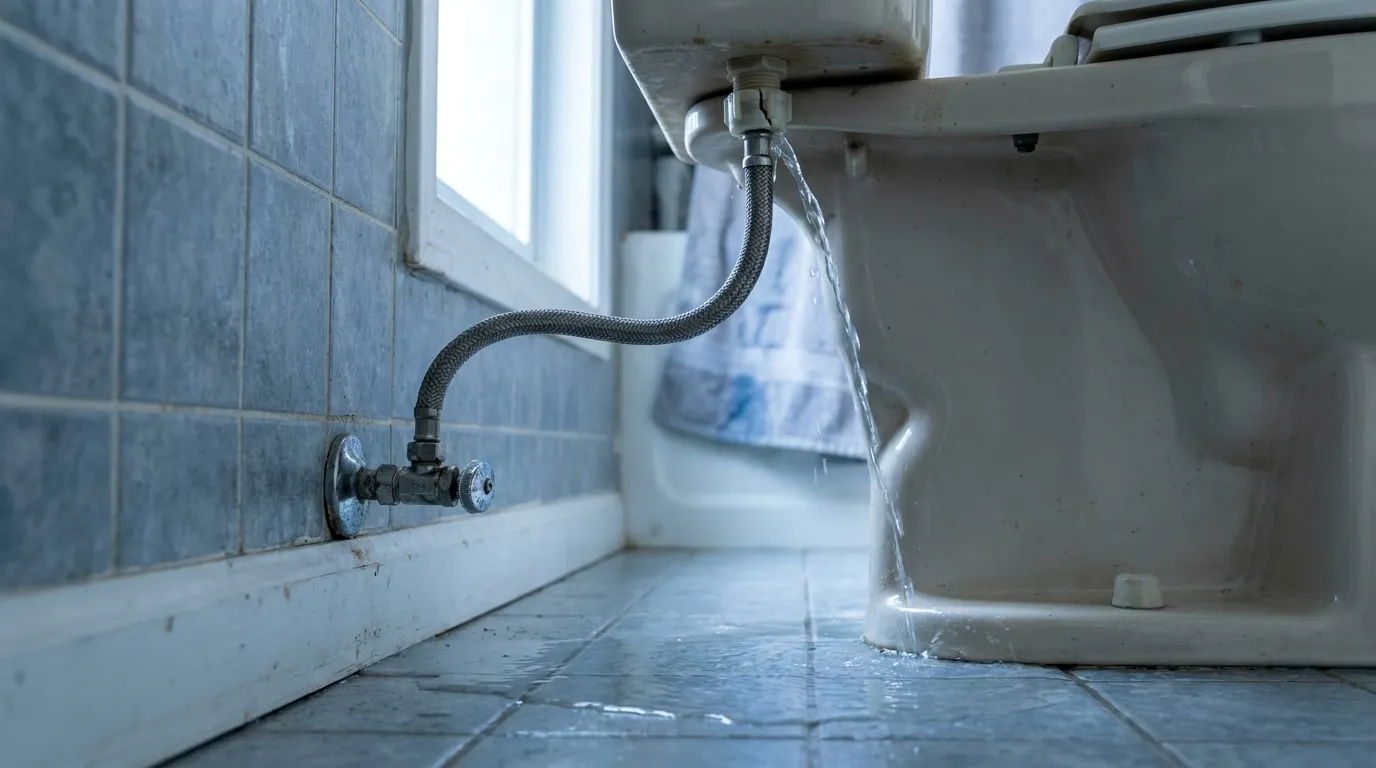
First Actions (To Do Immediately)
- 1 Close the shutoff valve behind the toilet. If it won't turn or keeps leaking, close the main water shutoff.
- 2 If water is coming through a ceiling light or reaching outlets below, turn off the main breaker from a dry spot, or call an electrician if you can't reach the panel without touching water.
- 3 Take a video of every wet room, then keep the broken supply line, its nut and any pieces.
- 4 In a condo or apartment, tell the unit below and the building manager right away.
DO NOT DO
- ✕ Do not force a stuck toilet valve with a long wrench or pliers. The stem or the pipe behind it can snap and leave water pouring out of the wall.
- ✕ Do not touch a ceiling light or flip its switch while water is dripping from it. Use the main breaker from a dry spot.
- ✕ Do not throw away the broken line, the nut or any pieces before the insurer has seen them or said photos are enough.
- ✕ Do not turn the toilet's water back on until a new line is installed.
- ✕ Do not just spray bleach on wet drywall or framing and close it up. Wet materials need to be dried or removed.
- ✕ Do not guess at how long it leaked or what caused it when you call the insurer. Say what you know.
Where Toilet Supply Lines Break
The First 10 Minutes
A toilet supply line is under full house pressure. When it breaks, it keeps pouring until a valve is closed, whether or not anyone flushes.
- Close the toilet's shutoff valve. It's where the line meets the wall or floor behind the toilet. Turn an oval handle clockwise until it stops; turn a lever a quarter turn. If it won't move, don't force it.
- If that valve won't turn, breaks, or keeps dripping, close the main. Most are where the water line enters the house: in the basement near the water heater or meter, near the front outdoor faucet, or in the garage. See where to find your main water shutoff. If you can't find or turn it, call your water utility's 24-hour emergency line and a plumber.
- Check the room and ceiling below. Water from an upstairs bathroom runs along the joists and drips at the first opening, often a ceiling light. If water is reaching lights, outlets or wiring, turn off the main breaker from a dry spot. Stay out from under a ceiling that sags.
- Tell people. In a condo or apartment, warn the unit below and call the building manager; the water may already be in their ceiling.
- Record it before cleanup. A slow video through every wet room, then photos of the broken line and nut where they failed, the floor, the ceiling below, and damaged belongings.
- Start getting the water out. Towels, a mop and a wet-dry vacuum plugged into an outlet in a dry room. Pull up rugs, lift furniture off wet floors, and check floor vents near the toilet: water that went into a vent sits in the duct.
- Call a plumber, your insurer, and a restoration company if water reached a ceiling, walls or another room. Same day if you can; the drying clock is already running.
Which Part Broke: What About 40 Reported Failures Show
We read about 40 first-hand accounts of a toilet supply line failing, posted to Reddit's plumbing, homeowner and insurance forums between 2012 and 2026. People tend to post about disasters, so these show how failures happen, not how often.
- The failed part was named in about 25 of them. In about 20, it was the plastic nut that screws onto the bottom of the toilet tank. Posters described it as cracked, split, sheared off at the threads, or "in pieces." Several of those lines were braided steel; the braid held and the plastic nut didn't.
- In 3, a rigid plastic pipe behind the valve snapped, each time after something hit it: an aerosol can that fell, a picture frame that fell, and installing a bidet.
- In 2, it was the shutoff valve itself.
- A few failed soon after other work on the toilet, such as new fill valve parts or a bidet attachment.
- How long it ran decided the damage. When someone was home and awake, it was caught in seconds to minutes and ended with mopping. Overnight or during a workday, it reached the ceiling and rooms below. One poster's line ran about an hour before neighbors shut it off and the claim came to about $60,000. When the house was empty for days, posters described collapsed ceilings and buckled floors on every level, with reported totals of $100,000 to $200,000.
- Who found the ones that happened while people were away: a neighbor who saw water coming out of the house, the water utility calling about unusual use, a contractor on an unrelated visit, and a security camera.
- A Connecticut Insurance Department pamphlet, citing an Insurance Institute for Business & Home Safety study, puts water damage from toilets at $2,000 to $10,000 per incident, with 78% of incidents caused by supply lines, flanges, fill valves, or overflows.
Why Toilet Supply Lines Burst
- Overtightening. Fluidmaster, the largest maker of these lines, says the plastic nut at the tank goes on by hand only, and warns that overtightening can damage the nut or the fill valve and cause flooding. Its warranty excludes damage from overtightening. A nut cranked with pliers can crack and hold for a while before it lets go.
- Sealant or lubricant on the plastic nut. Fluidmaster's instructions say not to use plumber's putty or thread lubricants on these fittings, because thread sealants or lubricants can damage the plastic nut and cause flooding. The rubber washer inside the nut does the sealing.
- Age. Fluidmaster says to replace a toilet supply line if it's worn or over 5 years old, and every time you replace the fill valve. Plumbers in the threads often go longer; some write the install date on a tag on the line.
- A line that's too short or twisted. A line stretched tight, kinked, or twisted against its curve pulls sideways on both nuts all the time. Plumbers advise a length that makes a gentle curve.
- High water pressure. The residential plumbing code caps static water pressure at 80 psi and requires a pressure-reducing valve where the supply is higher. If your pressure runs high, every connection in the house sees it.
- Damage to the pipe behind the valve. Rigid plastic pipe coming out of the wall can snap if the valve is knocked or twisted. When working on the valve, hold its body with a second wrench so the pipe doesn't turn.
Is It the Supply Line or Something Else?
Not every puddle by the toilet is the supply line. When it leaks tells you which part it is.
- Spraying or dripping from the hose, the nut under the tank, or the valve, whether or not anyone flushed: the supply line or valve. It's under pressure, so close the valve.
- A slow drip at the nut under the tank: Fluidmaster says to turn the nut just enough to stop it. If a small turn doesn't stop it, replace the line. A plastic nut that keeps weeping may be cracked; don't keep tightening it.
- Water at the pipe coming out of the wall, behind the valve: closing the toilet's valve won't stop it. Close the main and call a plumber.
- Water around the base only after a flush: usually the seal under the toilet, not the supply line.
- Drips from the underside of the tank after a flush: usually the bolts or gasket between the tank and the bowl.
- Beads of water all over the outside of the tank in humid weather: condensation, not a leak.
- Water over the rim of the bowl: an overflow. See how to stop a toilet from overflowing.
Clean Water, but Not for Long
- It starts clean. The restoration industry's standard (IICRC S500) lists a broken water supply line as Category 1: water from a clean source. That's why a supply-line leak caught quickly is easier to deal with than a toilet overflow or a sewer backup.
- It doesn't stay clean. The same standard says clean water can degrade to Category 2 or 3 once it contacts building materials and contents, and with time and warmth. A musty or sour smell is one sign it has.
- The clock: the EPA advises drying wet materials within 24 to 48 hours to prevent mold. Drywall can often be dried in place if it isn't swollen and the seams are intact; wet insulation and carpet pad usually come out. See what to do about wet drywall.
- Measure, don't touch. Surfaces feel dry long before the subfloor or the inside of a wall is. A restoration company uses a moisture meter until materials read normal.
- Skip the bleach. The EPA does not recommend bleach as a routine part of mold cleanup. Wet porous materials have to be dried or removed, and mold on them has to be removed, not just killed.
- Upstairs bathrooms: check the ceiling below even if it looks fine. Water can sit on top of the drywall and in the insulation for hours before it stains or sags.
Keep the Broken Line and Nut
- Keep every piece: the line, the nut, broken plastic, and the old valve if a plumber replaces it. Put them in a bag and label it with the date.
- Why it matters: the standard homeowners policy requires you, as often as the insurer reasonably asks, to show the damaged property. Insurers may use the part to recover their payout from the manufacturer or the installer.
- What they look at: whether the nut cracked on its own, and signs of how it was installed, such as tool marks on a plastic nut or sealant on its threads.
- Photograph it first, in place if you can, then close up from several sides. If the insurer asks you to mail it, ask whether photos are enough, and keep your own photos and a shipping receipt.
- The line's warranty won't pay for the damage. Fluidmaster's warranty, for example, excludes water damage. The damage is a claim on your homeowners or renters policy.
Insurance: What's Usually Covered
- Usually covered: sudden and accidental water damage from a plumbing system, which a burst supply line generally is. That pays for the floors, walls, ceilings and drying, subject to your deductible.
- Usually not covered: the supply line itself and the plumber's repair of it, and damage from a leak that went on for a long time. See whether homeowners insurance covers burst pipes.
- Mold is often limited or excluded, which is another reason to start drying right away. The policy also requires you to protect the property from further damage. See starting cleanup before the insurer approves it.
- If the house was empty, check your policy's conditions for unoccupied or vacant homes. In one reported $130,000 claim, the insurer looked into whether anyone had checked on the house before it paid.
- Condos: whether the line is yours or the association's depends on your condo's declaration. Damage below your unit often involves your policy, the association's and the neighbor's, so report it to all of them.
- Renting: renters insurance covers your belongings; the building is the landlord's. Tell the landlord in writing. If you changed the plumbing yourself, such as installing a bidet seat, say so.
- The water bill: usually not insurance. Ask your utility for a leak adjustment once it's repaired; many offer one.
- After a claim, some homeowners report insurers requiring metal-nut supply lines or an automatic water shutoff valve at renewal.
Replacing the Line
A plumber can do this in minutes. If you do it yourself:
- Buy the right size. Most toilets take a 3/8" compression x 7/8" ballcock line: 3/8" at the valve, 7/8" at the tank. Faucet lines sit on the same shelf and don't fit. Measure from the valve to the tank fitting and choose a length that makes a gentle curve, not a straight pull.
- Check what's braided. Some braided lines are a plastic braid, not stainless steel; the package says. Lines with a metal nut on the tank end are also sold, mostly through plumbing supply houses.
- Tank end: by hand only. Fluidmaster says to hand-tighten the plastic nut and not to use putty or thread lubricant. Some of its lines click when they reach the right tightness.
- Valve end: about a half turn past hand-tight with a wrench, per Fluidmaster, while a second wrench holds the valve body still.
- Turn the water on and check both ends. If the tank end weeps, turn the nut just enough to stop it. Check again after a few flushes and the next day.
- Replace a valve that stuck or dripped. If the toilet valve wouldn't close today, it won't next time either. See replacing a stuck or leaky toilet shutoff valve.
- Check your water pressure. A gauge that screws onto an outdoor faucet costs little. Above 80 psi, the code calls for a pressure-reducing valve; have a plumber look at it.
Before You Leave Home for a Few Days
Most of the expensive reports above happened while nobody was home. People who've had one now shut the water off before trips; others think it's overkill. The trade-offs:
- Closing the main limits a burst to the water already in the pipes. Try the valve a few days before you leave: an old valve that won't reopen, or starts leaking at the stem, is better found while you're home. See what to do if your shutoff valve is stuck.
- Water heater: turn an electric one off at the breaker, or set a gas one to vacation or pilot. Water heater makers warn that running an electric heater with a partly empty tank burns out the elements.
- Ice maker: switch it off if the water is off.
- Boiler heat or fire sprinklers: ask a plumber before closing the main. Some boilers take make-up water from it, and sprinklers fed from the same pipe would be shut off too.
- Winter: shutting off the water doesn't stop pipes from freezing if the heat fails. Keep the heat on, or have the pipes drained. See what to do about frozen pipes.
- Leak sensors and automatic shutoff valves catch a leak when nobody's home. Some insurers offer discounts for them.
- Someone checking in: a neighbor or friend who walks through every few days. It's also what some policies expect for an empty home.
Sources
- Fluidmaster, How to Maintain a Fluidmaster Fill Valve (replace the supply line if worn or over 5 years old), 400A Fill Valve Instructions (hand-tighten; don't overtighten), PerforMAX Repair Kit Instructions (no putty, sealants or lubricants on the plastic nut), Click Seal Toilet Supply Line (3/8" compression x 7/8" ballcock), and Limited Warranty.
- Fluidmaster, Click Seal Toilet Replacement Connectors announcement (metal nut a half turn past hand-tight).
- Connecticut Insurance Department, Quick Tips to Prevent Water Damage (IBHS toilet study figures).
- International Residential Code, Section P2903.3.1, Maximum Pressure, as quoted by the Cheyenne Board of Public Utilities.
- IICRC S500 water categories, as quoted in Restoration & Remediation, Applying IICRC Categories of Water to a Job Situation.
- U.S. EPA, A Brief Guide to Mold, Moisture and Your Home and Should I Use Bleach to Clean Up Mold?
- Homeowners 3 Special Form, Duties After Loss, as quoted in Neiman v. Farmers Automobile Insurance Ass'n, Illinois Appellate Court, 2016.
- National Association of Insurance Commissioners, Will My Homeowners Insurance Policy Cover Water Damage From a Burst Pipe?
- Centers for Disease Control and Prevention, Protect Yourself From Electrical Hazards.
- American Water Heater, Residential Electric Water Heater Instruction Manual.
- Reported failures: about 40 first-hand accounts on Reddit (r/Plumbing, r/homeowners, r/HomeImprovement, r/Insurance, r/legaladvice, r/Apartmentliving), 2012 to 2026, read and counted by Emergency Damage Pros in November 2026.
Severity Matrix: Critical
Life-safety hazard. Evacuate if necessary. Requires complete professional mitigation and potential reconstruction.
Who to Call
Licensed Plumber or Water Damage Restoration Professional
Insurance & Documentation
- Mitigation/documentation support only; no coverage conclusion
Frequently Asked Questions
Why would a toilet supply line burst?
Most often the plastic nut at the bottom of the tank cracks. In about 25 reported failures we read where the broken part was named, about 20 were that nut. The usual causes are overtightening it with a tool, sealant or lubricant on its threads, age (Fluidmaster says to replace the line after 5 years), a line too short or twisted, and water pressure over 80 psi.
How often should you replace a toilet supply line?
Fluidmaster says to replace it if it's worn or over 5 years old, and whenever you replace the fill valve. Replace it sooner if you see rust or discoloration on the braid, cracks or yellowing on the plastic nut, or kinks.
Does homeowners insurance cover a burst toilet supply line?
The water damage from a sudden burst is usually covered; the line itself and the plumber's repair usually aren't. Damage from a leak that went on for a long time, and mold, are often excluded or limited. Keep the broken line and nut, since the insurer may ask to see them.
Is water from a toilet supply line clean?
At first, yes: it's the same tap water as your sink, and the restoration standard treats a broken supply line as clean water. It doesn't stay clean once it soaks into floors, walls and insulation, especially as time passes, so dry it within 24 to 48 hours.
Can I use the toilet with the water shut off?
Yes. Pour a bucket of water (about a gallon or two) quickly into the bowl and it will flush. Leave the toilet's valve closed until a new line is on.
Should I turn off the water to my toilet when I go on vacation?
Closing the main protects every toilet and fixture at once, which is why many people do it for trips of more than a couple of days. Test the valve first, and turn off an electric water heater at its breaker. If you have boiler heat or fire sprinklers, ask a plumber first.
Get Professional Help Now
Connect with a local water damage expert immediately.