Does Nationwide Cover Mold?
Emergency Answer
Only when the mold comes from a covered water loss, like a burst pipe, a failed water heater or an appliance that breaks suddenly. Nationwide calls mold "biological deterioration" and pays a set amount to clean it up, including testing, tear-out and a hotel; that amount is $10,000, and a Nationwide spokesperson told CNBC it can't be raised. You have to report the mold within 180 days of finding it. Mold from a slow leak, humidity or groundwater isn't covered.
- Find the water and get the cause in writing: Nationwide pays for mold only when "a covered cause of loss results in" it. Have the plumber write down exactly what failed: the supply line, the water heater, the tank, the valve.
- Write down dates: When you last saw the area dry, when you found the water or mold, and when you reported it. Leaks that ran for "weeks, months or years" are excluded.
- Report it within 180 days, and sooner is better: In the Nationwide wording we read, mold cleanup is paid "only if you report" it "within 180 days of having first discovered" it.
- Photograph before anyone cleans: The mold, the wet materials, the part that leaked, and the water line if there is one. Keep the failed part.
- Ask the adjuster to split the bill: Wet drywall, floors and cabinets from a covered leak are paid as water damage. Only the mold cleanup comes out of the $10,000.
First Actions (To Do Immediately)
- 1 Stop the water at the fixture's valve or the main shutoff. If a well pressure tank failed, turn off the well pump's breaker.
- 2 Start drying within 24 to 48 hours: fans, a dehumidifier, and pull up wet carpet pad. Mold grows fast once materials stay wet.
- 3 Don't scrub or sand visible mold. Close the room off and keep the HVAC from blowing through it.
- 4 Take photos and video of the leak, the water, the mold, and any moisture readings the plumber or drying company takes.
- 5 Keep the broken part and the receipt for the replacement. In one Nationwide claim, that receipt is what got a denial reversed.
- 6 Call Nationwide's claims line and describe the source in one sentence, such as "a pressure tank inside the house ruptured."
- 7 Ask the adjuster before paying for mold testing. Testing comes out of the same $10,000 as the cleanup.
DO NOT DO
- ✕ Do not describe water from inside the house as "flooding" or "groundwater." Nationwide denied an Ohio crawlspace claim as groundwater until the owner explained a tank inside had burst.
- ✕ Do not let a mold company start a big remediation before you know the $10,000 also has to cover testing, tear-out and any hotel stay.
- ✕ Do not wait to report. The 180-day deadline is the outer limit; a leak left for weeks can be excluded as seepage.
- ✕ Do not let anyone leave floors cut open and drying equipment switched off. In one denied Nationwide claim, the floor sections cut for samples were never replaced and the dehumidifier was never turned back on. Ask in writing who pays to close up and dry out if coverage is denied.
- ✕ Do not call the claims line just to ask whether mold is covered. Calls about a loss can be logged as a claim. Ask your agent general questions first.
- ✕ Do not ignore a letter about streaks or algae on your roof. Nationwide has given homeowners as little as three weeks to clean it.
Which Mold Gets Paid, and What the Limit Has to Cover
When Nationwide Pays for Mold
Nationwide's mold page says it depends on the source: "If mold forms as a result of a covered peril or event listed in your policy — typically related to water damage — then your insurance should cover the damage." It adds that "your policy might also have a cap on the amount it pays toward mold removal."
The policy itself excludes mold, then gives some back. In the Nationwide wording we read, biological deterioration or damage "is excluded except as provided in" a separate additional coverage for cleanup and removal.
- Usually covered, per Nationwide: a washer or dishwasher that malfunctions and leaks, a burst or frozen pipe, a broken water heater, and water used to put out a fire. The mold is "resulting damage," so Nationwide pays for the remediation and the floors or walls but "will probably not replace a broken appliance."
- Usually not covered, per Nationwide: a poorly ventilated bathroom or kitchen, "improper sealing around the base of a toilet or shower, allowing water to seep through the floor," and dirty or broken gutters.
- Flood: mold after a flood isn't covered by the homeowners policy. That takes a flood policy.
What Nationwide Means by "Biological Deterioration"
Nationwide policies don't use the word "fungi" the way most insurers do. They define "biological deterioration or damage" as "damage or decomposition, breakdown, and/or decay of manmade or natural material due to the presence of fungi, algae, lichens, slime, mold, bacteria, wet or dry rot, and any by-products of these organisms, however produced."
- Rot is in the same bucket. Dry rot in a crawlspace falls under the same exclusion and the same small limit as mold. A North Carolina Nationwide customer was told "dry rot is not covered regardless if we knew about the damage or not."
- So are algae and lichens, the same organisms that streak roofs. That matters for the roof inspections below.
- Another cause helping doesn't save it. In *Weinberg v. Nationwide* (E.D. Pa. 2013), owners blamed a windstorm for damage around their windows and stucco. Nationwide paid for the inside damage but not the outside, and the court upheld that: the policy excludes biological deterioration "even if another peril or event contributed concurrently or in any sequence to cause the loss."
- Renters too: Nationwide renters policies list biological deterioration coverage as well.
What the $10,000 Has to Cover
The Nationwide wording, quoted in an Ohio denial letter and again in a Texas court record, pays "up to the amount shown on the Declarations" for four things. That amount is the most Nationwide pays for all of them together.
- Cleanup: "the cost to clean up, remove and dispose of" the mold.
- Tear-out: "the cost to tear out and replace any part of the building or other covered property needed to gain access to" it.
- Testing: "the cost of testing which is performed in the course of clean up and removal."
- Hotel: "additional living expenses you may incur" because of the cleanup.
- It's on top of your dwelling limit: "This is an additional amount of coverage." The regular deductible applies.
- The amount: a Nationwide spokesperson told CNBC in 2024 that Nationwide "covers up to $10,000 of mold damage caused by covered incidents, but that limit cannot be increased." That's double the $5,000 Travelers and Liberty Mutual forms we read, but Nationwide told CNBC you can't buy more.
Where You Can Get More: Florida and Private Client
- Florida: Nationwide's 2025 Florida underwriting guide says the policy "provides $10,000 (under Section I) and $50,000 (under Section II)" for biological deterioration, and "may be endorsed to provide additional levels of coverage." Section I is damage to your home; Section II is if someone sues you over mold.
- Nationwide Private Client (its high-value home line, written by Crestbrook Insurance) sells far more. One Texas family paid $4,554.53 a year extra for $1.6 million of mold coverage.
- Everywhere else: ask your agent what your declarations page shows for biological deterioration, and whether any higher amount is offered in your state.
The 180-Day Rule, and the Leak Has to Happen While You're Insured
Two conditions in the Nationwide wording catch people. Mold cleanup costs "are payable only if you report the 'biological deterioration or damage' to us within 180 days of having first discovered" it. And "the covered cause of loss that causes or results in 'biological deterioration or damage' to covered property must have occurred during the policy period."
- Found mold and put off calling? After 180 days, the cleanup coverage is gone even if the leak was covered.
- Just bought the house or switched to Nationwide? Mold from a leak that happened before your policy started isn't covered by it. Ask the seller's disclosure and inspection about past leaks.
- Switching away from Nationwide? A leak during your Nationwide policy can still be a Nationwide claim. Report it before you go.
Slow Leaks: "Weeks, Months or Years"
A Nationwide Florida policy posted for review excludes "continuous or repeated seepage or leakage of water, steam or moisture... over a period of weeks, months or years, even if such seepage or leakage... is unknown to all 'insureds' and is hidden within the walls or ceilings or beneath the floors." Leakage "from within or around any shower stall, shower tub, tub installation or other plumbing fixture" is excluded too.
When the water isn't covered, the mold isn't either, because the mold coverage needs a covered cause.
- How long is "weeks"? A Florida homeowner whose dishwasher leaked for a couple of months asked. An adjuster replied: "If I was being deposed on the language, I would attest weeks means more than 14 days." Several others said that claim would be denied.
- Not knowing doesn't help. The wording applies even when the leak was hidden and nobody knew.
- Nationwide's own advice: "Clean up water leaks and spills within a day or two of occurring," and keep indoor humidity below 60%.
Water From Inside, Called Groundwater: An Ohio Denial Reversed
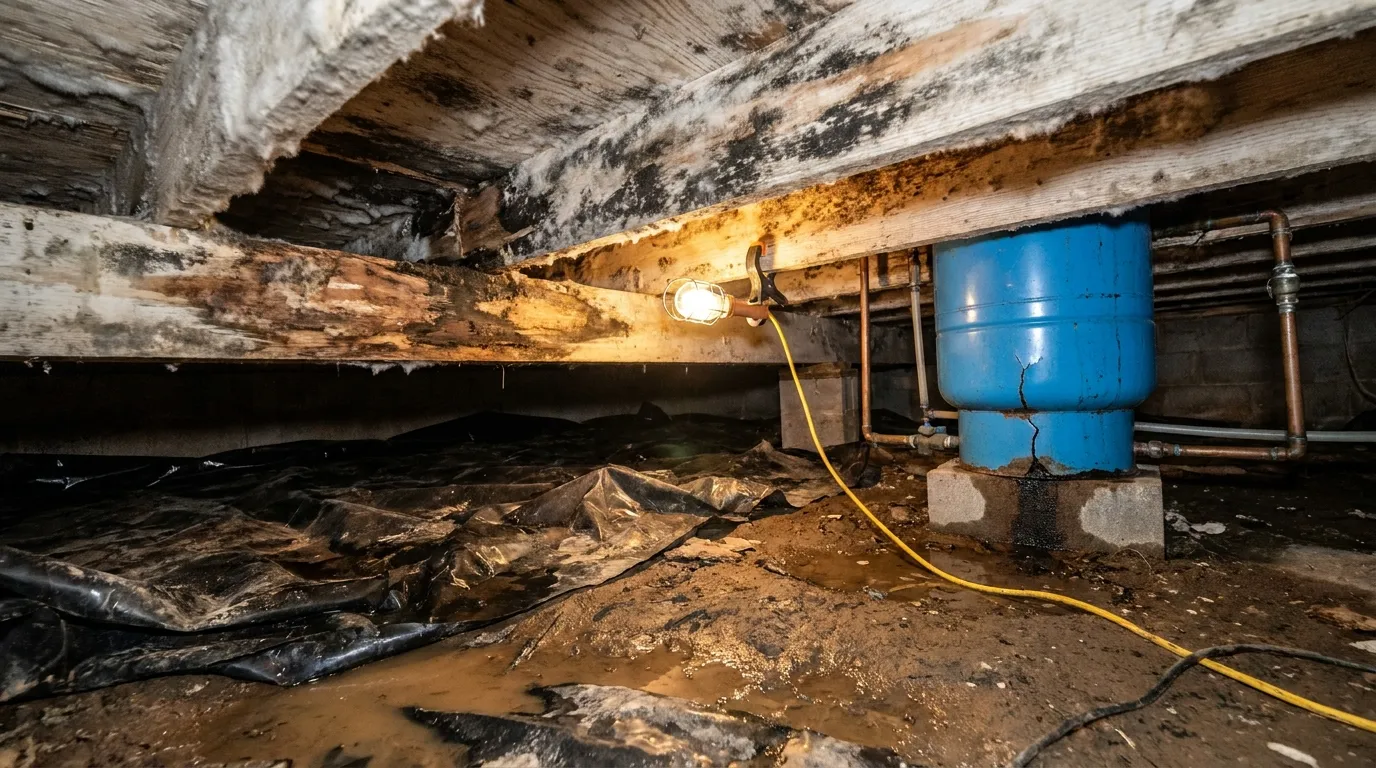
In Ohio, a cracked well pressure tank flooded a crawlspace with 1.5 to 2 feet of water. Roto-Rooter drained it, ran drying equipment for most of a week and did mold prevention, for over $8,000. Nationwide denied the claim: "Our investigation indicates that surface water/water below the surface of the ground is entering your crawlspace," and since the water was excluded, so was the mold cleanup.
A commenter told the owner the adjuster had misunderstood: "A pressure tank, inside the home ruptured, causing the lower level to flood. The water originated inside the home. Keep it simple and precise." The owner sent that, with the receipt for the new tank. "This did the trick, they've reverted the denial and will now cover this claim."
- Say where the water came from in one sentence, and back it with a receipt, a photo of the broken part, or the plumber's note.
- Crawlspaces and basements get read as groundwater by default. If your water came from a pipe, tank or appliance, make that the first thing the adjuster reads.
When the Mold Can't Be Tied to One Leak: Buchholz v. Crestbrook
A family in Austin, Texas, insured through Nationwide Private Client (Crestbrook Insurance), found mold behind a wall in 2019 and then throughout the house. Crestbrook paid $745,778 on five claims. It denied a sixth, for general mold growth and mold in the HVAC system, after engineers blamed a faulty HVAC design and "discrete leaks and a 'global' issue" with moisture. The policy's mold coverage wording was nearly the same as the standard Nationwide wording, with $1.6 million of coverage.
In 2023 the federal appeals court agreed with the denial: "The Buchholzes have shown they suffered a mold infestation, nothing more." Water intrusion in general isn't a covered loss when its only harm is mold.
- The lesson: mold coverage needs a specific covered event. Tie each area of mold to the leak that caused it, with dates and a plumber's or engineer's report.
- Design and equipment problems hurt the claim. Crestbrook's denial letter also cited the exclusions for faulty workmanship and construction, dampness, and mechanical breakdown.
Roof Streaks, Drones and Nonrenewal
Nationwide inspects roofs from the air. One homeowner was told Nationwide would cancel over "naturally occurring streaking" seen from a drone and given three weeks to fix it; the post was later deleted. Another Nationwide customer in the upper Midwest got a three-week deadline in November.
- What commenters advised: have the roof soft washed, not pressure washed. Send Nationwide a signed contract and deposit if the company can't come before the deadline, then before-and-after photos.
- Check the dates. An agent who works with Nationwide said its customers get these notices "6-9 months in advance" and often act only at the last warning. Find the first letter.
- If Nationwide won't back down, call your state insurance department. A former agent said a client's roof was cleaned with a report and Nationwide still refused; "Within a week of calling" the department, "NatWide issued a reinstatement notice."
- For more on this, see does homeowners insurance cover mold from a roof leak.
What Happened in the Nationwide Claims We Read
- Denial reversed: the Ohio crawlspace tank claim above, once the owner explained the water came from inside.
- Denied, floors left open: in North Carolina, puddles on a bedroom floor turned out to come with dry rot and mold in the crawlspace. Nationwide's contractor cut floor samples; a new adjuster denied everything, saying "dry rot is not covered regardless if we knew about the damage or not." Commenters called it long-term leakage and advised asking whether Nationwide would at least pay for the investigation.
- Water damage paid, plumbing not: a shower-wall leak soaked carpet and subfloor. The rep said "the plumbing causing the leak would not be covered, but the damage caused by the water would be," and offered Nationwide's repair network, which the customer said guarantees work for five years. Note that the Florida wording above excludes repeated leakage around showers.
- Expected denial: the Florida dishwasher leak of a couple of months; commenters said it would be denied as seepage.
- Backup paid, mold later: a basement backup paid to the $10,000 backup limit, then drying was cut short and mold spread upstairs over the years that followed. See Nationwide water backup coverage.
- The pattern: sudden leaks from inside the house got paid; slow leaks, rot and crawlspace moisture didn't. The fights were over where the water came from and how long it ran.
Should You Tell Nationwide About Mold?
- If it came from a sudden leak, yes, and within 180 days. The mold coverage only works if you report it.
- If it's small and old, get a remediation estimate first and compare it to your deductible. A denied claim still goes on your record, and one Nationwide customer found a question call logged as a claim with a 40% premium increase at renewal.
- Ask general questions of your agent, not the claims line.
- How Nationwide rates on claims: Nationwide scored 720 in J.D. Power's 2026 property claims study, 5th of 15 insurers and above the 702 average.
- For how other insurers handle mold, see Travelers mold coverage, Liberty Mutual mold coverage, Farmers mold coverage, and does insurance cover mold after a water leak.
Sources
- Nationwide, Does Homeowners Insurance Cover Mold?, read November 2026.
- Nationwide homeowners policy wording (Ohio): Additional Coverage E.14, Biological Deterioration or Damage Clean Up and Removal, and Exclusion 12, as quoted in a denial letter posted on r/Insurance. The same wording appears in the Crestbrook (Nationwide Private Client) policy quoted in *Buchholz v. Crestbrook*, W.D. Tex. No. 1:20-cv-00449 (order, govinfo.gov).
- Nationwide Florida homeowners policy H 00 03 FL, Section I Perils Insured Against A.2.c.(5), as posted on r/HomeInsurance, 2026.
- Nationwide, Florida Homeowners Quick Reference Guide, 2025: Biological Deterioration form 12747.
- CNBC, Insurers deemed mold too risky decades ago. That coverage gap still surprises homeowners, August 11, 2024.
- *Buchholz v. Crestbrook Insurance Co.*, No. 22-50265 (5th Cir. Apr. 18, 2023) (opinion).
- *Weinberg v. Nationwide Casualty & Insurance*, E.D. Pa. 2013 (CourtListener): definition of biological deterioration or damage.
- J.D. Power, 2026 U.S. Property Claims Satisfaction Study.
- U.S. EPA, A Brief Guide to Mold, Moisture, and Your Home: dry water-damaged areas within 24 to 48 hours.
- About 10 Reddit threads on Nationwide mold, rot, roof and water claims (r/Insurance, r/HomeInsurance, r/HomeImprovement), read by Emergency Damage Pros in November 2026. US posts only. They show what happens in practice, not legal outcomes.
Documentation Checklist
- Take wide-angle photos of the entire affected room.
- Take close-up photos of the specific damage point.
- Save the broken part or pipe if a plumber replaces it.
- Keep all receipts for emergency repairs and mitigation.
- Do not throw away damaged property until the adjuster has seen it.
Severity Matrix: Medium
Requires professional extraction equipment and dehumidifiers. Moderate risk of mold and structural damage.
Who to Call
Licensed Plumber or Water Damage Restoration Professional
Insurance & Documentation
- Coverage depends on policy, cause, timing, exclusions, endorsements, and documentation
- Coverage depends entirely on your specific policy details, the exact cause of the damage, timing, exclusions, endorsements, and your documentation.
- This information is educational and does not constitute a guarantee of coverage or a promise that your claim will be approved.
Frequently Asked Questions
Does Nationwide homeowners insurance cover mold?
Only when the mold results from a covered loss, such as a burst pipe, a failed water heater or an appliance that breaks and leaks. Nationwide then pays to clean it up, up to the biological deterioration limit on your declarations page. Mold from slow leaks, humidity, poor ventilation, flooding or groundwater isn't covered.
How much does Nationwide pay for mold?
Up to $10,000, according to a Nationwide spokesperson quoted by CNBC in 2024. That one amount covers cleanup, tear-out to reach the mold, testing and hotel costs together. It's paid on top of your dwelling limit, and the regular deductible applies.
Can I raise Nationwide's mold limit?
Nationwide told CNBC the $10,000 "cannot be increased." Its Florida guide says the Florida policy "may be endorsed to provide additional levels of coverage," and Nationwide Private Client sells much higher amounts. Ask your agent what's offered in your state.
What is "biological deterioration" in a Nationwide policy?
Nationwide's term for damage from "fungi, algae, lichens, slime, mold, bacteria, wet or dry rot." It's excluded except for a limited additional coverage that pays to clean it up when a covered loss caused it.
How long do I have to report mold to Nationwide?
In the Nationwide wording we read, 180 days from when you first discovered it. The leak that caused it also has to have happened during your policy period. Report sooner: a leak left running for weeks can be excluded as seepage.
Does Nationwide cover mold from a slow leak?
Usually not. The Nationwide wording we read excludes leakage "over a period of weeks, months or years," even if it was hidden and nobody knew, and leakage around showers and tubs. When the water isn't covered, the mold isn't either.
Does Nationwide cover dry rot?
Dry rot is part of Nationwide's definition of biological deterioration, so it's excluded except under the limited cleanup coverage, and only when a covered loss caused it. Rot from a long-term leak or crawlspace moisture is usually denied.
Should I file a Nationwide claim for mold?
If it came from a sudden, covered leak, yes, and within 180 days. If it's small or from an old leak, get an estimate and ask your agent first; a denied claim still goes on your record. Nationwide scored 720 in J.D. Power's 2026 claims study, above the 702 average.
Get Professional Help Now
Connect with a local water damage expert immediately.