Does Progressive Cover Water Backup or Sump Pump Failure?
Emergency Answer
Only if your policy has the water backup and sump pump overflow add-on. Without it, water that backs up through a sewer or drain, or overflows when the sump pump fails, isn't covered. With it, the insurer pays for damage to the house and your belongings up to the limit you picked; the Progressive quotes we saw offered $5,000 to $20,000. It doesn't pay for the pump itself, the sewer pipe in the yard, or flood water. Progressive often isn't the insurer that pays the claim, so check the company named on your declarations page first.
- Find the insurer's name on your declarations page: Progressive sells policies from its own Progressive Home companies (formerly ASI) and from other insurers such as Homesite. The company named on the policy is the one that handles the claim.
- Look for the backup line and its limit: It may be called Water Back-Up and Sump Discharge or Overflow, or form ASI HO WBU. If it isn't listed, you don't have backup coverage.
- Check the deductible for backup: On the Progressive Home (ASI) backup form we read, the deductible is your regular deductible or $1,000, whichever is greater.
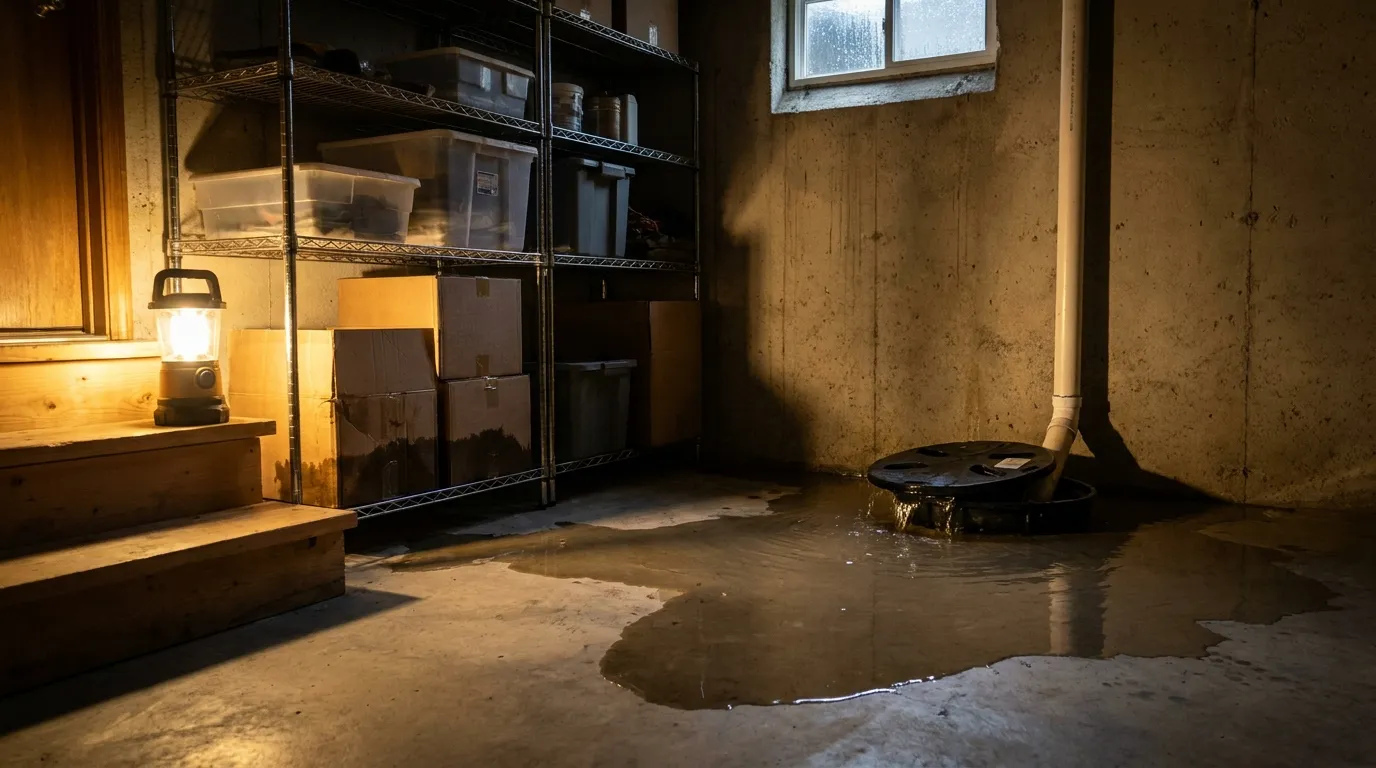
- Photograph where the water came in: Water up a floor drain or toilet, or over the sump pit, is backup. Water through the walls or up through the slab is groundwater, which the add-on doesn't cover.
- Get the cause in writing from the plumber: The ASI backup form excludes loss "caused by the negligence of an 'insured'." A written cause, such as a city main surcharge, a tripped breaker in a storm or a failed float switch, answers that before it comes up.
First Actions (To Do Immediately)
- 1 If sewage came up a drain, keep children and pets out, and stop running water and flushing until the line is cleared. Every drain in the house empties into the same pipe.
- 2 If water is near outlets, the furnace or the water heater, shut off power to the basement from a dry spot.
- 3 If the sump pump stopped, check its plug, the outlet's GFCI button and the breaker. Get a backup or rented pump running if the pit is still filling.
- 4 Take photos and video before cleanup: the water line on the walls, the drain or pit the water came from, the pump, and everything that got wet.
- 5 Have a plumber clear the line and write down what caused it and where. Ask for the camera video if they scope the line.
- 6 Call the claims number for the insurer named on your declarations page, which may not be Progressive. Ask for your backup limit and deductible before you sign the restoration company's contract.
- 7 Keep every letter the insurer sends. If the claim is denied, the date on the first denial letter can start the clock for a lawsuit.
DO NOT DO
- ✕ Do not assume Progressive handles the claim. Homesite's own site says "Progressive is not responsible for the insurance claims" on the policies Homesite writes.
- ✕ Do not let the restoration company run up a bill before you know your limit. Drying and tear-out can use most of a $5,000 or $10,000 limit.
- ✕ Do not call it a "flood" if water came up a drain or over the sump pit. The ASI backup form excludes backup "as a direct or indirect result of flood." Describe exactly where the water entered.
- ✕ Do not throw anything away before the adjuster has inspected it or approved photos. Set it aside.
- ✕ Do not wait months for a second review before talking to a lawyer on a big denied claim. In *VanHorn v. ASI*, a second denial letter a year later didn't restart the two-year deadline to sue.
- ✕ Do not count on a pump-only fix being covered. The backup add-on pays for the water damage, not the pump that broke.
What Pays for What When Water Comes Up in the Basement
First, Find Out Who Actually Insures You
Progressive sells home insurance differently from the other big carriers. When you get a quote, Progressive's site says, "you could be matched with us or another trusted carrier." Its list of homeowners insurers includes its own Progressive Home and twelve others: American Integrity, American Modern, Bamboo, Hippo, Homesite, Nationwide, Openly, Plymouth Rock, RLI, Stillwater, Tower Hill and TRUE.
Progressive Home is the former American Strategic Insurance, or ASI. Progressive's St. Petersburg office page says "Progressive Home—formerly American Strategic Insurance (ASI)—provides property insurance" for the Progressive group, and the ASI name can still appear on policy forms and claim letters.
The others are separate companies. Homesite's program page is blunt: "Progressive is not affiliated with Homesite... Homesite provides the coverage for, and pays the claims associated with, these insurance policies. Progressive is not responsible for the insurance claims or any other obligations of Homesite."
- Why it matters for backup: the insurer named on your declarations page decides what the add-on is called, what it pays, the deductible, and who answers the claims line.
- People mix this up. In the Reddit threads we read, homeowners described their insurer as "Homesite via progressive" and "Progressive (Plymouth Rock)."
- The rest of this page uses Progressive's own descriptions and the Progressive Home (ASI) policy forms. If your policy is from another company, ask it for its backup endorsement.
What Progressive Says the Add-On Covers
Progressive's article on water backup: "water back-ups and sump pump overflows aren't usually covered unless you add optional water back-up and sump pump overflow coverage to your policy." It adds that "even if you have a separate flood insurance policy, your water back-up issue may not be covered."
- What it lists as covered: "Sewers or drains that back up into your home," "Failure or overflow of a sump pump," and "Blocked drain tile." It may pay for belongings like furniture and electronics, and for floors and walls, "up to your coverage limits and minus your deductible."
- What it lists as not covered: "Flooding," "Costs to repair or replace any municipal service lines," and "Replacement of a broken sump pump, though adding equipment breakdown coverage to your policy could cover this."
- A burst pipe is different. Progressive notes that water backup coverage won't help with a burst pipe, "though your homeowners policies may."
The Wording on a Progressive Home (ASI) Policy
We read the backup endorsement in an ASI homeowners filing approved in Tennessee in 2014: form ASI HO WBU 09 13, "Water Back Up and Sump Discharge or Overflow." The same filing explains that ASI "does not rate to cover water or sewer back up in the basic form" and offers this endorsement instead. Your state and policy year may use a newer version, so ask for the form number on yours.
- What it covers: "direct physical loss, not caused by the negligence of an 'insured'," from water that "backs up through sewers or drains" or "overflows or is discharged from a sump, sump pump" or related equipment, "even if such overflow or discharge results from mechanical breakdown." A pump that just died is covered damage, not an excuse.
- Not the pump: "This coverage does not apply to direct physical loss of the sump pump, or related equipment, which is caused by mechanical breakdown."
- A $1,000 minimum deductible: "your deductible shown on the declarations page or $1,000, whichever is greater." If your regular deductible is $500, a backup claim uses $1,000. It doesn't apply to hotel and living costs.
- Still excluded: flood and surface water; water below the ground that seeps through a foundation; and sewer or sump backup "as a direct or indirect result of flood."
- The negligence exclusion is where disputes start. An unmaintained pump, a known clog left alone, or an inspection report that flagged the drain can all be raised against a claim.
Limits: $5,000 to $20,000 on the Quotes We Saw
You pick the limit, and it's the most the add-on pays. The ASI form says the coverage "does not increase the limits of liability" for the house or belongings.
- Package limits in the ASI filing: the HomeShield package included "$5,000 Limit on Water Backup/Sump Pump Overflow," and HomeShield Plus included $10,000. The sample declarations pages showed $5,000 and $10,000.
- Quotes homeowners posted: a North Carolina buyer was offered Progressive water backup at $5,000, $10,000 or $15,000. A central New York buyer's Progressive quote listed "Water Backup Coverage $20,000." Another Progressive quote listed water backup at $10,000 and mold at $5,000 as separate coverages.
- Cost: a Progressive customer said "the sewer backup was like $25 for 6 months." An agent in a thread about a Progressive quote said the $25,000 maximum they put on every policy costs about $3.33 a month. Prices vary by state and insurer.
- How much to pick: a finished basement with carpet, drywall and furniture can pass $10,000 quickly. After one Wisconsin sump failure, the owner said "they only gave us 5k," and a reply said, "You were underinsured."
One More Water Limit to Look For: $10,000 for All Water Damage
The same ASI filing includes a separate endorsement, ASI HO LWD, "Limited Water Damage Coverage." It isn't about backup, but it catches people who assume any water claim gets the full house limit.
- What it says: "The total limit of liability for water damage to covered property is $10,000 per policy term," for the house, other structures and belongings combined.
- What it applies to: sudden discharge from "a plumbing, heating, air conditioning or automatic fire protective sprinkler system or from within a household appliance": the burst pipe, the failed water heater, the washer hose.
- How to check: look for "Limited Water Damage" or ASI HO LWD on your declarations page. If it's there, a burst pipe is capped at $10,000 for the whole policy year.
Pump, Sewer Line, Septic or Flood: Which Coverage Pays
The backup add-on pays for water damage inside the house. The other things that go wrong are covered by other add-ons or not at all. The diagram above shows the four main ones.
- The pump itself: Progressive's equipment breakdown article lists sump pumps among the equipment it may cover, but only for sudden electrical or mechanical breakdown. "Normal wear and tear, and damage from neglect and poor maintenance, aren't covered," and it "is not available on all policies."
- A cracked or root-filled sewer line in the yard: that takes service line coverage. Progressive says the limit "is often up to $10,000 and may include a deductible," and it can pay for digging and landscaping.
- A septic tank or lift station: Progressive's service line article lists "Septic systems" among the things service line coverage typically won't pay for. Ask how your insurer treats a septic lift station or ejector pump before it fails.
- Water through the walls or along the ground: groundwater and surface water are excluded even with the add-on. That takes a flood policy.
A Lift Station Backup ASI Denied
A homeowner who had bought an ASI policy through Progressive had a septic lift station stop when its breaker tripped. Gray water backed up through the basement floor drain, about three inches deep. The policy had the backup endorsement.
- The denial: the adjuster cited negligence, pointing to a three-year-old pre-purchase inspection report. The owner said the note the adjuster relied on was about exterior gas lines, not the floor drain, which the report called satisfactory. The letter also cited groundwater.
- A new reason later: a supervisor then asked for proof there were no foundation cracks, a reason that wasn't in the letter, and said the claim might be reconsidered.
- A new policy, a closer look: the policy had started about two months earlier, and the supervisor said that called for extra due diligence.
- What to take from it: keep your inspection report and maintenance records handy, ask for every denial reason in writing, and get a plumber to document the cause the same day, before the evidence is gone. A property reinspector in the thread said it looked like a plumbing discharge from the septic system on the property, not off-premises sewer water.
What Happened in the Progressive Claims We Read
- Paid within an hour (Homesite policy): after a major Milwaukee storm, an owner with "Homesite via progressive" and the sump and sewer backup add-on "sent pictures and had 9k in my checking within an hour." The agent said they would normally send someone out, but paid right away because of the emergency. The owner made sure to explain the sump pump "couldn't keep up and it overflowed."
- Paid $5,000: a Wisconsin owner with Progressive had a sump pump failure in a flood and said "they only gave us 5k." A reply: "You were underinsured. Lucky you had back up coverage at all."
- Reported as denied: after record rain in Albany, a commenter said "Progressive will not cover sump pump failures even with the extra backup coverage" and didn't get a call back for three days. Another reply named the insurer as Plymouth Rock. We didn't see the policy or the denial letter, and the Wisconsin claims above show backup coverage does pay for sump failures.
- The pattern: when the add-on was on the policy and the water came up a drain or over the pit, it paid. The losses came from limits too low for the basement, flood water mixed in, and negligence arguments.
If You're Denied: The Two-Year Clock (VanHorn v. ASI)
In September 2018, a Michigan couple found their basement flooded and suspected an overflowing toilet. ASI sent at least four companies to inspect. Its engineer concluded the water was groundwater seepage plus a construction defect, a missing vapor barrier under the laminate floor, and ASI denied the claim in a letter mailed November 1, 2018. A second letter in November 2019 said the denial would stand.
The ASI policy said a lawsuit must be "filed within two years after the date of loss," with the time paused from when the loss is reported until the insurer "formally denies liability." The couple's lawyer filed in June 2021. In January 2023, a federal court in Detroit ruled the clock started running again at the first denial letter, not the second. Even with 101 extra days from COVID-era orders, the suit was "over 7 months late," and the case was dismissed.
- Find the "suit against us" clause in your policy and note the deadline.
- Count from the first denial letter. Asking for a second look doesn't pause the clock unless the insurer clearly withdraws the denial.
- On a large denied claim, talk to a lawyer or your state insurance department well before the deadline.
Before You File or Switch: Claims History and Underwriting
- Water claims follow you. A Nevada homeowner with Progressive since 2009 filed two water claims totaling about $8,500 and then got a non-renewal notice for "failure to provide proof of professionally installed Water Flow Monitor with Automatic Shutoff on the water main." An agent replied that water claims are "the number one loss in NV Homes."
- New policies can still be reviewed. One family switched to Progressive (written by ASI) and six weeks later got a cancellation notice: "The roof type does not meet our eligibility criteria." Ask whether an inspection or underwriting review is still open before you cancel the old policy.
- If the damage is small, get a repair estimate and compare it to the backup deductible, which may be at least $1,000. If it's big, report it right away; drying can't wait.
- How they rate on claims: in J.D. Power's 2026 property claims study, Progressive Home scored 704, 7th of 15 insurers and just above the 702 average. Homesite, which writes some policies sold through Progressive, scored 657, last of the 15.
Keep It From Happening Again
Test the sump pump at least once a year by pouring water into the pit, and add a battery backup; Progressive's own article notes that "losing power can cause a sump pump to stop working." Check that the discharge line outside isn't crushed or frozen and empties well away from the foundation. If the city sewer has backed up into your house before, ask a plumber about a backwater valve. Keep the receipts and dates; they answer a negligence question.
If water is coming up through a floor drain right now, start with what to do when a basement floor drain backs up. For a pump that just quit, see signs your sump pump failed. For how other insurers handle this, see does insurance cover sump pump failure, does home insurance cover sewer backups, Travelers water backup coverage, Liberty Mutual water backup coverage, Farmers water backup coverage, and Nationwide water backup coverage.
Sources
- Progressive, Does Home Insurance Include Water Back-up Coverage?, Property carrier information, What Is Equipment Breakdown Coverage?, What Is Service Line Coverage? and Progressive Home in St. Petersburg, Florida, read November 2026.
- Homesite, Program Details: "Progressive is not responsible for the insurance claims or any other obligations of Homesite."
- American Strategic Insurance Corp., Tennessee homeowners form filing, SERFF AMSI-129408484, submitted April 7, 2014, approved (AM Best): forms ASI HO WBU 09 13 and ASI HO LWD 11 09, HomeShield package rules, sample declarations.
- *VanHorn v. American Strategic Insurance Corp.*, No. 2:21-cv-11881 (E.D. Mich. Jan. 31, 2023) (GovInfo).
- J.D. Power, 2026 U.S. Property Claims Satisfaction Study.
- About 9 Reddit threads on Progressive, ASI and Homesite backup quotes and claims (r/Insurance, r/homeowners, r/milwaukee, r/Albany), read by Emergency Damage Pros in November 2026. US posts only. They show what happens in practice, not legal outcomes.
Documentation Checklist
- Take wide-angle photos of the entire affected room.
- Take close-up photos of the specific damage point.
- Save the broken part or pipe if a plumber replaces it.
- Keep all receipts for emergency repairs and mitigation.
- Do not throw away damaged property until the adjuster has seen it.
Severity Matrix: Medium
Requires professional extraction equipment and dehumidifiers. Moderate risk of mold and structural damage.
Who to Call
Licensed Plumber or Water Damage Restoration Professional
Insurance & Documentation
- Coverage depends on policy, cause, timing, exclusions, endorsements, and documentation
- Coverage depends entirely on your specific policy details, the exact cause of the damage, timing, exclusions, endorsements, and your documentation.
- This information is educational and does not constitute a guarantee of coverage or a promise that your claim will be approved.
Frequently Asked Questions
Does Progressive cover sump pump failure?
Only with the water backup and sump pump overflow add-on. Progressive says that coverage may pay for "failure or overflow of a sump pump," up to your limit and minus the deductible. The Progressive Home (ASI) form covers the overflow "even if such overflow or discharge results from mechanical breakdown," but not the pump itself.
Does Progressive cover sewer backup?
Only with the add-on. Progressive says water that backs up from sewers or drains "typically isn't covered under standard homeowners insurance policies." With the add-on, it may cover "sewers or drains that back up into your home" and "blocked drain tile."
Who handles my claim if I bought through Progressive?
The insurer named on your declarations page. That may be Progressive Home (formerly ASI), or a separate company such as Homesite, Plymouth Rock or Openly. Homesite's site says "Progressive is not responsible for the insurance claims" on Homesite policies.
How much water backup coverage does Progressive offer?
The Progressive quotes we saw offered $5,000, $10,000, $15,000 and $20,000. In the ASI filing we read, the HomeShield package included $5,000 and HomeShield Plus included $10,000. Limits depend on your state and the insurer behind the policy.
Does Progressive water backup have its own deductible?
On the Progressive Home (ASI) form we read, yes: "your deductible shown on the declarations page or $1,000, whichever is greater." Other insurers Progressive sells for may use the regular deductible. Check your declarations page.
Does Progressive pay to replace the sump pump or sewer line?
Not under the backup add-on. Progressive says equipment breakdown coverage could cover a broken sump pump, though not wear and tear or neglect. A broken sewer line in the yard needs service line coverage, often up to $10,000. Neither is on every policy.
Why would a Progressive backup claim be denied?
The common reasons are no add-on on the policy, water that came from flooding or groundwater rather than a drain, and negligence. The ASI form excludes loss "caused by the negligence of an 'insured'." Get the cause in writing from a plumber the same day.
Is Progressive good at paying water claims?
Progressive Home scored 704 in J.D. Power's 2026 property claims study, 7th of 15 and just above the 702 average. Homesite, which writes some policies sold through Progressive, finished last at 657. In the claims we read, backup add-ons paid; the problems were low limits and negligence or flood arguments.
Get Professional Help Now
Connect with a local water damage expert immediately.