Dishwasher Leaked Under Vinyl Plank Flooring? Why Surface Fans Won't Dry It
Emergency Answer
When a dishwasher is leaking under the floor, luxury vinyl plank (LVP) acts as an impermeable vapor barrier that locks standing water against the subfloor. Surface box fans cannot evaporate moisture trapped beneath waterproof vinyl backing. Trapped moisture wicks into OSB or plywood within 24 to 48 hours, causing irreversible edge-swelling and mold growth.
- Stop Water and Power: Shut off the dishwasher water valve under the sink and kill power at the breaker.
- Expose the Subfloor Edge: Remove the lower kickplate/toe-kick to expose the front subfloor edge.
- Meter the Perimeter: Pull baseboards along the nearest perimeter wall and check the subfloor with a pinless moisture meter.
- Vent Above 16% WME: If moisture exceeds 16% Wood Moisture Equivalent (WME), unclick 3 to 4 perimeter plank rows to vent the subfloor cavity or deploy commercial negative-pressure floor drying panels before subfloor wood fibers suffer permanent compression set.
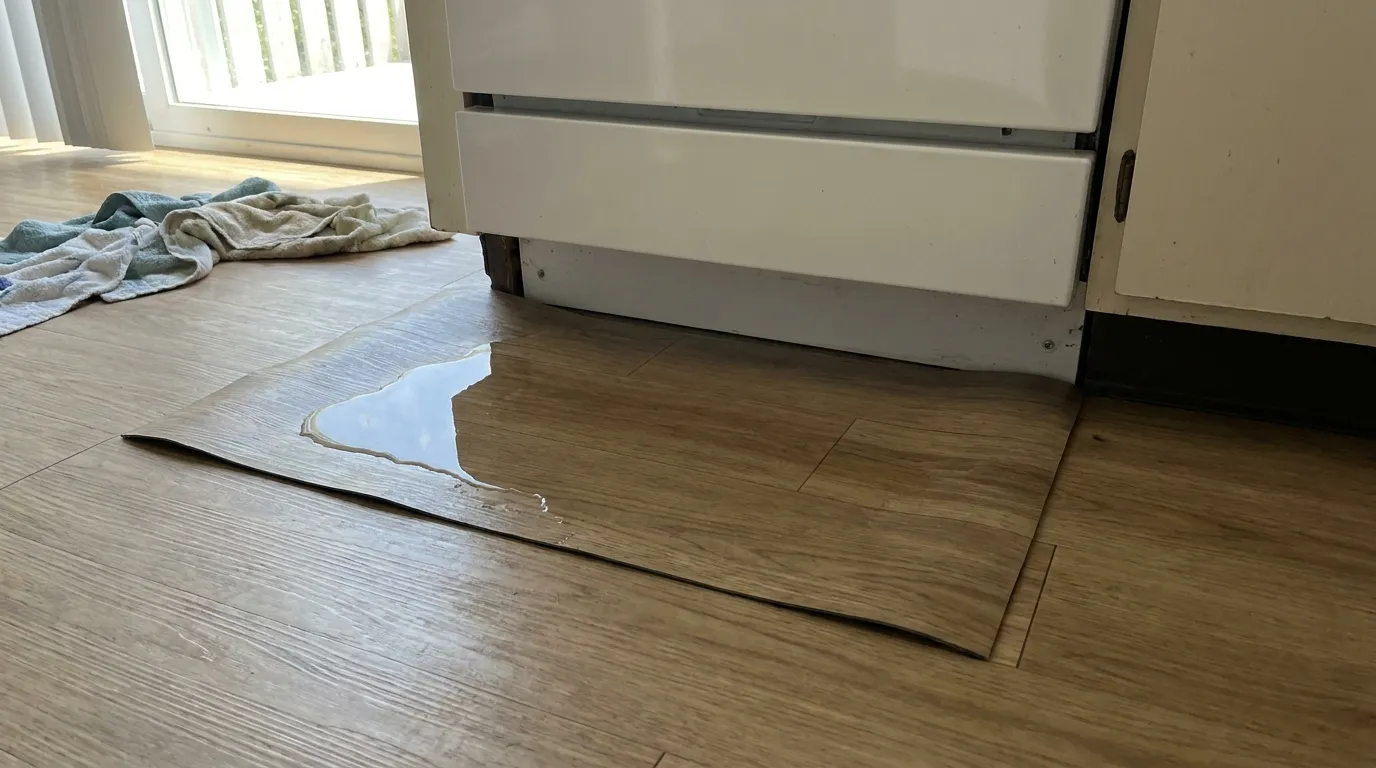
First Actions (To Do Immediately)
- 1 Cancel the dishwasher cycle and close its dedicated water shutoff if the valve is safely accessible; use the main shutoff only if the leak cannot otherwise be stopped.
- 2 Keep clear of wet plugs, wiring, outlets, and the appliance connection, and remove only surface water you can reach safely.
- 3 Photograph water at the dishwasher, cabinets, seams, and lifted or discolored vinyl, then check the toe-kick and flooring edges for signs that moisture spread underneath.
DO NOT DO
- ✕ Do not run surface fans over intact vinyl planks and assume trapped water will evaporate through click-lock seams.
- ✕ Do not leave wet acoustic foam underlayment in place; foam retains water against wood decking indefinitely.
- ✕ Do not delay moisture checks past 48 hours; swollen OSB subfloor seams do not shrink back down once dry.
How the Water May Be Spreading
CROSS-SECTION: WHY VINYL PLANK TRAPS DISHWASHER WATER AGAINST THE SUBFLOOR
What This Usually Means
Water can move from beneath the dishwasher under vinyl seams or edges and become trapped against underlayment or subfloor. Vinyl slows evaporation from below, so the exposed surface may dry while wood-based materials, adhesive, cabinet bases, or flooring layers remain wet.
Why Hidden Moisture Matters
Hidden moisture matters because it provides the perfect environment for secondary damage. Mold can begin developing within 24 to 48 hours in dark, damp spaces like wall cavities, under subfloors, or inside HVAC ducts. Additionally, prolonged exposure to moisture degrades structural integrity—wood rots, drywall crumbles, and metal fixtures can corrode. The longer the materials stay wet, the more complex and expensive the restoration process becomes.
How Serious Is It?
A brief leak confined to a reachable surface is less serious than water that spread beneath fixed vinyl, cabinets, or walls. Swelling, soft spots, lifting seams, odor, or moisture beyond the dishwasher footprint indicate that underlayment or subfloor drying and repair may be needed.
Signs a Dishwasher Is Leaking Under the Floor
Planks lifting, cupping, or darkening at the seams in front of the dishwasher. A soft or squishy spot at the toe kick. A musty smell under the sink. A stain on the basement ceiling below the kitchen. Water that only shows up during a cycle. Any of these means water has been getting under the floor, sometimes for weeks. See squishy floor in front of the dishwasher.
Where Dishwasher Leaks Under the Floor Come From
Pull the toe-kick panel, lay a dry paper towel under the dishwasher, and run a cycle with a flashlight. A drip at the water inlet valve or supply line that happens even when it's off means the supply connection. A leak only when it drains points to the drain hose or its clamp at the sink or disposer. Water at the front corners during the wash usually means a worn door gasket, or a dishwasher that tilts forward and pushes water at the door. Water under the middle during a cycle points to the pump seal or a cracked tub.
Is the Subfloor Ruined?
Usually not if it's dried within a couple of days. Plywood handles a short soak and dries back flat. OSB and particle board swell at the edges and don't shrink back, so soft, raised seams mean that section gets cut out and replaced. Check from the basement with a moisture meter or by lifting a plank. See particle board vs. OSB subfloor after water damage.
What You Can Check Safely
- Listen for dripping or running water: Can help identify active leaks behind walls or above ceilings.
- Check the water meter: If all fixtures are off but the meter is spinning, you have an active plumbing leak.
- Inspect adjacent rooms: Water travels horizontally along floor joists and subfloors.
What Professionals Look For
- Thermal imaging (infrared) to detect temperature anomalies indicating hidden moisture.
- Moisture meters to test the exact saturation levels of wood, drywall, and masonry.
- Borescope inspections to look inside wall cavities without removing large sections of drywall.
- Hygrometers to measure the relative humidity of the affected rooms and evaluate the risk of condensation and mold.
Severity Matrix: Medium
Requires professional extraction equipment and dehumidifiers. Moderate risk of mold and structural damage.
Who to Call
Licensed Plumber or Water Damage Restoration Professional
Insurance & Documentation
- Documentation and claim context only; no coverage conclusion
Frequently Asked Questions
Can water under vinyl plank flooring dry on its own?
No. Because LVP contains a non-porous PVC core, trapped water cannot evaporate into the room. Stagnant moisture remains trapped against concrete or subfloors until mechanically extracted or vented.
Do I have to tear up my entire vinyl floor after a dishwasher leak?
Not if caught within 24 to 48 hours. Removing baseboards and unclicking several perimeter plank rows allows commercial air movers to circulate air through the subfloor cavity, often saving the floor from replacement.
Why is my dishwasher leaking from the bottom?
Most often a loose supply line at the inlet valve, a drain hose that's loose or cracked, a worn door gasket, or a failed pump seal. When it leaks tells you which: all the time is the supply; only while draining is the drain hose; during the wash is the gasket or pump.
Will a dishwasher leak if it's not level?
It can. A dishwasher that tilts forward pushes water against the bottom of the door seal and drips at the front corners. Check with a level on the door opening and adjust the front legs.
Does homeowners insurance cover a dishwasher leak under the floor?
Sudden leak damage to the floor, subfloor, and cabinets is usually covered; the dishwasher itself usually isn't. Slow leaks that went on for weeks are often denied as wear or lack of maintenance, so photograph everything and report it quickly.
Get Professional Help Now
Connect with a local water damage expert immediately.