Particle Board vs. OSB Subfloor After Water Damage: Which Survives?
Emergency Answer
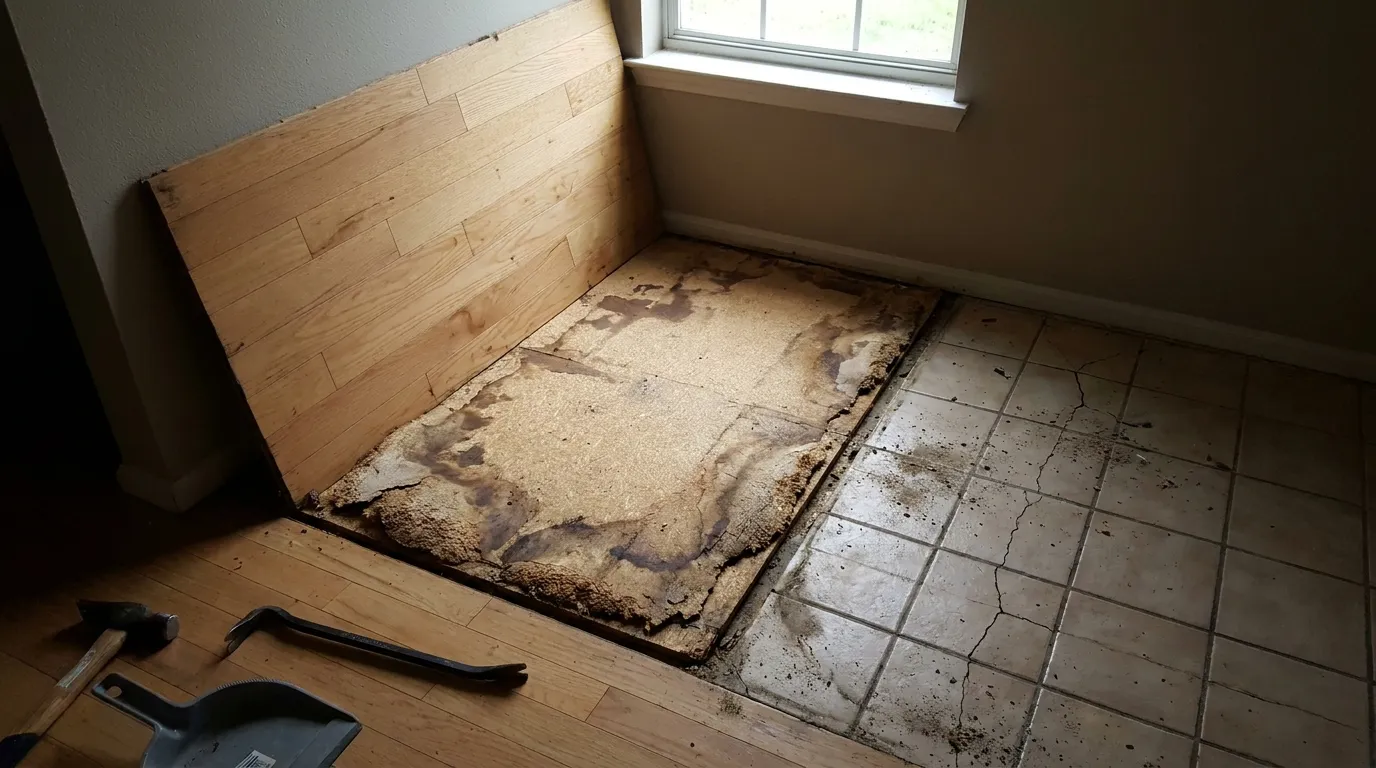
Plywood handles water best, OSB is in the middle, and particle board is the weakest. Particle board underlayment swells, loses strength, and often crumbles after one soaking. OSB swells permanently at the edges and can lose strength if it stays wet, but a short clean-water soak caught quickly may dry out. Any panel that is soft, delaminated, or flexes underfoot after drying should be replaced.
- Identify the Panel: Look at an exposed edge from below or at a cut opening. Plywood shows thin layers, OSB shows large wood strands, and particle board looks like fine compressed sawdust.
- Check for Swelling: Run a hand or straightedge across the floor; raised ridges at panel seams mean the edges have swollen.
- Test for Strength: Press and walk the area. Soft, spongy, or crumbling spots have lost their strength.
- Dry or Replace: Dry firm panels quickly and verify with a moisture meter; cut out and replace anything soft, crumbling, or delaminated.
First Actions (To Do Immediately)
- 1 Stop the leak and remove standing water and wet flooring above the subfloor.
- 2 Identify whether the subfloor or underlayment is plywood, OSB, or particle board.
- 3 Check the seams for raised edges and press for soft spots.
- 4 Start drying with dehumidifiers and take moisture readings daily.
DO NOT DO
- ✕ Do not install new flooring over swollen seams or soft panels.
- ✕ Do not assume a panel is sound because it looks dry on top; check the edges and underside.
- ✕ Do not stand on or set heavy appliances over crumbling or spongy sections.
How the Water May Be Spreading
CUTAWAY: SLOW DISHWASHER LEAK TO SQUISHY, BOUNCING SUBFLOOR
What This Usually Means
Subfloor panels are wood bonded with resin. Plywood's cross-layered veneers resist swelling. OSB's large strands swell most at cut edges and seams, which often stay raised. Particle board's fine wood particles lose their bond when wet, so the panel can turn soft or crumble; it is not a structural panel, but it was widely used as underlayment under carpet and vinyl, especially in older and manufactured homes.
Why Hidden Moisture Matters
A weakened subfloor can sag, crack tile, open seams in vinyl, and eventually give way underfoot. Swollen OSB edges telegraph through new flooring as ridges. Knowing which panel you have tells you whether drying is realistic or replacement is the safer path.
How Each Panel Handles Water
- Plywood: Best tolerance. Usually dries flat after a short clean-water soak; delamination is the warning sign.
- OSB: Moderate tolerance. Edges and seams swell and often stay raised; strength drops if it stays wet for long.
- Particle board: Poor tolerance. Swells quickly, loses its bond, and often crumbles; usually replaced after a soaking.
When the Subfloor Has to Be Replaced
Replace panels that are soft, crumble, show delamination, flex noticeably when walked on, or stay wet after a week of drying. Swollen OSB seams that are otherwise solid can sometimes be sanded flat after drying, but a flooring contractor should make that call before new flooring goes down.
Drying a Wet Subfloor
Remove wet flooring and pad so the panels can breathe, and dry from below too if there is a basement or crawlspace. The IICRC S500 dehumidifier and air mover calculator estimates dehumidifier and air mover counts for the room.
What You Can Check Safely
- Listen for dripping or running water: Can help identify active leaks behind walls or above ceilings.
- Check the water meter: If all fixtures are off but the meter is spinning, you have an active plumbing leak.
- Inspect adjacent rooms: Water travels horizontally along floor joists and subfloors.
What Professionals Look For
- Thermal imaging (infrared) to detect temperature anomalies indicating hidden moisture.
- Moisture meters to test the exact saturation levels of wood, drywall, and masonry.
- Borescope inspections to look inside wall cavities without removing large sections of drywall.
- Hygrometers to measure the relative humidity of the affected rooms and evaluate the risk of condensation and mold.
Severity Matrix: High
Requires immediate professional intervention. High risk of structural weakening, electrical hazards, and mold.
Who to Call
Licensed Plumber or Water Damage Restoration Professional
Insurance & Documentation
- Documentation and claim context only; no coverage conclusion
Frequently Asked Questions
Does OSB subfloor need to be replaced after getting wet?
Not always. OSB that got wet briefly with clean water and stays firm after drying can often stay. OSB that is soft, delaminated, or has badly swollen seams should be replaced.
Can particle board subfloor be dried?
Particle board rarely recovers. It swells and loses strength quickly when wet, so soaked particle board underlayment is usually removed and replaced with plywood.
How can I tell what my subfloor is made of?
Look at an exposed edge from the basement, a floor register opening, or a cut section. Plywood shows thin layers, OSB shows large flat wood strands, and particle board looks like fine sawdust pressed together.
Get Professional Help Now
Connect with a local water damage expert immediately.