Water Under Laminate Flooring: Will It Dry Out? What to Do Now
Emergency Answer
Not on its own. Laminate floats on a foam underlayment, often over a plastic vapor barrier, so water that gets underneath is trapped there and soaks into the fiberboard core from below. Stop the leak and wipe the seams dry, then within a day or two lift the planks back to the wet area, pull the wet underlayment, and dry the subfloor with fans and a dehumidifier. Planks that stayed flat can be reinstalled; planks with swollen or peaked edges usually need replacing.
- Stop the Source: Shut off the dishwasher, fridge line, sink, or toilet supply feeding the leak.
- Dry the Surface Fast: Wipe and vacuum water off the seams immediately; the longer water sits on a seam, the more soaks into the core.
- Lift the Wet Planks: Remove the baseboard or quarter-round along the nearest wall and unclick planks back to the wet area.
- Dry Underneath: Pull wet underlayment, dry the subfloor with fans and a dehumidifier, and check readings before reinstalling anything.
First Actions (To Do Immediately)
- 1 Shut off the leak and wipe standing water off the floor and seams.
- 2 Remove trim along the nearest wall to reach the planks.
- 3 Unclick and lift planks back to the wet area, keeping them in order.
- 4 Remove wet underlayment and run fans and a dehumidifier on the subfloor.
DO NOT DO
- ✕ Do not wait for swollen seams to shrink; laminate cores rarely recover.
- ✕ Do not leave water trapped under the floor on top of a plastic vapor barrier.
- ✕ Do not sand or plane swollen laminate edges; there is no solid wood to sand.
How the Water May Be Spreading
CROSS-SECTION: WHY VINYL PLANK TRAPS DISHWASHER WATER AGAINST THE SUBFLOOR
What This Usually Means
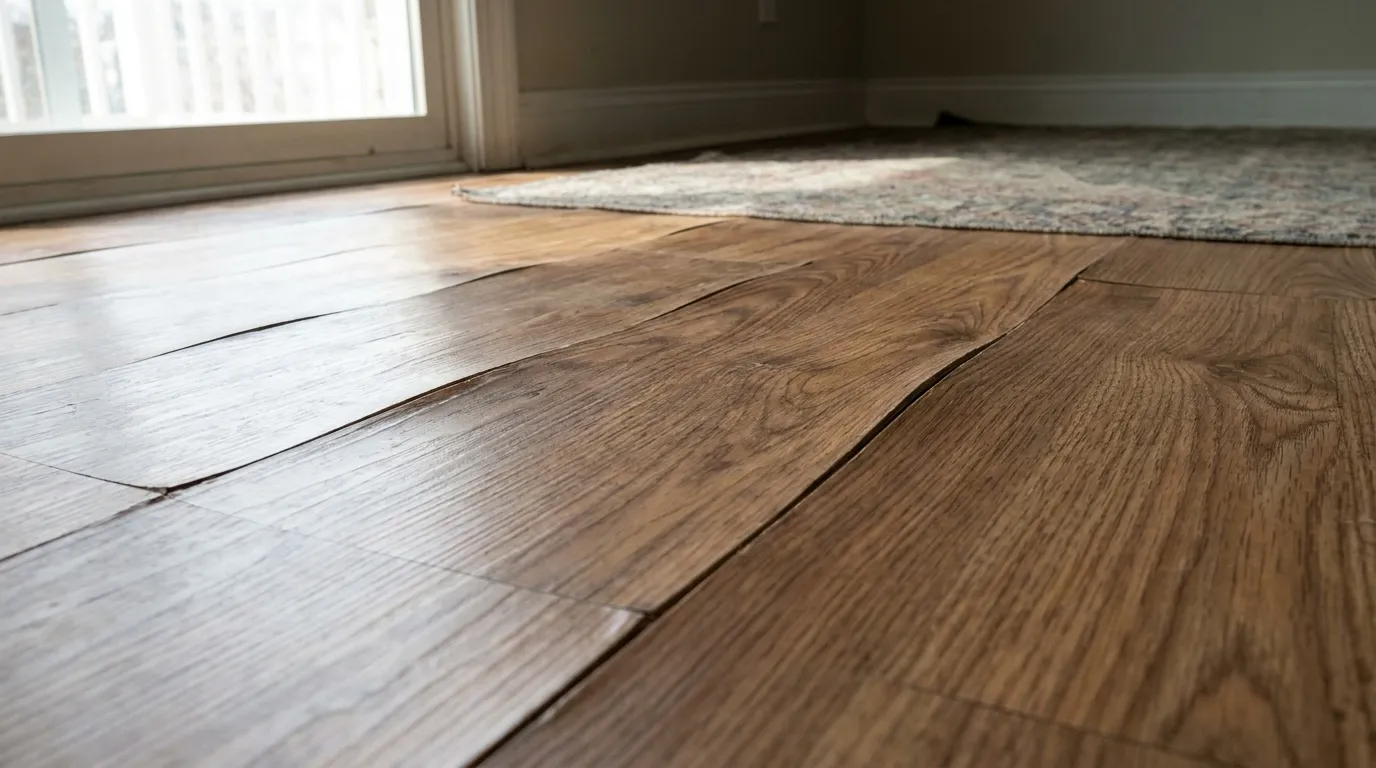
Laminate is a photographic layer bonded to a compressed wood-fiber core. The core absorbs water through the seams and swells at the edges, lifting them into ridges. Unlike solid hardwood, the fibers do not return to their original size when they dry, so swollen planks usually stay raised.
Why Hidden Moisture Matters
Water under a laminate floor sits on the underlayment and subfloor, where it can grow mold and soften wood subfloors with no sign on the surface. Lifting the floor quickly limits the damage to a few planks instead of the whole room.
Will Water Under Laminate Dry Out on Its Own?
Usually not. The planks, the underlayment, and on concrete a plastic vapor barrier all block airflow, so water underneath can sit for weeks while the fiberboard core wicks it up from the bottom edge. Signs it's still wet: seams that feel soft or push water up when you press them, edges that start rising days later, or a musty smell. A pinless moisture meter over the floor, compared with a dry room, shows how far it spread.
A Small Amount of Water Under Laminate
A spill or mop water that reached a seam for a few minutes: wipe it, run a fan and a dehumidifier over the spot for a day or two, and watch the edges. If water came from a leak that ran for hours, spread past a plank or two, or the seams squish when pressed, it's under the floor and the planks need to come up.
How to Get Water Out From Under Laminate Flooring
Lifting the floor is the only fast way to dry it. Drilling holes through laminate to let it breathe ruins the planks and barely reaches the subfloor. The IICRC S500 dehumidifier and air mover calculator gives a starting equipment count, and if drywall along the floor got wet, the drywall flood-cut calculator helps plan removal.
- Stop the source: shut off the dishwasher, fridge line, sink, toilet, or washer valve feeding it.
- Remove the trim: pull the baseboard or quarter-round on the wall nearest the wet area.
- Unclick the planks: lift each row at an angle along the long edge, slide the short ends apart, and number the backs with tape so they go back in order. Glued laminate can't be unclicked and has to be cut out.
- Pull the wet underlayment: foam underlayment is cheap; replace it rather than drying it.
- Dry the subfloor: wet-vac standing water, then run fans and a dehumidifier until moisture readings match a dry area. Concrete takes much longer than plywood.
- Reinstall or replace: stack flat planks with spacers to dry, then lay them on new underlayment. Planks with swollen edges get replaced.
Water Under Laminate in a Basement or on Concrete
On a slab, the plastic vapor barrier keeps water on top of the concrete, where it stays until the floor comes up. If water keeps showing up after rain with no leak inside, it's coming through the slab or the foundation wall, and drying the floor won't fix it. To check, tape an 18-inch square of plastic sheet to bare concrete for a day: moisture under it means it's coming up from below. Fix the drainage or the sump pump before putting the floor back.
Can Swollen Laminate Be Fixed?
Rarely. Light edge swelling from a quick spill may flatten slightly as it dries, but planks with peaked or mushroomed edges usually need replacement. If you have spare planks from the original installation, individual boards can be swapped without replacing the whole floor.
Replacing Just a Few Planks
If you have spare planks from the install, or the same product is still sold, you don't have to redo the room. Planks near a wall are unclicked from that wall. A plank in the middle can be cut out and a replacement dropped in with its bottom locking lip trimmed off and glued. Water-damaged planks next to undamaged ones that no longer match is a common insurance question; take photos of the whole floor before anything is removed.
Laminate vs. Vinyl Plank
Luxury vinyl plank (LVP) has a waterproof core and usually survives water on top, though water can still get trapped underneath it. Laminate's fiberboard core is what makes it swell. Water-resistant laminate products slow this down but are not waterproof under standing water.
Who to Call
A plumber or appliance tech for the leak. A water damage restoration company if more than a few planks are wet, water ran under cabinets or walls, the subfloor feels soft, or the water came from a toilet or sewer line. A sudden leak is usually covered by homeowners insurance, including the floor; a slow leak over weeks often isn't. See particle board vs. OSB subfloor after water damage if the subfloor got soaked.
What You Can Check Safely
- Listen for dripping or running water: Can help identify active leaks behind walls or above ceilings.
- Check the water meter: If all fixtures are off but the meter is spinning, you have an active plumbing leak.
- Inspect adjacent rooms: Water travels horizontally along floor joists and subfloors.
What Professionals Look For
- Thermal imaging (infrared) to detect temperature anomalies indicating hidden moisture.
- Moisture meters to test the exact saturation levels of wood, drywall, and masonry.
- Borescope inspections to look inside wall cavities without removing large sections of drywall.
- Hygrometers to measure the relative humidity of the affected rooms and evaluate the risk of condensation and mold.
Severity Matrix: Medium
Requires professional extraction equipment and dehumidifiers. Moderate risk of mold and structural damage.
Who to Call
Licensed Plumber or Water Damage Restoration Professional
Insurance & Documentation
- Documentation and claim context only; no coverage conclusion
Frequently Asked Questions
Will water under laminate flooring dry out?
Not on its own in time to save it. The underlayment and vapor barrier trap the water, and the core keeps absorbing it from below. Lift the planks back to the wet area and dry the subfloor within a day or two.
How do I dry water under laminate flooring?
Lift the planks back to the wet area, remove wet underlayment, and dry the subfloor with fans and a dehumidifier. Water left under the floor will not dry on its own in a reasonable time.
Will swollen laminate flooring go back down?
Usually not. The fiberboard core expands when wet and stays expanded after drying, so swollen seams typically mean the planks need replacing.
How long does it take for mold to grow under wet laminate?
Mold can start on wet underlayment, subfloor, and the bottom of drywall within 24 to 48 hours. You usually notice it days or weeks later as a musty smell or dark spots on the underside of the planks.
Is the subfloor ruined if it gets wet?
Usually not if it's dried within a couple of days. Plywood dries back flat; OSB and particle board swell at the edges and stay swollen, so soft or raised areas get cut out and replaced. Concrete isn't harmed but takes weeks to dry.
Can I replace just a few planks of laminate?
Yes, if you have spares or can buy the same product. Unclick from the nearest wall, or cut out a middle plank and glue in a replacement with its bottom locking lip trimmed.
Will water under vinyl plank flooring dry out?
No. Vinyl plank doesn't swell like laminate, but its waterproof core traps water underneath even more. Lift the nearest rows and dry the subfloor. See [dishwasher leaked under vinyl flooring](/diagnosis/dishwasher-leaked-under-vinyl-flooring/).
Is laminate flooring waterproof?
Standard laminate is not. Some products resist water on the surface, but water that gets into the seams or under the floor can still swell the core.
Can you mop laminate floors with water?
Only with a damp, well-wrung mop. Standing water and steam mops push water into the seams, which is how the edges start to swell.
Get Professional Help Now
Connect with a local water damage expert immediately.