Water Under Engineered Hardwood: Cupping vs. Crowning Explained
Emergency Answer
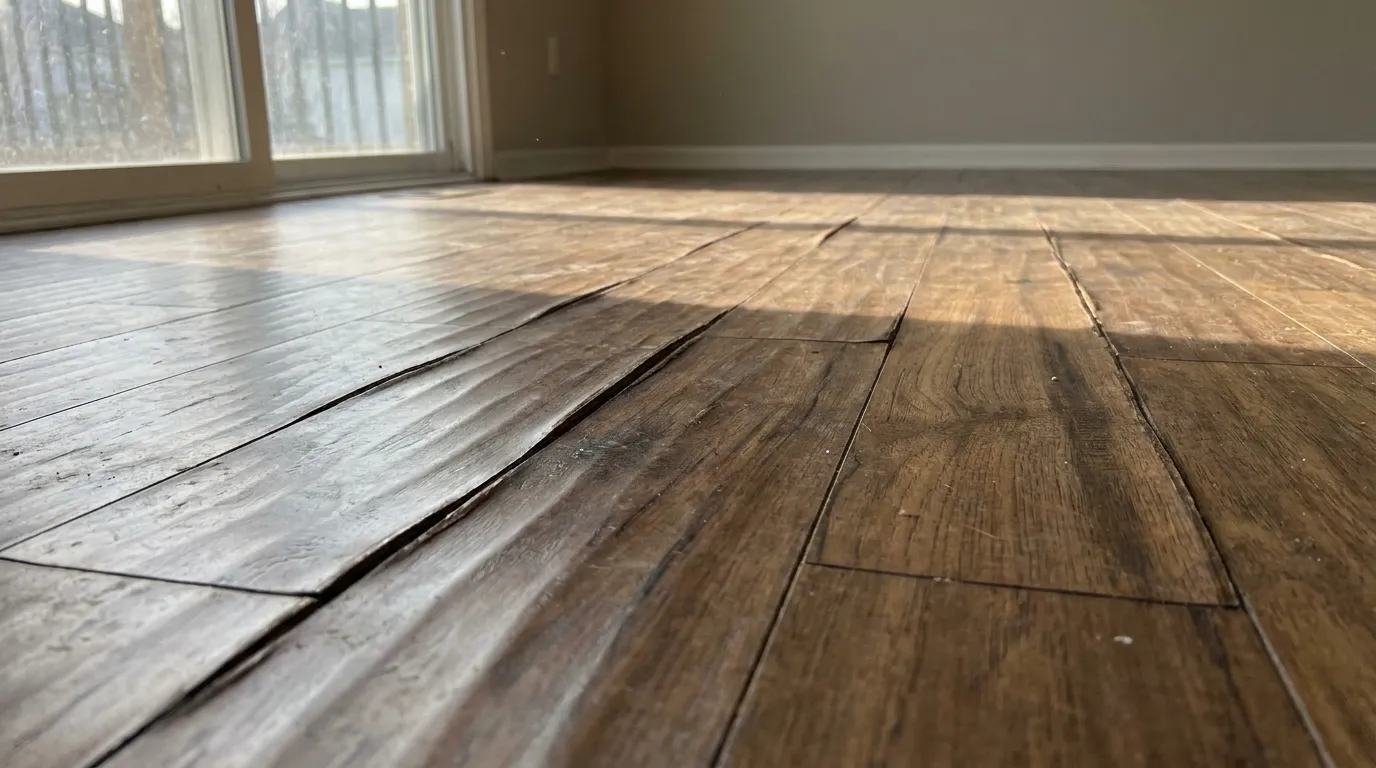
Cupping—edges higher than the center—means the planks are wetter on the bottom than the top, and it is the usual sign of water trapped under engineered hardwood. Crowning is the opposite, with the center higher, and usually appears after a cupped floor was sanded flat too soon. Engineered planks are a thin wood veneer over a plywood or HDF core, so trapped water can also break the glue between layers; dry the subfloor quickly to save them.
- Stop and Extract: Shut off the water source and vacuum standing water from the surface and seams.
- Find the Trapped Water: Meter across the floor and, if possible, check the subfloor from below. Floating floors over underlayment often hold water you cannot see.
- Lift Floating Planks if Needed: Click-together floating floors can be unclicked back to the wet area so the underlayment and subfloor can dry; glued or nailed floors need professional drying.
- Dry Before Any Sanding: Run dehumidifiers and log readings; sand only after the floor and subfloor are dry and stable.
First Actions (To Do Immediately)
- 1 Turn off the water source and remove surface water from the floor and seams.
- 2 Take moisture readings across the floor to map the wet area.
- 3 Check whether the floor is floating, glued, or nailed; floating planks can be lifted to dry underneath.
- 4 Run a dehumidifier in the closed room.
DO NOT DO
- ✕ Do not sand cupped engineered planks; the thin wear layer can sand through, and the boards crown once they dry.
- ✕ Do not leave a plastic vapor barrier or underlayment holding water under a floating floor.
- ✕ Do not reinstall planks that have delaminated, bubbled, or swollen at the core.
How the Water May Be Spreading
CROSS-SECTION: SUBFLOOR MOISTURE GRADIENT & HARDWOOD CUPPING
What This Usually Means
Engineered hardwood is a thin hardwood veneer bonded to a plywood or HDF core. Water trapped below it swells the bottom of the core more than the face, which curls the plank edges upward into a cup. If the floor is sanded flat while the bottom is still swollen, the edges lose material and the board crowns once it dries. Prolonged soaking can also break the glue bond between layers.
Why Hidden Moisture Matters
Engineered planks have a limited wear layer to sand, so a sanding mistake often means replacement. Water held under a floating floor or vapor barrier can sit there for weeks, growing mold on the underlayment and subfloor. Drying properly is what decides whether the floor can be saved.
Cupping vs. Crowning vs. Buckling
- Cupping: Edges higher than the center. The bottom of the plank is wetter than the top, usually from water below the floor.
- Crowning: Center higher than the edges. Usually caused by sanding a cupped floor before it dried, or by water on the top surface.
- Buckling: Planks lifting off the subfloor entirely after heavy saturation; needs professional assessment.
Can Engineered Hardwood Be Saved After Water?
Mild cupping often relaxes once the subfloor dries. Planks that have delaminated, show a swollen core along the edges, have black staining, or smell musty usually need replacement. Floating floors can sometimes be lifted, dried, and reinstalled if the click joints are not damaged.
Drying Water Trapped Under the Floor
Dehumidifiers do most of the work, with air movers across the surface and, for professionals, floor drying mats. Use the IICRC S500 dehumidifier and air mover calculator to estimate equipment for the room. If wall drywall along the floor also got wet, the drywall flood-cut calculator helps plan how much to remove.
What You Can Check Safely
- Listen for dripping or running water: Can help identify active leaks behind walls or above ceilings.
- Check the water meter: If all fixtures are off but the meter is spinning, you have an active plumbing leak.
- Inspect adjacent rooms: Water travels horizontally along floor joists and subfloors.
What Professionals Look For
- Thermal imaging (infrared) to detect temperature anomalies indicating hidden moisture.
- Moisture meters to test the exact saturation levels of wood, drywall, and masonry.
- Borescope inspections to look inside wall cavities without removing large sections of drywall.
- Hygrometers to measure the relative humidity of the affected rooms and evaluate the risk of condensation and mold.
Severity Matrix: Medium
Requires professional extraction equipment and dehumidifiers. Moderate risk of mold and structural damage.
Who to Call
Licensed Plumber or Water Damage Restoration Professional
Insurance & Documentation
- Documentation and claim context only; no coverage conclusion
Frequently Asked Questions
What is the difference between cupping and crowning?
Cupping means the edges of the boards are higher than the center, usually because the bottom is wetter. Crowning means the center is higher than the edges, often because a cupped floor was sanded before it dried.
Can water-damaged engineered hardwood be fixed?
Sometimes. If the planks have not delaminated or swollen at the core, drying the subfloor often lets mild cupping settle. Damaged planks can be replaced individually if matching stock is available.
How do I get water out from under a floating floor?
Remove the baseboard or trim along the nearest wall and lift the planks back to the wet area. Pull up wet underlayment, dry the subfloor, and reinstall only planks that are flat and undamaged.
Get Professional Help Now
Connect with a local water damage expert immediately.