Water Coming Up Through the Floor After Rain? What to Do First
Emergency Answer
Get the water up and keep clear of wet electrics, then fix gutters, downspouts and grading before paying for waterproofing; check for a plumbing leak if it's wet without rain.
- Stay Clear of Wet Electrics: If water reaches outlets, cords, a furnace or a water heater, turn off that area's power at the breaker, but only from a dry spot. If you can't, call an electrician.
- Photograph It: Video the wet floor, where the water is coming in, and any damaged belongings before cleanup.
- Get the Water Up: A wet-dry vacuum or a squeegee toward a floor drain or sump. Move boxes, rugs and furniture off the floor.
- Look Outside While It Rains: Where do the downspouts empty? Do gutters overflow? Does water pool against the wall? Is the sump pump running, and where does its hose go?
- Rule Out a Leak Inside: If it's wet with no recent rain, check the water meter with everything off. Moving means a plumbing leak, not groundwater.
First Actions (To Do Immediately)
- 1 If water is reaching outlets, cords, a furnace or a water heater, turn off power to that area at the breaker from a dry spot.
- 2 Photograph and video the water and where it's coming in before you clean up.
- 3 Get standing water up with a wet-dry vacuum and move belongings off the floor.
- 4 While it's still raining, walk outside and check gutters, downspouts, pooling against the wall, and where the sump pump discharges.
DO NOT DO
- ✕ Do not walk through water that's touching outlets, cords or appliances until the power to that area is off.
- ✕ Do not paint the floor or walls with a waterproof coating, or patch the wall-floor joint, to stop water coming from below. In the cases we read, it moved to the next crack or the coating let go.
- ✕ Do not put new flooring down until the floor stays dry through several heavy rains.
- ✕ Do not route a sump pump or downspout into a floor drain, laundry sink or sewer cleanout. It's against the plumbing code and city rules in many places, and it can push sewage into other homes.
- ✕ Do not dig a gravel trench against the foundation unless it drains somewhere lower. Without an outlet, it collects rain against the wall.
- ✕ Do not sign a $10,000-plus waterproofing contract before the gutters, downspouts and grading are fixed, and get more than one quote.
- ✕ Do not seal the small gaps at the bottom of a brick wall. They're weep holes that let water out.
Where Rain Gets In, and What Fixed It
The First Hour
Water seeping up through a floor is rarely fast enough to be dangerous by itself. The risks are electricity, damage to what's on the floor, and paying for the wrong fix.
- Check for electrical hazards first. If water is reaching outlets, extension cords, a furnace, a water heater or a dryer, turn off that area's power at the breaker, but only if you can reach the panel without standing in water. Otherwise call an electrician.
- Record it before cleanup. A video of the whole floor, close-ups of where the water appears (a crack, the joint where the wall meets the floor, the middle of the room), and any damaged belongings. Note the date and how much it rained.
- Get the water up. A wet-dry vacuum for puddles, a squeegee toward a floor drain or sump pit, towels for the rest. Lift boxes, rugs and furniture off the floor.
- Check the sump pump if you have one. Is it running? A pump that hums but doesn't move water, or a float that's stuck, needs a plumber now. See signs your sump pump failed.
- Go outside while it's still raining. Watch where the roof water goes: gutters spilling over, downspouts emptying against the wall, water pooling by the foundation, a sump hose ending a few feet from the house. This is the most useful look you'll get.
- Start drying. Fans and a dehumidifier once the standing water is gone. Pull up wet rugs and carpet pad.
Is It Really Coming From the Ground?
We read about 55 first-hand accounts of water coming up through a floor after rain, posted to Reddit's home, basement, concrete and insurance forums between 2012 and 2026. People post when it's bad or puzzling, so these show how cases turn out, not how often each cause happens. In 16 of them, the rain was a coincidence and the water wasn't coming from the ground at all:
- Plumbing leaks (4): a sink leaking into the crawlspace, copper and supply lines under the slab, a pinhole in the pipe to an outdoor faucet inside the wall.
- Appliances (3): a pinhole in a refrigerator ice-maker line, a cracked refrigerator drip pan, a dishwasher.
- Rain getting in higher up (3): water from the roof, a window, or a deck missing its flashing running down inside the wall and out under the flooring.
- Lawn sprinklers (2): spraying the house, and a buried sprinkler head under a slab addition.
- Not outside water at all (2): a plastic chair mat trapping moisture on a slab, and old pet-urine salts in a floor pulling moisture from humid air.
- An air-conditioner drain line (1) that clogged and overflowed under a wall.
- An outdoor network cable (1) carrying rain into the wall and out of the wall jack.
How to Tell Where It's Coming From
- Does it only happen when it rains or snow melts? If the floor is wet after a dry week, suspect plumbing, an appliance or the AC drain first.
- Check the water meter. Turn off every faucet and water-using appliance, then watch the meter's small leak dial for 15 to 30 minutes. If it moves, water is leaking somewhere on the supply side; call a plumber. A still meter doesn't rule out a drain leak, which only leaks when fixtures are used.
- Do the plastic sheet test. Dry a patch of bare concrete, tape a square of clear plastic (about 18 inches) down on all four edges, and leave it a day. Moisture under the plastic is coming up through the concrete. Moisture on top is condensation from humid air. This is the method in ASTM D4263, a standard used before coating concrete: it shows whether moisture is there, not how much. See condensation or a leak?
- Follow the trail. Water runs along the slope of a floor, so where it pools isn't always where it comes in. Basement floors slope toward the floor drain. Lay paper towels across a wide area to see where it's wettest, tape toilet paper under a suspect window to catch drips, and pull off the cabinet kickboards to look for dried water trails.
- Check the sprinklers and the AC. Look at what the irrigation hits, and whether the air conditioner's condensate line is dripping where it should.
- Smell it. Water that smells like sewage, or is gray or brown, is a backup from the drain, not groundwater. That's a different problem and a different insurance question: see basement floor drain backing up.
Where It Shows Up, and What That Points To
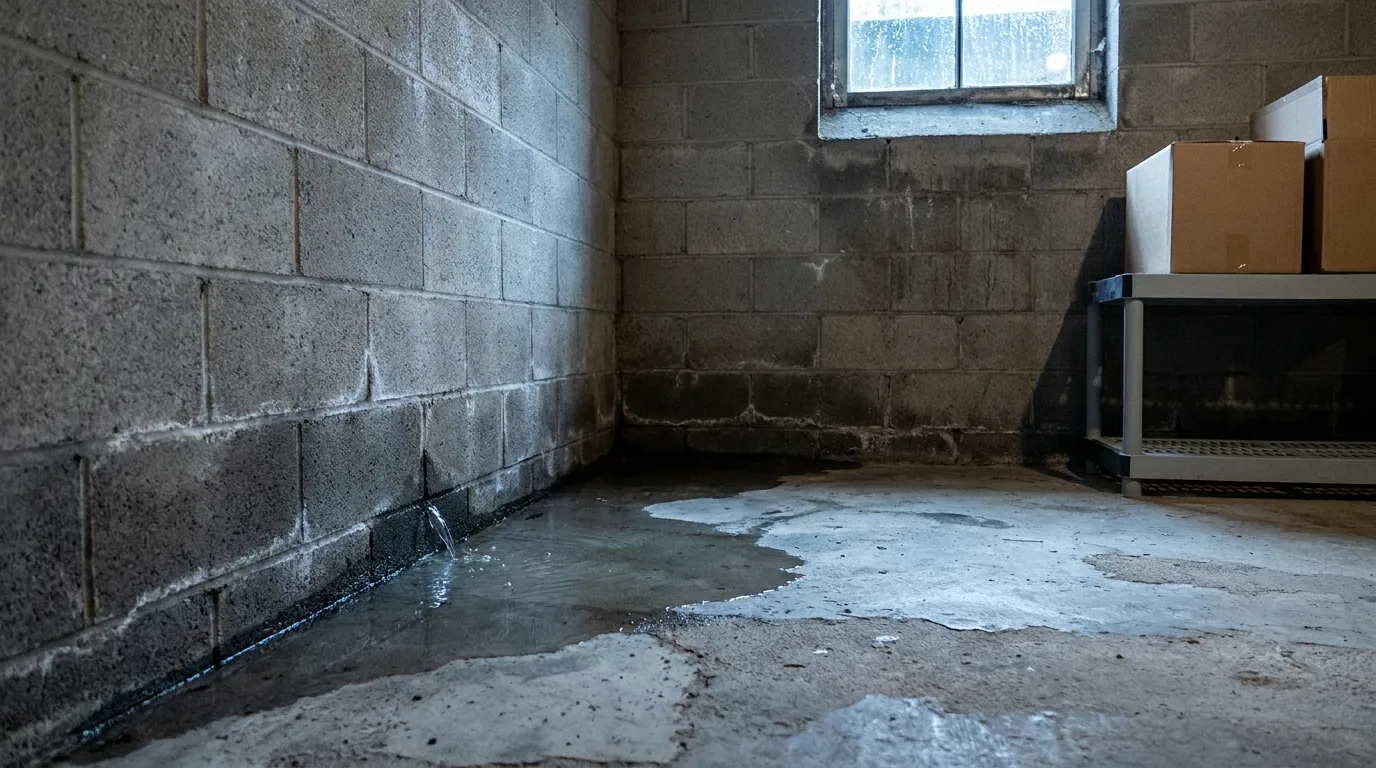
- At the joint where the wall meets the floor: the most common description in the accounts we read. Waterproofers explain that the footing, the wall and the floor are poured separately, so that joint isn't sealed and is where pressure from wet soil pushes water in first.
- Through cracks in the slab, sometimes visibly bubbling up during or after a storm: water under the slab is under pressure.
- In the middle of the floor, away from the walls: groundwater rising under the slab, a leak under the slab, or water that came in somewhere else and ran downhill.
- Along an outside wall in a house with no basement: more often downspouts, grading, sprinklers or rain running down inside the wall than groundwater.
- A day or two after the rain, not during it: soil, especially clay, takes time to fill up before water starts pushing through. Several posters saw it only after multi-day rain or a fast thaw on frozen ground.
- White powder on the concrete: mineral deposits left behind when water moves through concrete and evaporates. It means water has been coming through for a while.
- Horizontal cracks in a foundation wall, stair-step cracks in block, or a wall bowing in: call a structural engineer, not just a waterproofer.
Why Water Comes Up Through a Floor After Rain
- The soil next to the house holds water. The soil put back around a foundation after it was built is looser than the undisturbed ground around it, so rain collects there. Waterproofers call it a bowl.
- Wet soil pushes. When the soil around and under a basement is full of water, the water pushes in through the easiest path: the wall-floor joint, cracks, and the concrete itself.
- Roof water is concentrated. A downspout empties the rain from a whole section of roof onto a few square feet next to the foundation.
- Buried pipes fail quietly. Underground downspout pipes clog or turn out to end a few feet from the house. Old clay footing drains collapse or fill with silt. A plumber's drain camera shows which.
- Block walls fill up. Water gets into the hollow cores of concrete block walls, runs down, and comes out at the bottom.
- A dry spell, then a downpour. One poster's explanation for a basement that was dry for years and then leaked: the soil had shrunk away from the wall, so the first heavy rain ran straight down it.
- Water from uphill. A house on a slope, or next to a neighbor's or a road's runoff, catches water coming from above it.
Fix the Outside First
In the accounts we read, about 10 people said gutters and downspouts fixed it: cleaned, reattached, extended, or rerouted. Several had been quoted $10,000 to $20,000 for an interior drainage system first. One fixed it with less than $75 of downspout pipe and was still dry through heavy rain. Try these one at a time, cheapest first, and give each a few heavy rains before deciding it didn't work.
- Gutters: clear them, and check that they slope toward the downspouts and don't spill over at roof valleys. Gutters held up by long nails can pull away from the house and pour water down the wall; screws hold better.
- Downspouts: carry the water well away from the house, onto ground that slopes away. Where soils swell when wet, the residential building code's minimum is 5 feet from the foundation, or into an approved drainage system. Check buried downspout pipes: run a hose into the top and see where, or whether, it comes out.
- Grading: the building code requires the ground to drop at least 6 inches in the first 10 feet from the house, and driveways, patios and walks within 10 feet to slope away at least 2%. Where the lot is too tight, it calls for a swale or drain instead.
- Keep soil below the foundation's top: the code requires concrete or block foundations to stand at least 6 inches above the finished grade (4 inches with brick). On a slab house, soil or mulch piled above the slab edge lets water in under the wall.
- Sump discharge: send it well away from the house so it doesn't soak back in. Never into a floor drain, laundry sink or sewer line: the plumbing code bans storm water in sewers meant for sewage, and cities including Plymouth, Minn., Fargo, N.D., and Danvers, Mass., fine homeowners for it.
- Sprinklers: aim them away from the house.
When It Takes More: Sump Pits and Drain Tile
If water still comes up after the outside is fixed, it has to be collected and pumped out. Prices below are what posters reported between 2012 and 2026, so treat them as a spread, not today's prices.
- A sump pit and pump (about 5 cases): for water rising under the slab. Reported from about $300 done yourself to $750 or more from a plumber. A pump with a battery backup keeps running when a storm cuts the power. Two posters found their existing pit had solid sides, so water under the floor couldn't get into it.
- Interior drain tile and a sump (about 11 cases): a trench cut around the inside edge of the floor, a perforated pipe in gravel next to the footing, sloped to a sump, then new concrete. Most reported $8,000 to $15,000; large franchise companies quoted $20,000 to $33,000 for similar work. It collects water that gets in and pumps it out; it doesn't keep water off the outside of the wall. One homeowner did it themselves for about $6,400 and over 100 hours of work.
- Digging outside and waterproofing the wall: excavating down to the footing, a membrane on the wall, and a new footing drain. One reported cost was about $24,000; quotes ran $30,000 to $50,000. It's the only option that keeps water off the wall, but it's often impractical next to driveways, decks or close lot lines.
- What didn't work in the accounts we read: waterproof paint, floor coatings and waterproof flooring (the water moved to the wall-floor joint or kept pooling); hydraulic cement at the base of the wall; a contractor's gravel trench along a driveway with no outlet, which flooded the basement after every rain. A few interior systems still leaked at the seams or in one corner, so ask what the warranty covers.
- Get more than one quote. Similar jobs ranged from $8,000 to $33,000. An independent civil engineer or waterproofing consultant who doesn't sell the system can tell you what's needed before you buy it.
- New houses in wet areas: the building code requires foundation drains around basements below grade (except in well-drained sand and gravel soils), and waterproofing, not just dampproofing, where a high water table is known. A new house that floods may be a builder warranty question.
Drying Out and the Floor
- Dry it fast. The EPA advises drying wet materials within 24 to 48 hours to prevent mold. Run fans and a dehumidifier, and keep humidity below 60%, ideally 30 to 50%.
- Pull up what holds water. Carpet pad, cardboard boxes, and the bottom of drywall that stayed wet. Wet carpet over concrete rarely dries in place.
- Don't trap it. Vinyl plank, laminate, rubber-backed rugs and even a plastic chair mat hold moisture against the slab. If water is coming up under laminate, see water under laminate flooring.
- Wait before new flooring. Put it down only after the floor has stayed dry through several heavy rains and the plastic sheet test is dry. One poster's glue-down wood over a moisture barrier bubbled within 18 months.
- Water in the floor vents? That's water in the ducts, which needs different steps: see water in floor vents after heavy rain.
Insurance: Usually Not Covered
Of about 13 insurance outcomes posters reported, about 10 were denied as groundwater or seepage, including some with a water backup endorsement. That matches the policy wording.
- The standard homeowners policy excludes it. The common form excludes flood and surface water, and "water below the surface of the ground, including water which exerts pressure on, or seeps, leaks or flows through a building, sidewalk, driveway, patio, foundation, swimming pool or other structure." Rain that soaks into the ground and comes up through the floor falls under that.
- A water backup endorsement usually doesn't help. It covers water that backs up through a drain or overflows from the sump pit, not water coming through walls or the floor. Maryland's insurance regulator calls seepage a maintenance issue, and Massachusetts says no endorsement is available to add seepage coverage.
- Flood insurance only applies in a real flood. The federal flood policy defines a flood as a temporary condition covering two or more acres of normally dry land, or two or more properties, one of them yours. It covers seepage only when there's a flood in the area and the flood caused it. In a basement it pays for a limited list of items, such as the furnace, water heater, sump pump and cleanup, not finished walls or flooring. A new flood policy usually takes 30 days to start.
- A plumbing leak is different. If the water turned out to be a burst or leaking pipe, the resulting damage is often covered. See whether homeowners insurance covers burst pipes. Describe what you found accurately; don't call a groundwater problem a plumbing leak, or the reverse.
- Keep records anyway. Photos, rainfall dates, and receipts for repairs. They help if the problem comes back, with a contractor's warranty, and when you sell.
Who to Call
- Plumber or leak detection company: if the meter moves, the floor is wet without rain, or the floor is warm in one spot.
- Gutter or landscape drainage contractor: gutters, downspouts, buried drain lines and regrading. Usually the first call.
- Waterproofing contractor: sump pits and drain tile, after the outside is fixed. Get several quotes.
- Independent civil engineer or waterproofing consultant: when you've had conflicting quotes, or before a large job.
- Structural engineer: horizontal cracks, bowing walls, or a floor that's heaving.
- Restoration company: if finished walls, carpet or flooring got soaked and need drying or removal.
Sources
- International Residential Code, Section R401.3, Drainage, as quoted by the City of Ashland, Ore., Building Safety Division and explained in the International Code Council's Residential Code Essentials.
- International Residential Code, Section R404.1.6, Height Above Finished Grade, as explained in the International Code Council's Residential Code Essentials.
- International Residential Code, Section R801.3, Roof Drainage, as quoted by Klickitat County, Wash.
- International Residential Code, Sections R405.1 and R406, foundation drainage and waterproofing, as quoted by the City of Eastlake, Ohio, Building Department.
- International Plumbing Code, Section 1101.3, Prohibited Drainage, as adopted in Ohio Administrative Code 4101:3-11-01.
- Sump pump rules: City of Plymouth, Minn., City of Fargo, N.D., Town of Danvers, Mass.
- ASTM International, D4263-24, Standard Practice for Indicating Moisture in Concrete by the Plastic Sheet Method.
- Homeowners policy water exclusion, as filed by the North Carolina Rate Bureau.
- Maryland Insurance Administration, Understanding the Difference Between Flood Damage and Water Damage.
- Massachusetts Division of Insurance, Is My Flood Damage Covered?
- FEMA, Standard Flood Insurance Policy, Dwelling Form, 44 CFR Part 61, Appendix A(1)_to_part_61), and FloodSmart, Buy a Flood Insurance Policy.
- U.S. EPA, A Brief Guide to Mold, Moisture and Your Home.
- Reported cases: about 55 first-hand accounts on Reddit (r/HomeImprovement, r/homeowners, r/basement, r/HomeMaintenance, r/DIY, r/Concrete, r/waterproofing, r/Insurance, r/InsuranceCanada, r/adjusters), 2012 to 2026, read and counted by Emergency Damage Pros in November 2026.
Severity Matrix: Critical
Life-safety hazard. Evacuate if necessary. Requires complete professional mitigation and potential reconstruction.
Who to Call
Licensed Plumber or Water Damage Restoration Professional
Insurance & Documentation
- Mitigation/documentation support only; no coverage conclusion
Frequently Asked Questions
Why is water coming up through my basement floor after heavy rain?
Usually the soil around and under the basement is full of water and pushing it in through the joint where the wall meets the floor, or through cracks. The most common reason the soil gets that wet is roof water: overflowing gutters or downspouts emptying next to the house. But in 16 of about 55 cases we read, the water turned out to be a plumbing, appliance or sprinkler leak, so rule that out too.
Can water come up through a concrete slab?
Yes. Concrete is porous, and water under pressure comes through cracks, joints and the concrete itself. A plastic sheet taped to the floor for a day tells you: moisture under the plastic is coming up through the slab; moisture on top is condensation.
Why does water show up a day or two after the rain stops?
The soil takes time to fill with water, especially clay, and water keeps draining toward the house after the rain ends. If the floor is still wet a week after the last rain, check for a plumbing leak.
Will sealing the floor stop it?
Not if the water is coming from below. In the cases we read, waterproof paint, floor coatings and hydraulic cement either peeled or the water came in somewhere else. Fix the outside first, then collect and pump out what's left.
Does homeowners insurance cover water coming up through the floor?
Usually not. Standard policies exclude water below the surface of the ground that seeps through a foundation, and water backup endorsements cover overflow from a drain or sump pit, not seepage. Flood insurance covers seepage only when there's a general flood in the area. A leaking pipe is different and is often covered.
Do I need a waterproofing company?
Not first. About 10 people in the cases we read fixed it with gutters and downspouts, several after being quoted $10,000 to $20,000. If water still comes up after the outside is fixed, a sump pit or interior drain tile is next; get several quotes, since similar jobs ranged from $8,000 to $33,000.
Get Professional Help Now
Connect with a local water damage expert immediately.